Goodbye, Mr. Plastic Alto: Ornette Coleman, 1930-2015

ornettebypetermorgan2009
(When City of Palo Alto and Stanford University in 2006 combined to create the two-field soccer complex, the Mayfield Site, at corner of Page Mill Road and El Camino, I remember tripping on –figuratively — the little rubber pebbles that would bounce in the air when a long ball landed on the plastic green pitch; I tried to think of the field as a collection of those little black pebbles interacting with the green plastic, the leather ball, the humans, the air, history, politics. Ok, it was a thought exercise; personally I prefer God’s green grass, or natural California plants and grasses; as Tug McGraw once said, “I don’t know, I never smoked Astro-turf”. That evolved into thinking that the City of Palo Alto Twilight Concert series should try an event on these soccer fields. That evolved into fantasizing about bringing Ornette Coleman to Palo Alto to play on the plastic soccer fields –with the little black pebbles, dancing. I saw Ornette exactly once, at SFJazz, at the Masonic, on the guest list of Andy Heller, their and my sound guy; and no, I don’t really get “harmolodics” but I know it’s out there, on the Zeta horizon; and I admit that I listened to a track of Ornette and Don Cherry and them this a.m. on KCSM and did not nail it, like a sound-hound, but it did catch my ear — ????? — and I hear her back-announce the group but didn’t realize it was a tribute; later that morning, I bought the Chron and saw Ornette and his white Plastic –acrylic, by Grafton of England — Alto and did the math. The obit by Aidin V does not mention “plastic alto” or “harmolodics”. Somewhere later the idea of bringing Ornette to Palo Alto morphed into “plastic alto” as a code name, and then a couple years later I started a blog and called it such. At one point I imagined a book along the production value of Communication Arts, whose offices for years were across the street from Mayfield site, with articles on my weird mix of art, music, politics and Ornette).

(of the first 1,488 posts here, 36 mention “Ornette” according to the search function, although most of those are merely shouts; Ben Ratliff of The Times, in graph 20, mentions “plastic alto” that Ornette procured in 1954)

Posted in jazz, media, music | Tagged , , , , | Leave a comment

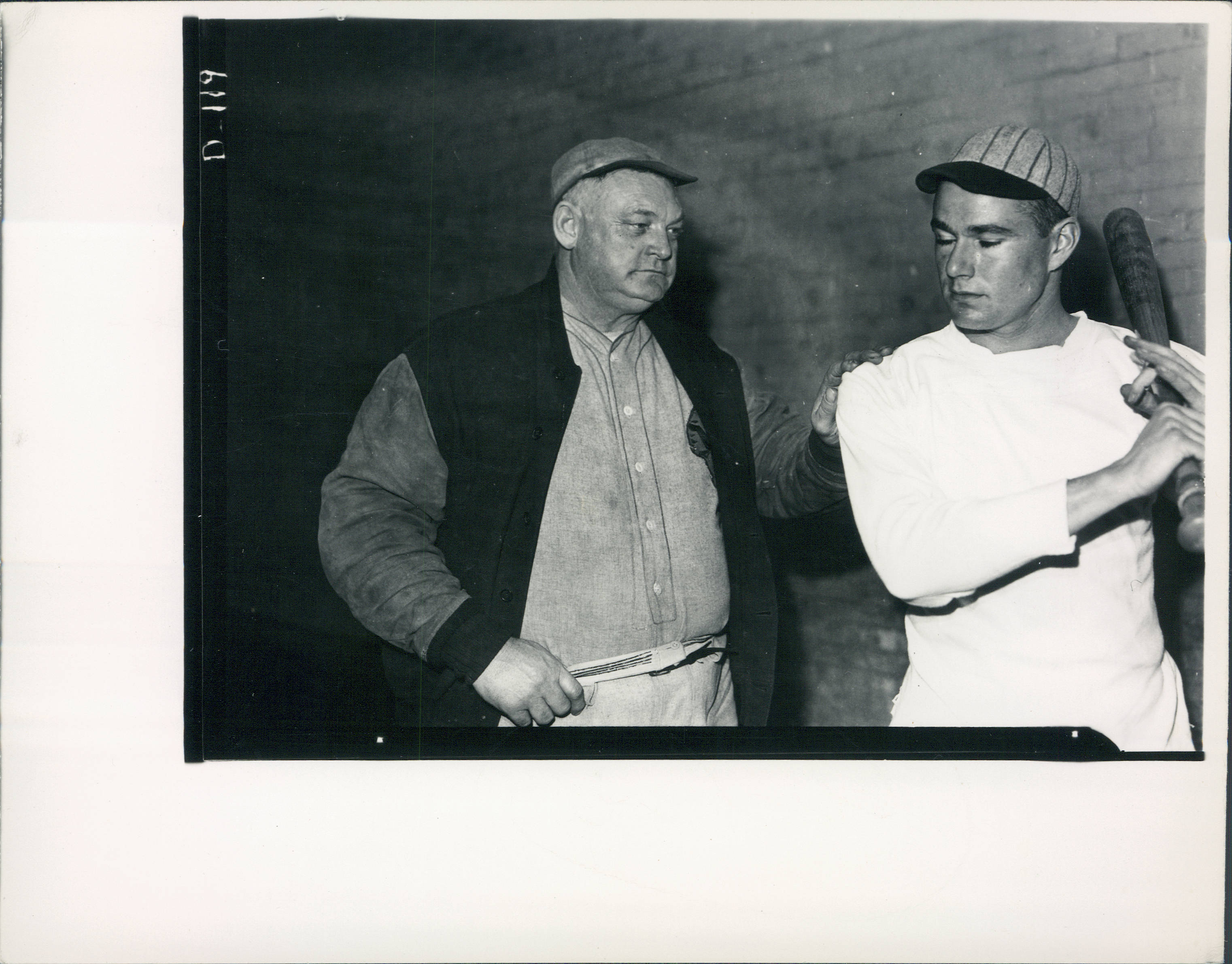
Jeff Tesreau w. Jack Chesbro

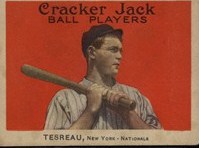
Jeff Tesreau of the Giants, also known as Jack? This is a 1914 candy era card

Jeff Tesreau of the Giants, also known as Jack? This is a 1914 candy era card

Henry Schulman in the Chronicle, apropos of the Chris Heston gem, mis-identified the previous Giants rookie to toss a no-no; he called Jeff Tesreau “Jack Tesreau.”

I texted him on that, or I tried, at least to send something from my cell to his email. Don’t know the man.

The only reason I know of Jeff Tesreau is that he later coached for Dartmouth, or managed, for about 30 seasons. I only unearthed this bit of Big Green trivia when researching Harry Hillman, a triple gold medal winner from 1904 Olympics, who coached track in Hanover for a similarly long tenure. I interviewed a handful of athletes from that era, from the 1940s and they spoke of the fraternity of great coaches of that era: Hillman, Tesreau, Ozzie Cowles in hoops, Tom Dent in lacrosse. When I asked Quentin Kopp (’49) about all this, he suggested I expand my research to include the great gridder Swede Oberlander. I did my research in 2004-5, mostly and several of those sources have since passed on. I made a few more calls out of the blue in 2014, checking on my guys. Plus I called Pete Broberg, the former Texas Ranger, mostly about his father the legendary Gus Broberg, basketball All-America (not to digress again, but Pete said he too was a basketball Block, and even covered Julius Erving and held him to 10 points!!)

I actually did not recall Tesreau as a pitcher, nor did I know of his no-hitter, in 1912. (Actually, while watching Heston pitch, and thereby taping the amazing but disappointing Warriors Cavs Game 3 loss, I started to think about John “the Count” Montefusco, and thought he had delivered a no-hitter during his rookie campaign; no, but he did hit a homer, or maybe a homer in his first at-bat? TK: okay, the Count actually threw his no-hitter in 1976, his third season and both hit a home run in his first at bat and was rookie of the year, in 1974, a feat only matched by Wally Moon).

Tesreau was from Missouri. His given name was Charles M. but he was called “Jeff” because he reminded people of the famous boxer Jim Jeffries. He actually sent his son Charles Tesreau Jr to play for the Big Green (or, Indians) in 1938. Tesreau was 115-72 and 2.43 ERA in the majors; in fact, he was the ERA king the first year that was ever computed and contested. He quit his stint with the Giants relatively young, age 30, after an argument with John McGraw and took an offer to coach at Dartmouth, where he won 350 games or so, or his boys did, rather.

Dartmouth archive has him in 1938 with an unnamed player(note the Indian logo, partially obscured):
icon16470099c0000004A

Jack Chesbro meanwhile was a Hall of Fame pitcher, slightly before Tesreau’s time. I think I learned of him via those alltime great leader cards that they had on the back of 1974 or 1975 Topps, which I collected in real time.
From a wiki page:
John Dwight Chesbro (June 5, 1874 – November 6, 1931) was a Major League Baseball (MLB) pitcher. Nicknamed “Happy Jack”, Chesbro played for the Pittsburgh Pirates (1899–1902), the New York Highlanders (1903–1909), and the Boston Red Sox (1909). The Highlanders, by the way, used to play in that era up on 165th Street, on a hilltop and then moved to the Polo Grounds, they sublet from the Giants, and then after a testy exchange in the 1921 World Serious, were told to build their own stadium. They became the Yankees in 1913. Chesbro was 198-132 and a 2.68, good enough for the Veterans.
He’s the guy who still holds the record for wins in a season, 41 in 1904, back before there were relievers per se. (And Bill James, apparently argues against his being in HOF)
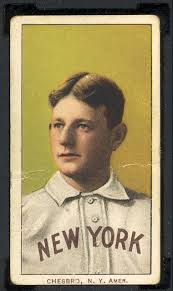
Here’s a 1910 Tobacco card T206 for Jack Chesbro, of the New York Highlanders (pre-Yankees):
chesbroNewYorkAmericanT206

Tesreau was known for his spitball, which was legal in that era. Incidentally, Chesbro was also a legal spitballer (compared to Gaylord Perry, years later, “Me and the Spitter”, but also a Giant). Chesbro won 198 games and was voted into the Hall of Fame by the Veterans Committee in 1948.I get the impression that Tesreau, named for a boxer was a tougher character than Chesbro, called “Happy”.

If I know anything about baseball before World War II, it is probably from Lawrence Ritter’s oral history, “The Glory of Their Times” or indirectly from Ring Lardner “You know me, Al” a work of fiction.

I think Tesreau got to Dartmouth via Chief Meyers a Native American catcher who was an alumnus and played for the Giants. I had a Chief Meyers T205 tobacco card, and then passed it on to my friend the cat burglar of February, 2008. Likewise, my 1910 Christy Mathewson. (And a couple nice Mays’s but I digress).

My letters from NCAA champion miler Don Burnham ’44 include references to Jeff Tesreau, or I’ll look that up and addend. Someone else said that Don Burnham and his brother were like “Mutt and Jeff” in that one was tiny and the other large. Again, I digress.(I just looked it up: “Mutt and Jeff” in the Chronicle of early 20th century, Mutt was the bigger guy or normal whereas Jeff was the little guy or truly tiny; its a red herring here, or too Plasty).

I have to admit I was reading City of Palo Alto staff reports, on the 15-acre Fry’s site, which I like as a 7-acre park and 100 units of apartments, and knew I was watching a potential no-hitter, but missed some of the nuance, such as the fact that Heston did not walk anybody but hit three batters, including one to start the ninth, that he then struck out his last three victims or that he had a baserunning boner after a safety, that cost his teammates a run and an RBI.

I caught the Linceum no-hitter last summer, about this time, a Wednesday day game, I bought a standing room ticket and stood in right field, not missing a pitch. Come to think of it, Timmy is on TV starting right now, and the Warriors come on in 2 hours.

Yikes, Schulman actually tweeted it to his 46,000 followers:
Last #sfgiants rookie to toss no-no was Jack Tesreau in 1912, and no, I didn’t cover it.
Here’s a link to his article, I bought the hard-copy, being OG Sporting Green kind of guy.

R.J Lesch meanwhile has an excellent biography of Charles M. Tesreau at SABR.

World champion Jim Jeffries, Jeff Tesreau’s namesake, incidentally, defended his Heavyweight World Championship three times at the old Mechanics Pavillion, at Larkin, Grove, Polk and Hayes Streets, before that venue burnt to the ground in 1906 following The Earthquake, even more reason for San Franciscans and people like Henry “Hank” Schulman and his followers to get the respective stories straight. Jeff Tesreau w. Jack Chesbro w. Jim Jeffries.

andand: meanwhile, Timmy gives up his first hit, a Texas leaguer in the 4th as Giants fight on, in New York…75 pitches, Giants up 2-1. Oops now 3-2 baddies while I proofread….:(

andandand: Crawford homers as Giants retake the lead from Mets, 4-3, although I am switching to hoops mode…

andandandand: This is way off topic, and it the risk of being picked off, here is an article about Juan Nieves, who is the second youngest person to ever throw an MLB no-no, and now the Red Sox pitching coach and about reuniting with his former prep school catcher, at Old Avon Farms, my Dartmouth classmate Brian “B.C.” Conroy, who also caught future Giant Mike Remlinger in Hanover.

More notes:
1) I did send word of this to the Chron guy, and am hoping he will acknowledge such, and or own up to it in print and correct the record, on Jeff Tesreau. There’s a window before I would send such to “corrections@Chronicle.com” per se. I bought today’s paper just to see if they are self-correcting. I cannot believe I am the only one of HS’s 46,000 readers to notice this flub.
2) I found my letter from Don Burnham which is the source of my knowledge of Tesreau. Out of respect to Burnham, they should get this straight.
3) Thanks to the nonohitters site of Dirk Lammers, I found the oddity of a no-hitter by a Big Jeff Pfeffer. Big Jeff was born Francis Xavier Pfeffer in Illinois in 1882, and was 31-40 in six seasons in MLB, 1905-1911. Meanwhile his brother, Edward Joseph Pfeffer, born in 1988, was 158-112, 1911-1924, 13 seasons but known as Jeff Pfeffer. He is listed as 6’3″ 210 in Baseball Encyclopedia. (No height and weight for his older brother, an earlier era). So besides the rhyming quality, “Jeff” and “Pfeff”, if you were a big guy like Tesreau and these brothers, in the wake of the great Jim Jeffries, heavyweight champion of the world, were you called “Jeff” because of your appearance?
4) Another interesting point about Jeff Tesreau is that he played for and managed a semipro team called the Tesreau Bears, who would play against black teams, this is before Jacke Robinson — scholars of that era track this. As in, Major League salaries were not that far above other jobs, players worked in the offseason and in the 1920s apparently the semipro leagues would compete for talent with the Majors. And some say this caused MLB teams to start paying better.

Posted in media | Tagged , , , , | Leave a comment

Some notes on provenance and Stanford’s Hopper

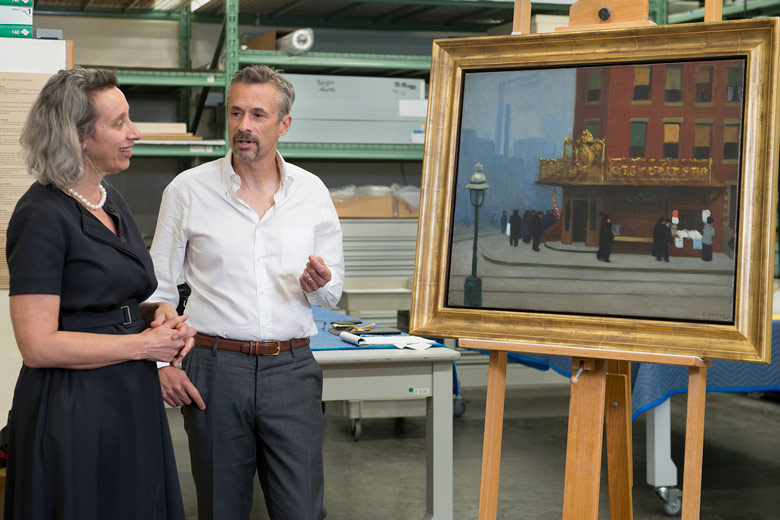
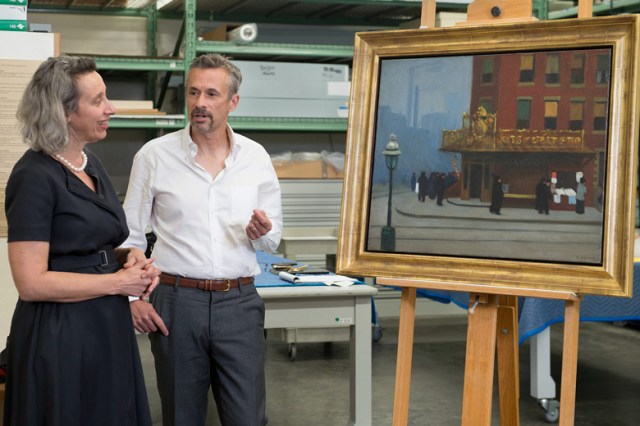
Connie Wolf, museum director and Alexander Nemerov, scholar and professor, with Cantor's new Hopper, photo by L.A. Cicero, via Stanford News Service

Connie Wolf, museum director and Alexander Nemerov, scholar and professor, with Cantor’s new Hopper, photo by L.A. Cicero, via Stanford News Service


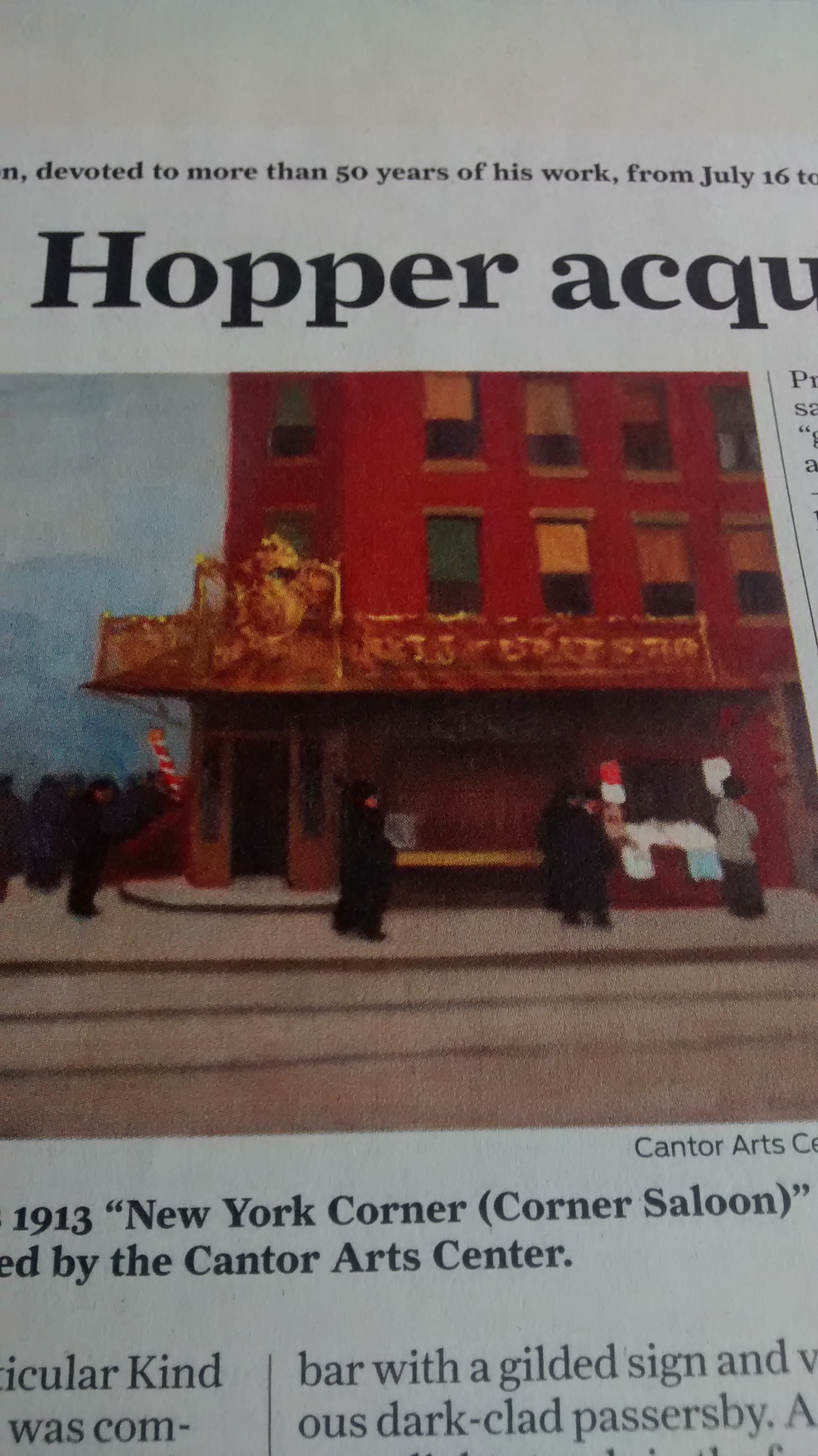
The Cantor Museum at Stanford announced its acquisition of an important painting, the 1913 Edward Hopper oil “New York Corner” also known as “Corner Saloon”. The press release lists 13 funds, couples, people, entities or anonymousi who helped the museum get this piece. I heard about it from Steven Winn of the Chron, who described the transaction in companion with a new Edward Ruscha show coming to the DeYoung, in July, 2016, a coming attraction.

I don’t follow the art market as closely as some but I venture that the typical Edward Hopper creates more interest (and principle) than the typical Edward Ruscha. I doubt I had heard of Ruscha until this recent phase, the one that started with my dating Terry Acebo Davis, the arts commissioner and artist. In our seven years together, we’ve gone to more gallery shows together that rock concerts (and I’m a concert promoter and artist manager, by trade, or at least that’s what I still tell the IRS).

Terry has a terrific art library. We pulled a catalog “Edward Hopper: The Art and the Artist” by Gail Levin, that pertains to a show from 1981 that traveled to the Whitney and the SFMoMA, among other stops. She believes she saw the show, but does not recall exactly where. Maybe while traveling.

And I admit we had to look it up to get the exact name of Hopper’s most iconic piece, “Nighthawks” which is in the Art Institute of Chicago, from 1942 and is somewhat large, 33 1/4 x 60 1/8 to be exacting.

Hopper was born in 1882 in Nyack New York and died in 1967.

One thing that is notable is that the Stanford press release shows a picture of Connie Wolf, the Cantor director (as of 2012 or so) and Alex Nemerov, the incoming head of the art department and the new work. Nemerov is quoted saying how great this is for the university and how, for example, students will be encouraged to go to Cantor and write papers on this Hopper. In contrast, I recall noting Jenny Bilfield, the head of Stanford Lively Arts, lunching with Loren Schoenberg a visiting Mingus scholar in the Cantor Cafe (the Cool Cafe, run by Jessie Ziff Cool, of Flea Street fame, but also on the wall is somethign about the generosity of Mr. and Mrs. Leland, she’s a Pearson Leland, the parents of my old friend Mark Leland, with whom I shared some of my earliest drug and alcohol experiences; when our parents were out, we would steal alcohol and crank Van Halen and Sammy Hagar quite loudly, and use our tennis rackets as proto-air-guitars, if you excuse the digression). I ran into the Cantor gift shop, managed then my Arlene Gutowski, and bought a copy of Peter Selz’ book on Nathan Oliveira. I wanted to emphasize, to the visiting East Coast scholar — he cut his teeth on early Led Zep I mean he was Bennie Goodman’s assistant, or was the head of that archive, at Yale; I in comparison did an 18-month term as a personal manager for a former Mingus sideman and writer). I wanted Loren to reap that righteous riff about Oliveira, Frank Lobdell, David Park, Elmer Bischoff and their various relationships to jazz (especially West Coast, and Stan Getz) and each other. Cantor actually did or does encourage this with little cards posted on the second floor pointing out the jazziness of some of those pieces, and more. This group, the Bay Area Abstract Figuratives, influenced each other and were influenced by jazz and influenced a generation of painters, not merely their students. I think that’s an important Stanford / Cantor / regional>national timely story, that is untertold.

The Hopper we acquired — and I say “we” even though I was not one of the 13 funders, but I did meet Connie a few times since she arrived and paid $65 for the basic membership — I think it’s about the ninth or tenth museum I’ve been a member of, past or present, I collect those little cards, at least -I saw “we” as in the community of people hereabouts in this time and space continuum althought I am not even a Stanford affiliate — Terry is an employee via her day job– is great news. My first reaction and my previous post, on Plastic Alto “Stanford Donors Rally — $20 M — behind fictional poor” was kind of snarky and I was contrasting, albeit elliptically and in a bit of a stretch — the idea of there being funds for great art but maybe not funds to help a community of poor, the residents of Buena Vista Mobile Home Park, buy themselves out from their evil landlord — there’s a $16 M pledge, from the county and the City, from money earmarked for BMR housing below market rate but it might take $20 million or more to force a deal. I was, I admit, sort of shaming Stanford, for their (and note the switch from “our”) bit of “let them eat cake” — it occured to me that my point would make perhaps more sense if they had announced a purchase of a maybe Wayne Thiebaud, who literally and artistically depicts cakes. But then I started thinking I was being a cynic, and a bit of an ass: maybe the purchase, by these 13 donors is actually a sign that either they or a different set of donors would give to the cause of economic diversity, and BV would indeed be saved. And for the record, I am a commenter and kibbitzer on BV but not actually part of the effort, or Friends of Buena Vista. I’ve stood up in public a half dozen times, if that counts. And no where else in the world is anybody mentioning Buena Vista and Edward Hopper in the same breadth.

One thing we noticed — Terry and I, this time, not Stanford and I– is that according to the catalog by Gail Levin as of 1981 at least the Hopper was in the Museum of Modern Art of New York, via “Abby Aldrich Rockefeller Fund”. So the basic provenance question, if its not impolite to ask is: How did the painting get from the MOMA to Cantor? And, does it glorify the piece of besmirch it, that it was once part of the MOMA?

One clue is the fact that San Francisco art dealer Jeffrey Fraenkel is credited as being the one who brokered the deal wherein Cantor was able to purchase this work.

It also turns out that in 2012 or 2013 he brokered a similar deal in which the San Francisco Museum of Modern Art, SFMOMA acquired a piece called “Intermission”. “Intermission” is also in the 1981 Whitney show: according to the notes, at that time it was lent to the show from a private collection of Mr. and Mrs. Morris P. Pelavin. The piece is 40 x 60 inches and a later or late Hopper, 1963.

It turns out, if you type variations of these terms into the search engines, you can suss out besides being a new media maven, Fraenkel had shown both of these works — “New York Corner (Corner Saloon)” 1913 and “Intermission” 1963 at a show in his Geary Street Gallery called “Edward Hopper and Friends” that featured a total of nine paintings and shown them in comparison to a group of photographs, to show the influence Hopper has had and continues to have on this other medium or a group of artists working in that medium, on photographers. We presume that the paintings, in 2009, were merely NFS and were used to lure people in and peddle the multiples. (And not to disparage the field, or the work or clients collectors of Fraenkel, some of his transactions run to 7 or maybe 8 figures, at least according to his own father, at the time).

Another clue to the story is the fact that Fraenkel’s big break had to do with making an investment in a cache of prints by Carlton Watkins and re-selling them at a profit. One article on his success claims that in the early 1980s he was working as an assistant in another gallery and saw an announcement, in the trash bin no less (!) about a sale of a group of Watkins; he borrowed from F&F and took the plunge and the rest is his story. Stanford recently had a big Carlton Watkins to do; I went to the opening and heard the speeches. Actually I recall catching Connie Wolf in a bit of a stretcher in that she misquoted Kenneth Baker, from his review. She said he said the catalog — we bought, we bit — was the deal of the century but he only said it was deal of the year. Connie Wolf who is a Stanford 1981 and therefore “forty-something” came to Cantor after a tenure at the Jewish Museum of SF, so she would presumably know Jeffrey Fraenkel from those circles. My guess is that the seeds of this June, 2015 deal on Hopper were somehow sewn in that Watkins 2013 dealio.

The article by Kenneth Baker on “Intermission” stated that the SFMOMA deaccessioned a lesser Hopper to make way for the superior piece. Maybe it’s looking the gift horse in the mouth but I am curious what Hopper or modern work might have made its way to New York’s MOMA after they shed “the Corner”. Or, were there any intermediate steps between MOMA and Fraenkel’s client/confederate. I presume over time Fraenkel earned the trust of the person who started by lending work to him and advanced to letting him help broker these two deals. I presume the person or entity that held in 2009 as many as 9 Hoppers also held or holds quite a few nice photographs as well, but that part is conjecture.

A red herring I presume is the fact that Stanford’s Alex Nemerov is the nephew of Diane Arbus, whose work is shown semi-exclusively by Fraenkel Gallery.

Disclosure: I have visited Fraenkel Gallery a handful of times. I believe I bought a Lee Friedlander book there, on New Orleans musicians perhaps. I recall visiting the gallery when it was on Grant and I was on a lunch date, circa 1990 with Elizabeth Hutchinson, who was between her bachelors from Yale and Masters from Stanford, and is now an expert on early photography and teaching at Columbia. If I own a half dozen photographs they are sub-collectible, although sometimes I cheaply frame my own work (And I’ve shot and posted 1,000 images here, beside literally and figuratively nearly 1,500 posts, not that means I’m making ModernBook).

Also: this is probably too goofy to mention but I recently tried to donate a lesser Laddie John Dill to Stanford, via a development officer I met as Terry and I stood between Cantor and Anderson, watching them take down the Richard Serra. The Anderson has a major Dill and my gesture was meant to help close that gap. I think I also threatened to buy something from “She Who Tells a Story” and donate it to Dartmouth. (I was just flirting).

I also remember reading about Cantor procuring a Noguchi for about $200,000 it was reported. This is again too far out of bounds but I am reading Timothy Egan on Edward Curtis and he reports that a treasure trove of Curtis’ are now in the hands of a pair of Silicon Valley investors or collectors.

The Hopper is set to be shown in July, they say.

edita: Gail Levin, who wrote the catalog I mention, from 1981 and or compiled a catalog raison for or of Hopper, was later fired by the Whitney in 1984, supposedly for moonlighting on a book about him. In 2006 her name popped up regarding the controversial Sanborn collection of Hopper works; the article also states that Hopper had left 2,500 works to the Whitney.

and1: New York Corner was shown in 2007 at the Boston MFA, according to a review by Holland Cotter of the Times. Who lent the painting to that show?

The Fraenkel Gallery is still selling a poster from its spring 2009 show “Edward Hopper and Company” ($100) but seems to be out of stock of the catalog, which might be illuminating here. Note that “Intermission” now at the SFMOMA is used in the poster. It lists works (for sale, I presume) by: Robert Adams, Diane Arbus, Harry Callahan, William Eggleston, Walker Evans, Robert Frank, Lee Friedlander and Stephen Shore.
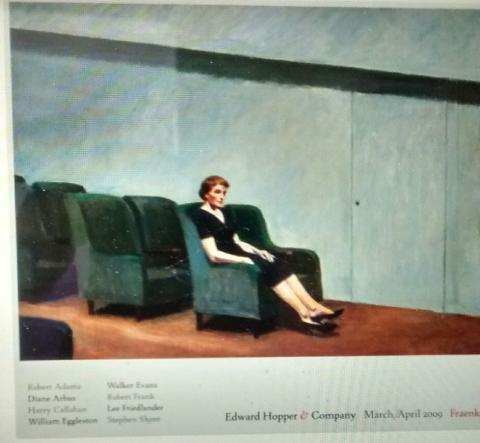
hopperposterbyFraenkel

edit to add, the next day: Leah Garchik had a riff on this today:
In response to an e-mail, Connie Wolf, director of the Cantor Arts Center at Stanford University, described the particular appeal of the collection’s new acquisition, Edward Hopper’s 1913 painting “New York Corner (Corner Saloon).” The work, as Steven Winn said in Wednesday’s Chronicle, was bought in a private deal brokered by San Francisco gallerist Jeffrey Fraenkel, paid for with funds raised from many contributors.

“I think what was great about this work and how the many supporters felt about it,” Wolf said, “is that it is of New York City. Yet everyone loves having it here in California. There is no question, we all love NYC, but we live here because we love the area, the people, the ideas. Yet we value what is NYC, and so to have a little of that here with such a beautiful painting … well, that’s the best of both worlds.”

I’d be curious what about it caught her eye, what exactly she asked Connie…The bottom line, I’m not expert but I think it’s a good but not great Edward Hopper and I’d hate for Stanford to hype it just because they own it, and then make it doctrinaire about their students that this is the shit.

bop, bop

Posted in Uncategorized | Tagged , , , | Leave a comment

San Jose’s ukelele source

sanjoseukelele

Janet and Smiley Kai own and operate a great little ukelele store Ukelele Source, in San Jose’s Japantown, on the corner of Jackson and North 5th (599 North Fifth Street, 95112; 408.998.2640)
What caught my eye was the proximity of a Ukelele Jam studio — defunct, I soon learned — directly across the street. Who knew?

Janet was too shy to pose for my photo. They have a range of stuff. One of these days, I may have to learn to play the uke. If not this place, and not Hawaii’s Holualoa Ukelele Gallery, then Gryphon in Palo Alto or McCabes in Santa Monica (Janet knew of the last two of those).

They have an extensive web site. They say this is an outgrowth of their many years co-presenting Hawaiian music shows and workshops here (something Janet was a little coy or sly about mentioning when I met here, and namedropped having almost presented George Kahumoku once, and that he played at the library, in Palo Alto).

Posted in music | Tagged , , | Leave a comment

Stanford donors rally ($20 M) behind fictitious poor

Edward Hopper “New York Corner” 1913 and its invented 13 or so regular folk brought in from the cold versus Palo Alto kind words money talks bullshit walks so far apropos of Buena Vista and its 400 or so actual people

Posted in ethniceities, filthy lucre, media, Plato's Republic | Tagged , , , , , , , , | Leave a comment

The Mendoza Line and taxing the payrolls here

I posted something to Steve Levy’s column today, about San Francisco payroll tax:
As of 2012, San Francisco had a 1.5 percent payroll tax, that brought in $400 M to city coffers.

What would you estimate, Dr. Levy, the hypothetical effect of such a thing here?

I would not mind so much being overrun by this new species if there were something in it for me.

And what about my comment a few posts back about taxing realtors rather than having a parcel tax, or in addition? How much of a “residential real estate transfer tax” hypothetically would we need to impose to match the $10 M per year of the recent and renewed parcel tax?

Because an adjacent post referenced baseball averages, I digressed a wee bit about Mario Mendoza, whose name because attached to a minimum standards. I thought it was related to “hitting your own weight”. I was grasping for something about feeding a pig and slaugtering a hog. Tax the fat cats.

mendozaline

Since you digressed a bit into baseball, I am posting again to add the detail that on my own blog I grasped for but did not quite reach a clever reference to Mario Mendoza, a mediocrity from the 1980s baseball who is immortalized for “The Mendoza Line” which to many people is a minimum standard of success, like a .200 batting average. I actually think it is something less tangible, having to do with the expression “hitting your own weight” i.e. a batter whose average was below his body weight. There was a period there wherein Mendoza started putting on weight, but his batting average did not increase proportionally. To me the Mendoza LIne is not .200 but is more like an irrational that cannot be described simply: There was also a yarn about the guy with the lowest average being “the strongest man” in that he held up the other 500 players in the charts they used to print in the Sunday paper. Mendoza arguably was better off as a 170 pounder hitting .200 than being a 235 pounder hitting .205.

I actually did hit .667 on a single at bat, my first hit in Senior Little League, as a 13 year old playing with 14 and 15s; it took me almost to mid-season to get a safety; I knocked Paul Hopper’s hanging curve the opposite way off the right field fence, took two bases but cluelessly tried to stretch it to a triple and was thrown out by a mile. It’s actually, of course, still a hit, but in the context of economics it is more like a hit and an out, or two bases and an out, 2 of 3, .667.

Web Link
e most irrational thing you do.

i am also saying something about “feed a pig slaughter a hog” in that the developers are getting fat and we should or could benefit, maybe by taxing them. Or indirectly by taxing their tenants.

Famously, a Palo Altan named Ron Conway moved to SF and helped Ed Lee get elected partly by getting some high tech companies exemptions from the payroll tax. I’ve never met or even seen Ron Conway but I presume he is more likely a porker (compared to a CEO like T.J. Rodgers who is an exercise nut).

And yeah, I admit I am carrying more on my frame than I did for the 1981 League Champion Titans: 30 percent more!

edita: when i post a couple things to Levy’s column, knowing full well that he is likely to delete, it is a type of yarn bombing.
yarn

and1: Re Conway: he raised $600K for Ed Lee. Wow. He is a major investor in AirBnB: we should see if he is influencing local (Palo Alto) policy on taxing it here; moreover, what was Conway’s political footprint locally when he lived here? Commercial real estate here is a billion dollar business.

Posted in Plato's Republic | Tagged , , | Leave a comment

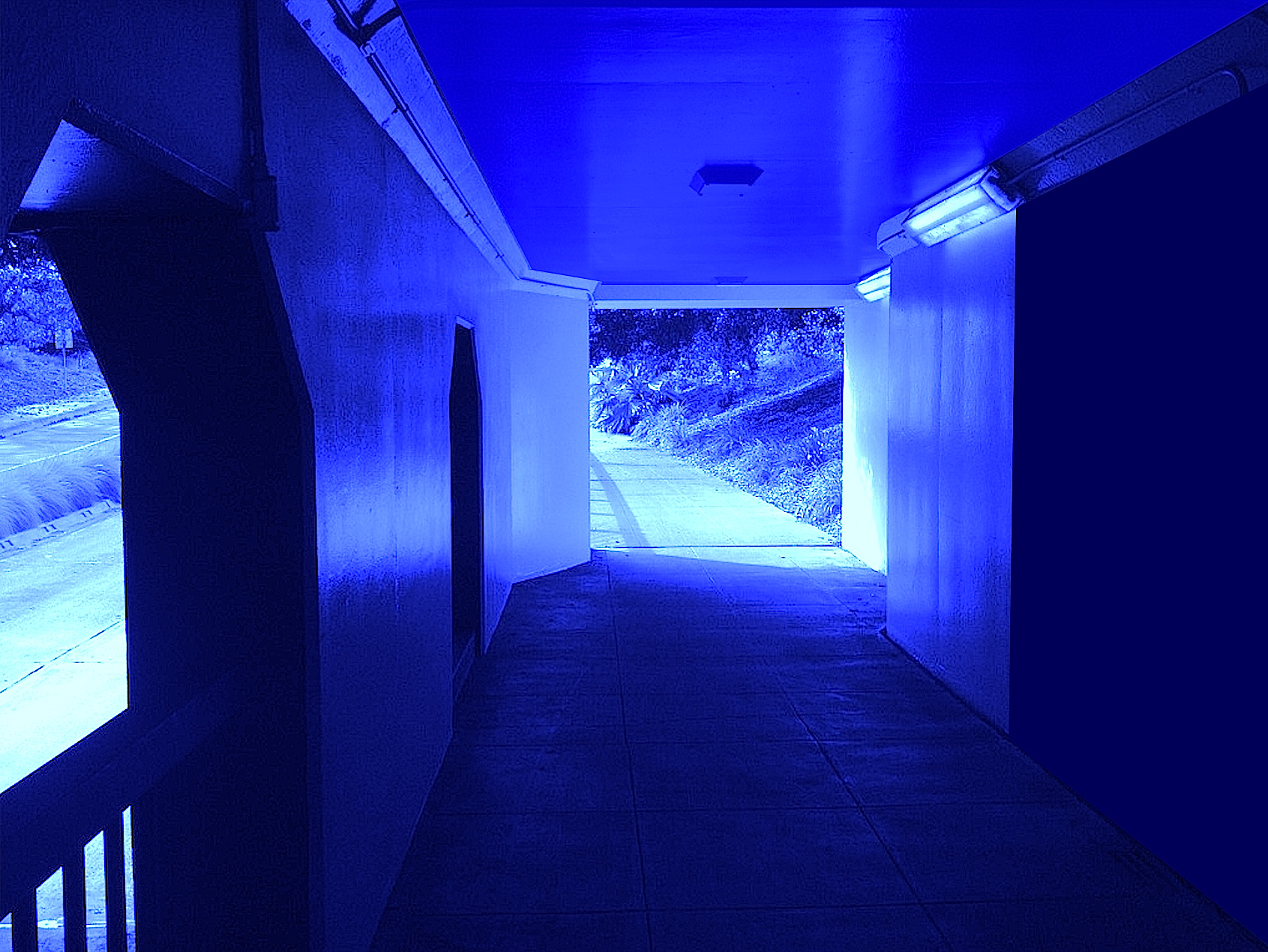
Cool public art in the pipeline for Palo Alto (Ala & Binta)

Ala Ebtekar and Binta Ayofemi

(the blue tunnel thingy did not cut and paste from staff report, will update)

(you can find it here, in the staff report, if you scroll down)

edit to add: Elise DeMarzo sent me the JPEG: it’s funny how excited I got over this, whichi is just a doctored picture of the tunnel under El Camino, on Uni Ave — reminds of the 2014 article new to me by Peter S about Jeff Koons in New Yorker and New York and the relative small distinction between a fake blow up bunny and a real one.

almost blue, in Palo Alto, the new subterraneans, Ala and Binta

almost blue, in Palo Alto, the new subterraneans, Ala and Binta

Peter Schjehdahl in The New Yorker, on Koons. It’s funny I had such a strong reaction to a photo-shopped picture of the tunnel. The other Ebtekar I had seen was more technique-oriented. Apparently he is teaching at Stanford, where he got an MFA in 2006 and leading his students on this project.

Posted in art, Plato's Republic | Tagged | Leave a comment

Yo La Tengo and BV

Yo La Tengo is a rock group based in New Jersey featuring the husband wife duo of Ira Kaplan and Georgie Hubley. They are big in my world, even if you’ve never heard of them.

Their name is a baseball reference. When the New York Mets started out, as an expansion team, they were pretty horrible, and laughable. This was about nine years before “the Miracle Mets” the 1969 Champions, Tom Terrific and and that.

Elio Chacon

Elio Chacon

“Yo La Tengo” is Spanish for “I Got It’ or maybe “I Got Her” — I guess that’s a pun, or inside joke between the couple. The Mets had a centerfielder Richie Ashburn, formerly a champ with Philadelphia I think, without looking it up. They had a Venezuelan shortstop, a pioneer –now there are more than 200 close to 300 Venezuelans who’ve played MLB, including our Panda Sandoval and King Felix of the Seattles — excuse the digression — the Mets had a shortstop who spoke Spanish but little English, Elio Chacon. There was a pop fly to the outfield that fell between Ashburn and Chacon. Ashburn learned that “Yo La Tengo” means “I Got It”. The next game another similar ball up there and Ashburn or Chacon call for it in Spanish but another outfielder Frank Thomas comes running in, plows over or maybe there is a 3-way collision. He missed the meeting where they went over “Yo La Tengo”. I think, by the way, this is also the source of the SNL character played by Garret Morris Chico Escuela “baseball been berra berra good to me”.

My point is that between Molly Stump, Jim Keane, Council, the FOBV, Simitian, I don’t see real leadership I see a lot of chatter and I fear the ball is going to drop. I suggest eminenent domain for $10 M — don’t take his property, merely refund what it put in, the ownership group, back in 2000. Let the courts decide if that is fair. Seems fair, and due process to me. And adios amigo to the ownership group.

edit to add: that’s a typo. I meant “emimet domain”

like this

edit to add, November: when the World Series (of baseball) started with the Royals shortstop hitting the first pitch for an inside the park home run, I shot a screen capture of the New York Mets outfielders and thought “Yo La Tengo 2″….Royals won in five.

Posted in ethniceities, Plato's Republic, sex, words | Tagged , , | Leave a comment

Eminent domain is clear moral choice for Buena Vista Mobile Home Park

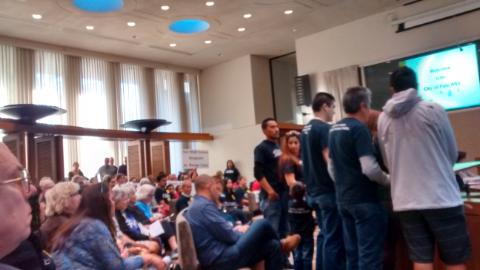
bvhearing41315t
I say eminent domain is the clear moral choice.

What the current ownership group intends to do, and I believe that was their plan since they took over, in 2000, is an economic pogrom. Palo Alto meanwhile has protective wordings in use permits and even our General Plan that date back generations, to the park’s opening, in the 1960s.

The Fifth Amendment guarantees due process, not optimized profits.

Posted in media, Plato's Republic | Tagged , , | Leave a comment

Pat Monahan rocks Shoreline Friday, photo by Eric Cohen of The Dancing Twins

When Train played Cubberley, in January, 1999 they had sold barely 50,000 cds, compared to their millions of fans now, as of Friday

When Train played Cubberley, in January, 1999 they had sold barely 50,000 cds, compared to their millions of fans now, as of Friday

Posted in media, music | Tagged , , , , , | Leave a comment