Excuse me for talking about myself here, Wedge, but I want to say that the dumbest thing or most embarrassing thing I did was produce a Steve Lacy Quartet show (or his trio, plus Roswell Rudd) in a storage space in San Carlos, California. This was in 1999. I had been doing shows at Cubberley Community Center, in Palo Alto, which holds 300 but didn’t think Steve and Roswell would fill Cubberley so we decided to do the show at Andy Heller’s storage space, Heller being our sound contractor. Then we concocted a lie that this was a studio and we would be taping the show; Steve gently nixed the recording part of it. I wrote about this a wee bit recently in a discussion of Josh Roseman on my blog Plastic Alto, which is indebted to this blog. https://markweiss86.wordpress.com/2011/11/04/go-down-roseman/
I got to watch Steve and Roswell rehearse the day of show, before. It seemed like a long time for them. Also, Steve, JJ and John and I went to get a pop at the Carlos Club bar I think it was — they stayed at Days Inn. We got chased from the bar when the karaoke started, which I find ironic as hell. Steve and Irene a couple years later played a show at Cubberley; I took a loss but have this story. Will Bernard and Miya Masaoke duo debuted and opened. I suggested Carla Kihlstedt for the opener that next night Larry Kassin produced show at St. John’s in Berkeley. Irene was amazed at Kihlstedt’s singing while bowing, not a typical technique.

GREAT Koopee POT at DeYoung
With Steve he did not drive so promoter carried him to next show. I recall en route he recommended Danilo Perez for a show, I did eventually do. Also, fond memories of taking Steve not to KZSU but KFJC where Steve broke the law as part of his preparation for the interview. Genius v. G-men kind of thing. “Pepper” spray. Oregano. I dunno. Self-treatment. Dig?
(SHOUT OUT TO IN ALL CAPS NONETHELESS TO CRAIG MATSUMOTO AND MEMORY SELECT BLOG — THANKS FOR ADDING ME TO YOUR BLOGROLL LINKS SECTION — ALSO, AM CHANNELING THE MEMORY OF WATCHING SATURDAY NIGHT LIVE SKIT WITH CARRIE FISHER, BILL MURRAY AND MORE, “THE LOUD FAMILY”)
and edit to add speaking of “great pot” this seems like a good place to insert my photo of a adobe olla by the recently deceased died way too young Hopi ceramicist artist Jacob Koopee (1970-2011), in the Weiss Collection at the DeYoung. Actually, here’s a recent post from their blog, by Sarah Bailey Hogarty:
FRAME|WORK is a weekly blog series that highlights an artwork in the Museums’ permanent collections. This week we feature an extraordinary contemporary piece of Pueblo pottery born out of centuries-old traditions. Jacob Koopee’s seed jar is currently on display at the de Young.

Jacob Koopee (American, 1970–2011). Seed jar. Slip decorated earthenware. Gift of Paul E. and Barbara H. Weiss. 2007.75.16
Pueblo pottery is an important Native American art form that was first brought to the attention of the Euro-American art world at the turn of the 19th century. In the Arizona pueblo (or village) of Hano, a young Hopi woman named Nampeyo began making pottery inspired by ancient Sityatki pottery sherds that she discovered lying on the ground around her home. She sold her pottery to the hotels and restaurants lining the Santa Fe Railroad, the majority of which were owned by the Fred Harvey Company. Recognizing a marketable commodity in Nampeyo and her finely crafted pottery, the Fred Harvey Company encouraged and promoted the artist, featuring her in advertisements for Southwestern tourism and sponsoring pottery demonstrations for visiting tourists. In this way, Nampeyo of Hano put pueblo pottery on the map. Today she is widely recognized as the original matriarch of pueblo pottery and was the first Native American artist to be recognized by name.
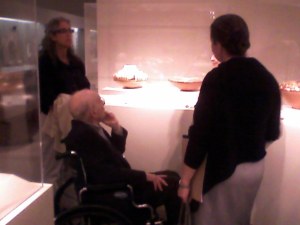
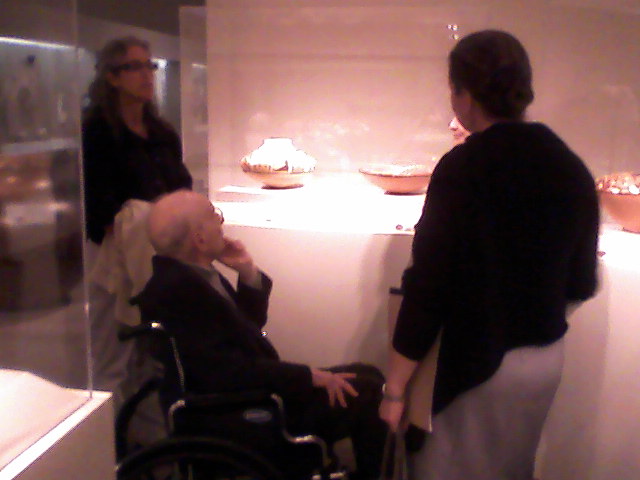
Paul Weiss and AOA curator Christina Hellmich admire the Hopi pots
Jacob Koopee is Nampeyo’s great-great-great-grandson, and his pottery exemplifies the evolution of style and originality for which his family is famous. Taught by his aunt, renowned potter Dextra Quotskuyva, Koopee demonstrates through his work the height of innovation in pueblo pottery today. Although he continues to use the traditional methods of coil construction and stone polishing, Koopee employs inventive shapes and patterns to create contemporary works of art.
The overall “shattered” format of this seed jar’s surface design references Nampeyo of Hano’s resourceful use of ancient pottery sherds for inspiration. Koopee has visually represented the rejoining of a variety of sherds to create this pot’s intricate facade. Throughout the abstract design, Koopee has scattered cartouches revealing the geometric faces of kachinas. Kachinas make up a vast pantheon of spiritual beings in Hopi religion. Each kachina is associated with a specific aspect of Hopi life, such as agriculture, hunting, or warfare.
The combined elements of community and family are integral to understanding this unique art form. Traditional techniques and designs are paramount to the continuation and preservation of pueblo culture and native art practices. Ancestral patterns and methods handed down through generations identify artists as members of a particular family, reinforcing both heritage and aesthetics. Contemporary pueblo pottery illustrates the fluid fusion of past and present used to create striking new forms.
On your next visit, learn more about Jacob Koopee and his family’s long history in art. Pottery by Koopee, his aunt, Dextra Quotskuyva, and their ancestor, Nampeyo is on display in the Art of the Americas Gallery at the de Young.
__
Further reading: Africa, Oceania, the Americas, and the Jolika Collection of New Guinea Art: Highlights from a Decade of Collecting

Barb Weiss talking with the clay, 2011

 Here I shot Terry Davis and Eric Cohen distracted by their stupid I mean smart handhelds, while almost tripping over the Noguchi.
 Eric kindly hammed it up with the Terry Allen in the next room: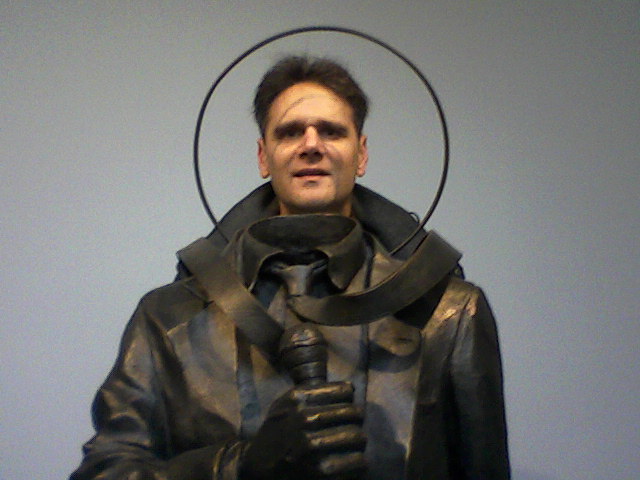








 Plastic Alto with Mark Weiss