The precision of Judd’s sculpture has led people to see an idealizing impulse behind it. But Judd saw himself as empiricist and his work as sharpening the perceptions of a public addled by encountering falseness daily on every front, from advertising to architecture.
I was living on Pepper Street in Palo Alto, across from Smith-Andersen Gallery when this article came out and I refer to the clipping from time to time as I ponder my path from journalism to advertising to high tech pr to commercial pr to being an activist and environmentalist to being a freelance marketeer for non-profits to running a concert series to managing musical acts to running for public office to collecting art to finding good homes for some of Robert Syrett’s art to writing a blog, and back and forth between those posts or posits.
(I never saw the show Baker describes, at Berggruen gallery, but have seen some Judd at SFMOMA and other places).
In a related matter, I thought about a campaign to re-boot the Palo Alto political scene “to the beat of a different drum”: “Hey PA- Way”, based on the rhythm pattern of The Meter’s song. I texted Glenn Hartman about his availability to do an ear training event here.
Or I think about Steve Lacy, who I knew slightly, and his ability to keep adapting and changing and pushing himself over a lengthy career.
And my heart races as I rush to finish skimming an article or a chapter in a book, then re-sort and re-stack a bunch of books not-yet-overdue from the Library: maybe I should take a week to just become better read.
I still wonder, 600 posts in, whether having a blog helps me keep track of ideas, that will eventually come to fruition, or just has my energy dissipate.
(This post is slightly more personal than most of what shows up here).
edit to add: Did not realize that Donald Judd was in residence at Dartmouth in 1966 (before my time) and that there is a show related to that fact in Hanover currently:
Organized in collaboration with the Studio Art Department, this exhibition celebrates the important history and legacy of the Artist-in-Residence Program at Dartmouth College, which began in 1931 when the Guatemalan painter Carlos Sánchez, Class of 1923, was invited back to campus on a year-long fellowship. The exhibition showcases the work of more than eighty artists who have participated in this acclaimed international program since that time, including Charles Burwell, Walker Evans, Louise Fishman, Allan Houser, Donald Judd, Magdalene Odundo, José Clemente Orozco, Robert Rauschenberg, Alison Saar, Paul Sample, and Frank Stella, whose presence on campus has undoubtedly enhanced the vitality of the arts at Dartmouth.
This is a companion piece to below about Ehren Tool, veterans’ art, coming to Palo Alto Art Center in June.
“Reunion Hill” was written by Richard Shindell, for Joan Baez. Here are comparative versions, one by each.
Meanwhile, I am reminded of “Women on the Wall” by Wallace Stegner, my former neighbor. It was published in Harper’s in 1946, i.e. it is about World War II. It is also the title of a collection of short stories by Stegner, who was born in 1909 and died in 1993. Woman On The Wall is kinda sorta also the name of a project wherein I imagine at least that a group of contemporary singer-songwriters, but not Shindell or Baez, either write or perform songs based on Stegner stories, that was started as a Stegner Centennial event in 2009, by Dao Strom and myself. I made this flyer, for a very minor event, in Austin, on his actual 100th anniversary. This is 1981 from University of Nebraska Press although all these stories are in The Collected Stories of WS, which came out in the 1990s.
David Evan Harris of the Institute of the Future and its Governance Futures Lab
I am carrying the business card of David Evan Harris, one of the panelists (along with Sid Espinosa, Steven Levy and Ann Dunkin): Research Director, Institute for the Future, 124 University Avenue, Palo Alto.
Harris said, and my own eyes confirmed, that IFF is hanging an art show at 201 Hamilton, the former faucet shop, which I told him, is also known as 209 Hamilton, the former clubhouse for Sons of the Golden West and, in the 1960s and 1970s, artist studios and stage space for Nathan Oliveira and others. Harris said he is a Mountain View High grad (before his advanced degrees in sociology and languages, Berkeley b.a. and jets to Brazil) and was part of the Bay Area Action Schools Group in the late 1990s. I told him that when I left the advertising world and moved back to Palo Alto, a pivot experience for me was working on Bay Area Action Earth Day in 1993 where I met future-Mayor Peter Drekmeier among others. I said further that someone should write a history of Bay Area Action and assess how radical or not it really was.
I thought it was more entertainment than public hearing. A dog and pony show.
I’d rather have the public sector stay out of that field, or leave it to Arts and Culture Division, like when Richard Shindell played Johnson Park (which I helped set up, or middled, or co-presented — or may have been paid a fee to help organize).
I thought it would be interesting to make a transcript of the event and then re-stage the event as a performance piece wherein four people read the words of Espinosa, Levy, Dunkin and Harris while a musician or two improvises. Film that, put it on Youtube and see which video gets more hits.
I think they were trying to tell us that we will have more office space built AND more super-dense housing, whatever the developers want, continuing the route rout the builders have enjoyed since at least 2009 (when I started following and or civic-engaging).
I prefered a similar event a few months back wherein John Barton got a bunch of young French students to tell us in sexy accents that we should get used to a giant office tower being built at 27 University. I thought it was brilliant that Barton merged his professional, personal and civic lives by staging an academic exercise as fake-public hearing or performance art and getting leadership (staff, commissioners, Chief of Police Dennis Burns, council) to make cameo appearances or members of the studio audience.
I had some fun last night (but not as much if I had dragged my four-cylinder Chevy to San Francisco to check out Hurray for the Riff Raff at the Independent).
I refrained from any of the nosh provided and definitely did not drink the kool-aid.
Someone mentioned The New York Times has an upcoming Sunday Magazine story, viewable now online about When the Economy Bubble in Palo Alto Pops, Will It Make a Sound? Thanks for mentioning that.
I think I name-checked George Packer The Unwinding to a couple people. I should carry around and gift copies, now in paperback.
Not sure what this does for my economic theories, but it turns out Shindell is the son of a one-percent-of-the-one-percenter and his father, Richard H. Shindell donated $3 million to Rutgers to endow a chair in Neuroscience.
Not sure exactly what it says about Palo Alto politics, but I like “Confessions” also known as “Hey Doc, how about a refill?” I wanted to call this, despite the esoteric tangential reference, “Hey, Democ, how about a refill?”
that’s kind of a lame video, so this one I am adding to the mix, because it looks and sounds like the Richard I know, and the song, although passive-aggressive, is catchy, and of the era when he would play Palo Alto (Johnson Park, Cubberley, and I think a house concert); Shindell is like the James Merrill of the singer-songwriters; he was kind of outed by a Times story from 1998, before he was famous, before his father really hit the jackpot: the investment banker and future T.Rowe Price honcho was also a Rutgers choir member, and they sang with Richard, and or Joan Baez at an early show. The Times has always been amazingly kind to Richard (not that he isn’t great); Robyn Israel also profiled him or previewed the show at Johnson, summer, 2000.
From the 1998 Times story:
The oldest of four children, Mr. Shindell was born in New Jersey and raised in Port Washington on Long Island. His father, who worked in the investment banking field, is very much a singer himself: in college he took part in the American premiere of Orff’s ”Carmina Burana” with the Rutgers University chorus, and was later a choir member at an Episcopal church on Long Island. Even now Richard Shindell Sr. sings with the Baltimore Symphony Chorus.
Back to the event per se, and not the long, musical digression which is the hallmark of Plastic Alto, the blog by the former concert promoter and two-time Council candidate (and former Nelson Rockefeller Center Fellow in Policy while at Dartmouth College), named for Ornette Coleman’s acrylic alto sax, Harris mentioned something about Governance Futures Lab, and I booted up my laptop to this link, but also thought of something that Packer touts, Evgeny Morozov, To Solve Everything Click Here, which I admit I merely skimmed.
I greeted Sid Espinosa warmly and he reciprocated, although gently indicated he was about to step to the fore such that I would not embarrass both of us if I started my typical burst of ideas and he had to cut me off. I took this shot because my stupid cell phone camera is so bad I didn’t think it would get him from across the room to the dias. (And that’s Aaron Aknin of the Planning Department and Steven Levy near Sid, waiting to take their places):
Aaron Aknin, Steven Levy, Sid Espinosa, Downtown Library, spring, 2014
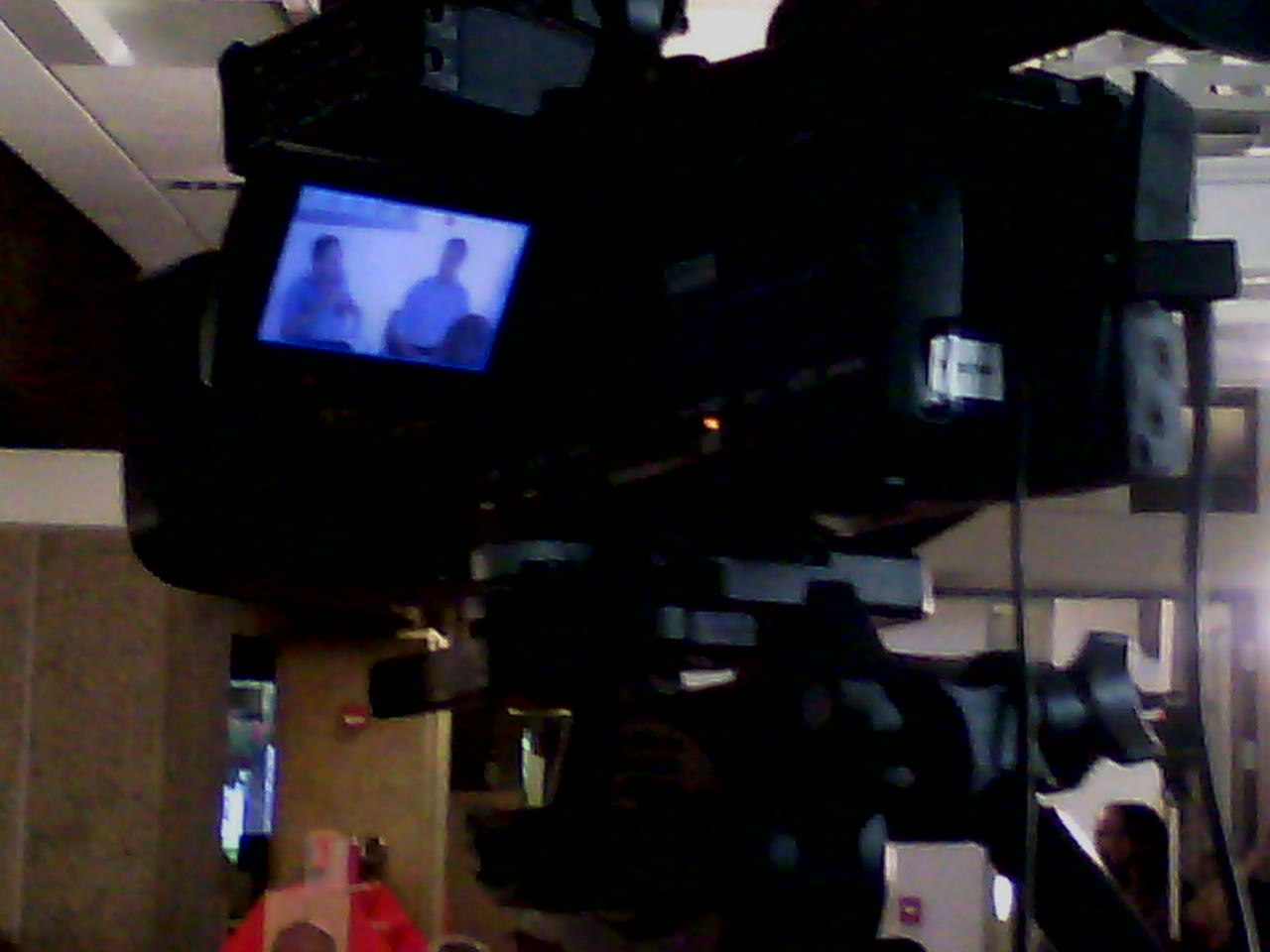
This is a quibble, but I shot this photo of one of the three cameras, provided by Public Media Center. The panel was miked, and there was a wireless talk mic for the audience questions, from 7:30 to 8, after 90 minutes of the panelists per se. But there was no sound reinforcement for the room itself, no p.a., as in, we were at a live taping for someone creating content and not participants per se, if you look at it by the production technique. (I raised this point about a Planning Commission meeting in the same room, a couple years ago, for Patch: the commissioners faced the camera and the citizens sat in the wings; Gail Price later made the same point from the dias). I actually had no idea who produced the event; Greg Schmid (one of three Council members there, who asked a question, or countered something data-heavy Levy said, with more data) said council did, i.e. the public sector or “the people”. Like the public honoring of Martin Luther King that was actually a private fund-raiser and schmooze-fest by an uber-power-broker, sometimes you gotta read the fine print to discern public-private-corporate or new media. The event was slicker than most things coming from 250. New tree logo, et cetera.
shot within shot of steven and sid
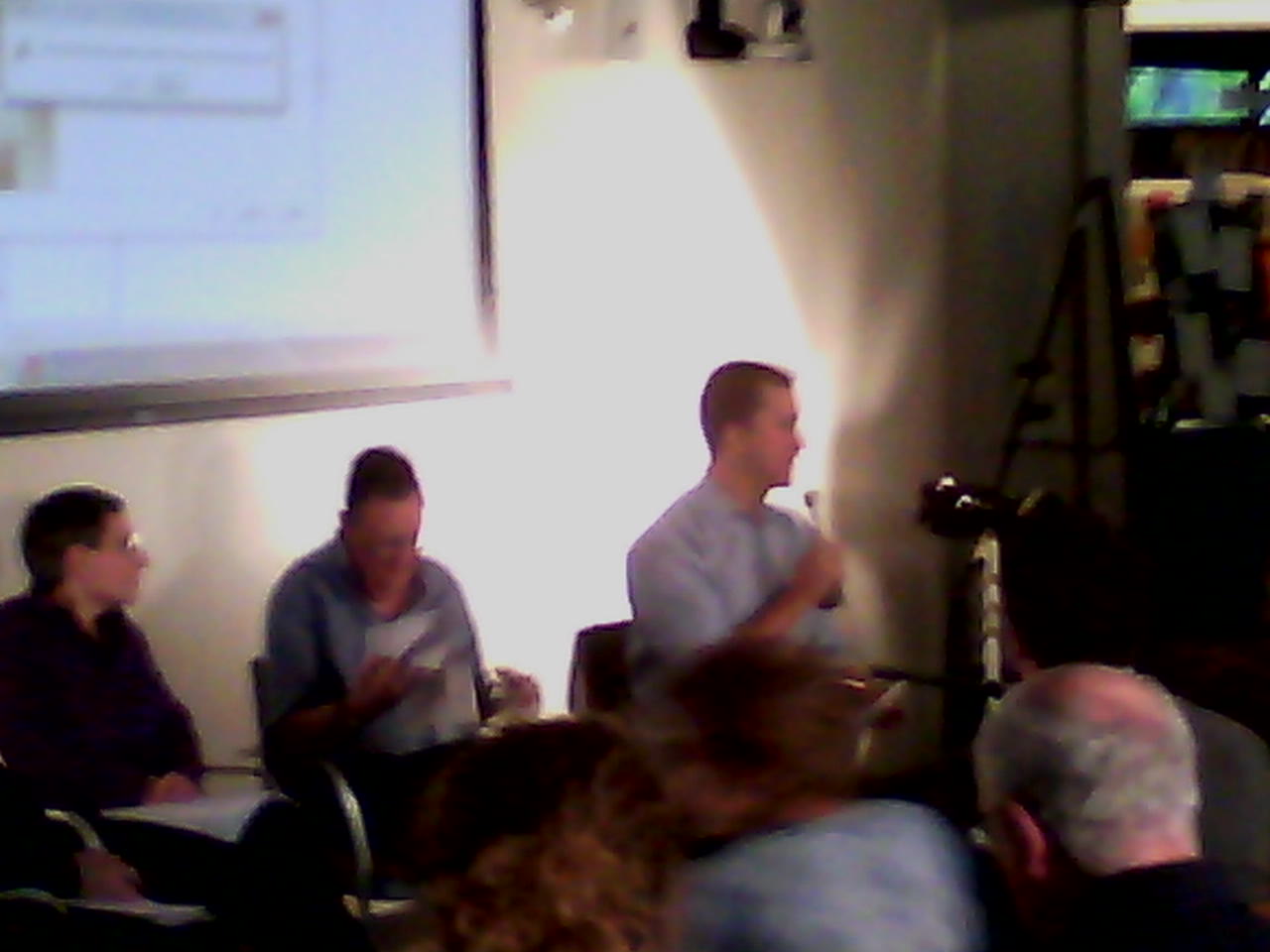
Ann Dunkin, Steven Levy, Sid Espinosa at Our Palo Alto discussion, April, 2014
2) Gen Sheyner, in the Weekly, has a thorough coverage of the conversation and a lively comments section (including by Hilary Gitelman, director of planning, and Cheryl Lilienstein from the successful Maybell referendum). He has a direct quote from Nancy Shepherd, which struck me at the time.
“This is a very interesting time in our city and we are working to strike that right balance between a place to grow companies and a place to grow families”.
Who in Palo Alto actually holds equally raising a family and “growing companies”? Unless you are a VC or own downtown property (as I believe Nancy does, or her husband does), no one. And when did it start, this myth of Palo Alto per se being an incubator?
3) If Katharine Schwab publishes something on this I will link to it. I gave her a lecture on history of the press here and my pet theory that there is a gap or opportunity in that most of the press, like leadership per se, has a bias towards the development industry. (A young woman pulled out a reporter’s notebook, and I started to lecture her on the history of the press here. The search-injuns led me to her identity, and some of her clippings.)
edit to add: Elaine Meyer in her activistic newsletter of May 2, notes that there are 4,000 housing units in line or built since the 1997 Comprehensive Plan, which calls for only 2,400 such. http://paloaltohousing.blogspot.com
Edit to add, May 9, 2014: I went to a further installment of the Our Palo Alto process, yesterday at Avenidas, where I met, among others, city staff members Shannon Burkey and Consuelo Hernandez with whom I exchanged views on the project and its overall context, meaning and purpose. Earlier that afternoon, I attended the actual subcommittee of City Council that deliberated the ways to approach the Housing Element of our revised Comprehensive Plan, per state and regional policy mandates.
Thirty days later:
I clicked on a packet of documents sent to me by City Hall and this comes tumbling out:
On February 3, 2014, the City Council approved the conceptual framework for Our Palo Alto. Our Palo Alto is a community conversation about the future of the City. This two-year, citywide engagement effort is intended to create opportunities .for dialogue around important ideas and programs while tackling issues the community cares about. Fueled by input and participation from citizens, Our Palo Alto is organized into three parallel, yet interconnected tracks: Ideas, Action and Design. This action increases funding for Public Communications contractors and consultants, and for marketing and advertising on social media sites. More specifically, the increase includes support for Our Palo Alto communication, advertising, and messaging. Our Paio Alto additional support includes funding for videos about Palo Alto; and an increase to the City’s photo database for social media and website communications. Our Palo Alto initiatives specifically linked to planning, traffic, and parking are budgeted in the Planning and Community Environment Department in the amount o f $175,000. The total one-time funding for this effort is $325,000. (Ongoing:.$0)
Let me reiterate the above 1,800 words as succinctly as possible:
We the people, of Palo Alto, do not need to spend THREE HUNDRED TWENTY FIVE THOUSAND DOLLARS for bureaucrats and spin-doctors to filter what should be a transparent, simple and straight-forward effort at self-governance. We do not need layers of bureaucrats explaining each other to each other. City Manager Jim Keane should be ashamed of himself. How many more people should I sent this message to?
Twenty three venezuelan chocolate bonbons, at Coupa Cafe, Palo Alto, Thurdsday, April 24, 2014, 9:36 a.m. (detail)
Jose Carlos Altuve
Alexi Jose Amarista
Elvis Augusto Andrus
Oswaldo Celestino Arcia
Gregor Miguel Blanco
Asdrubal Jose Cabrera
Jose Miguel Cabrera
to be clear I bought this magazine but did not actually eat the 23 bonbons
Alberto Jose Callaspo
Ronny Cedeno
Francisco Cervelli
Endy De Jesus Chavez
Alcides Escobar
Eduardo Jose Escobar
Freddy Jose Galvis
Avisail Antonio Garcia
Carlos Eduardo Gonzalez
Franklin Rafael Gutierrez
Jesus Antonio Guzman
Jonathan Alejandro Herrera
Omar Rafael Infante
Cesar David Izturis
Maicer Izturis
Jose Manuel Lobaton
Victor Jesus Martinez
Miguel Angel Montero
(Source: Who’s Who In Baseball, 2014, 2014, New York, Pp 3-110)
edit to add: from a 2012 post about Venezuelan baseball, again inspired by Coupa Cafe coffee:
GUTIERREZ, Seattle — I am going to hold on to this guy’s card, and maybe put it in my vault because the stats on the verso are for a Washington pitcher and not a position player from Seattle. With more hours in the day, I could comb through my Baseball Almanac and call this error by it’s proper name.
The chief myersist of the search injuns leads me to believe that Topps has seen fit to attach Sean Burnett’s numbers onto the card of Gutierez. And not to nit-pick but I found a number of cards, in my pack of 12, wherein the stats listed “3B” twice, that is for both double and triple columns. Also, it lists “W” for both wins and walks; I would suggest “BB” (base on balls).
MONTERO, Arizona – I am forgetting now, since I left the stash in my new baseball-hotdog-apple-pie-mobile, what I learned from this 2×3″ oracle, but I think I noted that he is one of about 200 Venezuelans in the show, all time, and that he broke the Arizona record for extra base hits by a catcher — hence the thing about 3B having too many plate appearances so to speak.
I am not working on my blog because there are this many — 12 — things more interesting than my new computer, tempting though it may be. At Printer’s Inc, Cafe, Palo Alto, with about 90 minutes to be “productive”.
1. Sonny Smith, 100 Records, 11/40, set of prints, box set, including “I Walk the streets, richest man who ever lived” by Hank Champion, although it is signed Esther Peace Watson, on Mr. Pickes High Fidelity, and Jackie Feathers & Carol Darger, with the Concrete Praire Band, on Melody House, (which, although I’m not expert, looks like Sonny Smith himself and a confederate wrapped in a faux Navajo — Navafaux?– blanket — not to be confused with lecture taking place either right this minute or in a minute at DeYoung Museum in SF apropos of the Thom Weisel Collection of Native Doodads and Goodies — signed on verso SlHR PRN 2010 — Del Rio, Prayer for a Dying Dog” — this time the verso-graph looks more like Wilson, 2010 — and now I am totally confused and DEFINITELY NOT blogging or surfing or serfing the cloudgate today. I bought this a while ago, Holiday Season, 2011 or so, I remember Steve or Eric Cohen with me, at Gallery 16, and I now I paid in installments but honestly don’t know if I am current or not — if you excuse the Coen Brothers reference — and have not heard the music either. This spiffy new computer, from the leading brand, does NOT have a disc drive by the way — too cool for disc drive, you have to buy that separate.
2. Big Youth New Painters From Chicago catalog or chap book from Corbett vs. Dempsey, Modern Art & Uncommon Objects, cvsd 0034, 2009; (the Vivian Maier story I wrote about below made me suss this out from my archive, anew);
3. HAND-MADE Notebook with Found Photograph blank, by Emily Parrish, a Bay Area artist or publisher who Robert Syrett discovered and did bidness with at an East Bay zine fare recently, I bought at Accent Arts just a minute ago, for four zuzim, I could not pass over. The print is a squared 35 mm print of a man in a sweater standing in from of a building with Baltimore-esque stoop, although rounded, not quite Federal Style windows, doors and shutters (3), but weird blue and white zig-zag pattern on the facade.
4. I am carrying with me, the things I carried, for no apparent reason, the set of about 20 “Fox Says Ding” stickers that Robert Syrette made for me last fall, 2013, and I have had some ideas of how to actualize the concept, them being stickers and not prints, they seem destined for more glory than merely being horded or saved. Look out for them! (one idea was to try to get Palo Alto Mayor Nancy Shepherd to let us install them for a few months on her door or window or anywhere on the 6th floor of 250 Hamilton and call it public art, or temporary public art.
5. a collection of 10 cassettes (something that came before cd, which is something that came before MPEG3 or streaming), circa 1994-1998, that were in storage locker, and part of a much larger collection: Freedy Johnston, This Perfect World; Devouring Our Roots, San Francisco new-folk uprising, a benefit for Food Not Bombs; The BabySitters Club (Matt Sussman, Rachel Metz, Jessie Oppenheimer) 12-song demo (tarbell7@yahoo.com); WXYC Demolisten 3 (includes Archers of Loaf “Web In Front); The Babysitters Club 4-song demo (including their smash hit, Serfn’ Sperm) and the tape is actually a re-purposed Fun Lovin’ Criminals promotional tape not for sale, as is the packaging, papered over); Will Ackerman, A Windham Hill Retrospective; La Zapatistas Del Norte (De Chiapas) Puras De La Sierra — corridos; Julie Lake, vocalist, “Deedle’s Blues”, “I Can’t Get Started” “I Remember You” with Gunn HS Jazz Trio; “Katie Gorman’s Demo”; and lastly Jose Cardenas, Firme, Mi Barrio Records, “Hiena” and more.
6. Today’s Chron, for articles by Ben Fong Torres “New Kind of Hipster“; and on Galeria de la Raza, bought for 1 zuzim, which is not cheap.
7. 2014 Who’s Who in Baseball, which reminds me that the Giants were deadlocked at 8-8 in Denver entering extra innings.
8. The Flame Throwers, by Rachel Kushner, first Scribner paperback edition, February 2014 — I continue to say, no matter how true it actually is, and though it is not really any of my business, that her parents were introduced in St. Louis in 1960 or 1961 by the poet Alden Van Buskirk, who was in grad school there and then and forever, Pinky and Peter.
9. Lucky The Magazine About Shopping April 2014 ($3.99) where my former Gunn High School Oracle co-editor Jean Watt (Jean Godfrey June they call her) is now Executive Beauty Editor, reporting, through only one or two intermediaries, to Anna Wintour, artistic director, which I bought for an article about an app where if you buy food from certain restaurants, somebody makes a donation to some needy cause or peoples in a faraway land.
10. The Economist, April 12, 2014, which suckered me for $8, for the book review section and maybe the cover story about The History of Finance in Five Crises.
11. I was gonna write about Le Video, and their Indiegogo.com campaign and my conversation with their founder, Catherine Tchen, who posed for this portrait:
Catherine of Le Video
Katie Gorman, I had run into at the Barbara Stanwyck festival at Stanford Theatre — the movie that had a cameo by Bettie Davis, sitting for an artist — and she had mentioned Le Video, and when I went to the City the other day for Matthew Robb’s lecture of the Weisel Collection, at DeYoung I had parked near 19th Avenue but in the park and walked the rest of the way in, then wandered up to 9th for an enchilada at Park Chow, but wished I had gone to Gordo’s just for the bigger serving, then popped in to Le Video, and heard Tchen telling another customer about their sticky situation, and nearly starting to cry, and I reminded her that in 1988 or so, Scott Smith and I had presented to her or at least described for her an ad project for our spec books, that had dual-ideas and puns, like Film Noir (“North by Northwest”) compared to Noir Film (picture of Spike Lee from “She’s Gotta Have It” which was a nautical term at the time, I mean au courant), “Gates of Heaven” (picture of dogs) compared to “Heaven’s Gate” (picture of a turkey); Green Apple will take most of the space but Tchen wants to raise money to buy more space-efficient cases for her 100,000 titles; I left with Ricki Stern’s recent film about R.A. Dickey and Tim Wakefield, which I saw about 7/9ths of and then mailed it back to Le Video, although I used a “priority mail” envelope on a Saturday from the lobby-service only Birge Clark designed and doomed Palo Alt0 Post office, the robot charged me only First Class which is about $2, compared to $10 or so for actual “Priority” and I hope they don’t lose it or ding me. Obviously I hope we don’t lose Le Video or the Post office but I am only one person, what can I do?
Anyways, back to my 11 things I’d rather be doing and a room temperature Amstel Light, although the bottle doesn’t seem to want to tell me how little alcohol it has, compared to 95 calories.
(If I update this I have a half-dozen photos in my stupid cell phone from that same afternoon in SF, including a couple more Le Video shots)…
(originally a draft of something I was to post on another wordpress site)
self portrait of Vivian Maier, from the Maloof holdings
I thought of Darger in relation to Maier, and found your blog. (Part Time Lion Timer by Gretchen Jacobsen aka Wilhemina Frame, on wordpress)
A difference between Jessica Yu’s film and the work of Maloof/Siskel here is that Yu did not have a vested interest in promoting Darger’s work, does not control the bulk of his catalog. I think in some ways the filmmakers are trying to exoticize Maier by the comparison to Darger (although she is pretty odd already).
And maybe this is an esoteric reaction, but I thought it was interesting (but not in the film) that gallery owner Jim Dempsey (of Corbett and Dempsey, a cool gallery in Chi-town) says he knew Maier, and discussed films with her but actually admits that people joked that there was probably no film in her camera. As in, too bad Vivian didn’t ask these guys to look at her work and represent her. They, for example, arranged for a set of documents relating to Sun Ra be part of the collection at University of Chicago.
That Vivian met or knew some fellow travelers at galleries and film societies shows that she was a different breed that Darger, who didn’t associate with the arts scene at all, or so it seems.
I’m curious to learn more about this case. I liked the film, but it left a sour taste in my mouth, and sussing around cyberspace post-viewing, I’m generating more doubts and cynicisms.
I actually wondered if a little boy in the film, in her work, pressing his nose to a window, could be my brother Richard; you can see him at 1:26 of this trailer. Because roughly 6 percent of my life overlapped with Maier’s in Chicago, I kept looking for familiar views, or my family, or me.
Apropos of this film, which moved me but then got me thinking, I am reading some of the other research, before and after the film. One thing that rankles me: how did Vivian lose control of her archive? (Maloof and others bought the lockers and boxes two years before Maier passed away; meanwhile the people, her former charges, who paid for her last apartment are not interviewed in the film, which gives the impression that some of the others interviewed in the film were her patron at the end. I am particularly interested in a long article in Chicago Magazine by Nora O’Donnell -December, 2010- which pre-dates the film but has some direct quotes exactly like what some said in the film, which makes me think, besides the obvious conflict of interest, also borrowed pretty heavily on someone else’s work.)
It doesn’t surprise me that curators of museums don’t want to touch this stuff, for various reasons. Terry checked and saw a print on sale for $1,800. Seems high (not that I collect photography; I know others would could contextualize this better).
I am getting cynical, but it occurs to me reading Nora O’Donnells’s version of this: why should be believe Maloof at all? What flashed in my mind is “A Simple Plan” the book by (Dartmouth ’87) Scott Smith, about two brothers and a friend finding $4 million in cash and the trouble they have, and the movie that is made of that with Billy Bob Thornton. I also think of “The Old Man and The Sea”: it’s hard to drag your giant catch back to shore without the sharks taking their bites out of you. And I think of Stella Brooks, who I met thru her obituary: Kay Kosty and I drove to Santa Rosa once to meet her niece and rummage thru her archive of letters and documents, and envisioned turning them into a one-woman show or a one-act play (and I don’t recall if Terry Abrahamson consulted this archive for his play about Stella, produced around that time).
Working in the arts is about creating opportunities for artists to convene with the muse and not about what to do with the product of that process, which ultimately, we cannot control.
Digging on, like Frida at the beach, and on the matter of Charlie Siskel being Maloof’s co-producer, and it listing him as being involved with “Bowling for Columbine” (the Michael Moore movie), according to IMDb, he is a “field producer” and one of 15 listed as various types of producer. (And another movie I recently had my qualms about is Penn and Teller’s movie about Vermeer — I am meaning to explicate my issues therein herein: I flashed to that because Jeff Garlin is a producer of this film).
edita: Richard Cahan and Michael Williams in The Times in Nov. 2012 have a lot of info on the last days of VM; it mentions the Gensburgs; I am trying to find or recall if, indeed, the Gensburgs did not participate in the film and why. (And not to be confused with “ginsburgs”).
Someone else said that VM was a mix of Mary Poppins and WeeGee.
And not being a photo buff but not a total philistine, I am reminded of Garry Winogrand, who was probably the first person I ever heard of who shot with a camera like that, and had a show recently posthumously in SFMOMA, reviewed in The Times. I recall seeing all this back in the 1990s however, maybe at Fraenkel Gallery — did it overlap with my friendship with EH, at the time, who worked there?– and especially the show of Cape Kennedy launch, a print of which sold at auction for about $6,000 recently.
edita, later that day:
The plot thickens in that there are two docs about VM: “The Vivian Maier Mystery” which I found via a link from the Goldstein (i.e. not Maloof) collection website. Maybe from the BBC.
Also, pulling selective quotes from an interview with Maloof in Indiewire:
Maloof: I’ll be honest. When this thing first went viral, it’s amazing how easy it is for people to fall in love with her work. I’m not terribly surprised to see when people see this unfold in a larger way, that people are enjoying it. It’s been a lot of positive response for a long time.
I have this general category of dubiousness about things that break via the magic of the internet: is it more about the medium than the message, in a McLuhanesque sense?
And this:
Maloof: Vivian is one of those people that becomes mythical. Nobody has moving footage with dialogue out there. Nobody knows her that well. There’s a lot of room for the imagination to create who she was.
To me, the idea that the filmmaker is aware of her being “mythical” is akin to him admitting that he has a vested interest (due to his control over the catalog) to having that happen. It also reminds me of the line “kill the Indian to save the man” attributed to Richard Henry Pratt, founder of Carlisle College, and also reclaimed by Ward Churchill. In both cases the power structure is trying to extract culture, hence property, hence value, from the person or persons. It also reminds me of something someone said, maybe Jello Biafra, maybe in Maximum RocknRoll, about major labels liking their talent to be on heroin so that they would be malleable or controllable in a Pavlovian sense (but probably apocryphal).
This topic raises a more general question: how much do you need to know about the artist to fully appreciate the work? In the case of a diseased artist, especially who was unknown in her life, the background becomes telescoped to the fore, and is malleable. I don’t know, maybe someone is paying Jim Dempsey to say he met Maier but didn’t recognize her as an artist — which is reminding me that I worked in Green Apple in the late 1980s and don’t recall meeting Margaret Cho there, although Kevin Ryan says I worked with her. And that I worked at Chiat-Day as an intern, and met Jay Chiat, but did not make a list of “anyone who anyone remembers who worked at Chiat-Day” (thanks, Tom, Rich, Garrison, Erin, Katy, Kelly, Stri, Mark, Dave, Mike, Mike…I remember yu!)
Well, shoot, I’ve been working on this almost all day, might as well check out the 5 p.m showing of the film, to address some of this list of questions and concerns (which is also a compliment to the film, to put it in the category of things I’ve paid to see twice, not more than a tenth of the films I’ve seen).
I don’t believe that Jeanne Bertrand was mentioned in the film, that the census showed that at one point Vivian Maier’s father was gone but she lived with her mother and a portrait photographer in New York, before coming to Chicago. A wordpress blogger based in Germany, Claus Cyrny, wrote about the Maier/Bertrand nexus as of March 2011. I am seeing the film a second time in about 90 minutes but am wondering: if the film omits the thread about Bertrand, are they doing so to, as I say, “dargerize” Maier, that is make her more exotic? And it’s a I digression but perhaps a great clue to the Maier mystery is this Boston Globe feature from 1902 about Jeanne J. Bertrand, then 21, wowing the congress of photographers; even if they only spent a few years together, I can imagine the impression Bertrand must have made on Maier. Cyrny’s blog mentions someone writing a book on Bertrand.
Jeanne J. Bertrand, portrait photographer, circa 1902, courtesy Albee Studios of Torrington, CT
I also flashed to the essay I wrote about the Indonesian scholar Jun Tulius who lectured at the DeYoung and wanted to rebut assertions made by Western scholars about a Mentawai carving, held at Stanford. He said that the market wants to exaggerate and exoticize works, for its own logic (in his case, to make the piece in question older and more ritualistic rather than appreciate merely as a wonder and a matter of pride for his people).
editing to adding, next day: I did see the film again and no, the Gensburg’s do not appear but their neighbor Carol and two of her kids, but not the one SPOILER ALERT hit by a car or falling off his bike. My first time through I thought the Mathews were the ones that paid for her at the end, but it is the Gensburgs. I didn’t catch Carol’s full name which is probably in the credits. Another thing: does possession of the negatives or positives convey to the owner the copyright? Why would that be? Couldn’t the Gensburg’s and like-minded people challenge the rights asserted by Maloof? Or, couldn’t anyone, in absence of an estate or Executor, claim the same copyright as Maloof? I would think the benefit of this treasure trove should be a public archive and give him a finder’s fee at most. A public agency could raise the capital to manage the collection. But overall, I’d rather generate interest in living artists and their struggle to create work. Another way to say it: I doubt the provenance of any of the work attributed to Vivian Maier. Provenance, that sounds French!
Corbett v. Dempsey mounted a show of Vivian Maier’s work in summer, 2012.
A VMware from Corbett v.Dempsey, via Allison Cuddy of WBEZ
Stanley Jordan’s “Friends” cd, from 2011 on Grosse-Point-based Mack Avenue features he and Mike Stern (with Kenwood Dennard restricting himself to the pacing) working thru a unique arrangement of “Giant Steps”, the prodigious contribution to the canon by John Coltrane. The liner notes break it down:
Jordan:
(In right side of stereo or headphones)
Ist Melody (of the 4:34 minute track): melody and bass lines simultaneously (and if this is literally the first thing you have ever read about Stanley Jordan, the Gunn graduate and former Blue Note Gold Record-garnering jazz wiz, he is known for unique and nearly inimitable “touch technique, employ[ing a] fretboard tapping to allow [him] to sound like 2 or 3 guitarists {or, for example the bassist per se, a phantom sideman] playing live without overdubs” from the liner notes while Palo Alto and Stanford affiliated jazz guy, consultant and author Ted Gioia, like most others, including Charlie Hunter^2, calls it a “fret-tapping” technique^1: “touch” versus “tapping” may or may not be a critical semantic distinction in understanding, appreciating or placing Jordan in your pantheon).
1st Solo (by Mike Stern, i.e. leads, while Stanley supplicates, reducing himself to bass and chords, on the same guitar, a Vigier Arpege, meaning he plays lower tones for the rhythm and carries the melody with the chords)
2nd Solo: plays chords in his left hand, melodies in his right hand, both as leads, although Stern adds some bass lines and chords, to Stanley’s solo.
“Last Melody” I guess that means 2nd Melody, which would be like a verse if this were a singer-songwriter’s composition or from a Broadway show with lyrics, essentially a repeat in structure from the previous Melody, that opens the song: Jordan plays Melody and bass lines, while Stern plays chords.
And by the way, if this thing isn’t already 9/10ths “by the way” and only 1/10th “meat” “the way” or “story per se” — and I updated and published even to get the word count — 300 –and meant to literally count how much of this is advancing a narrative “I am listening to a cd, and reading parts of a book…and Stanley made a cd, and there are liner notes I am reading and explaining to you” the cd features 11 tracks, 5 originals and 6 covers, and 8 different combos, Jordan and Dennard, often with Charnett Moffett on bass, and 10 luminaries as guests including most notably fellow guitar gods Stern, Charlie Hunter, Russell Malone, Bucky Pizarelli. And then oddly, to my mind, and I like Stanley and recall getting along with him okay when he played Cubberley in winter, 2001, there is a piece of artwork, I think attributed to Raj Naik, that seems to show 14 people, perhaps at a party, with Stanley in the center, facing the camera, but if you look even a little bit closer, and this is much easier to discern than keeping track of who is soloing or just adding chords to what melody or solo, you see there are actually, of those 14 “people” 7 other Stanleys, in various garbs and “looks”: a dude with sunglasses and a hoodie glaring at us, from the background, a guy with a big-hair wig (or “weave”?) and a headband, wearing tie-dye and a yin-yang symbol, a guy with braids or definitely a weave or wig and colorful high plains people (Chile? Nepal?) knit chamarra and cap — there’s even a lovely lady in a black dress and long gloves with shoulders exposed but whose hair obscures most of her face and too-large smile, and not really talking to anybody else in the picture or “digital compositing” whose skin tone and approximate height makes me guess that that too is our guitarist: I mean there is some kind of pun or play with “friends” yes, he or Mack Avenue producers (Al Pryor, Gretchen Velarde) or management (Vernon Hammond III) can get luminaries and peers and “friends” to show up in New York or at least send along digital compositing (and I had left out Garrett, McBride, Carter, Payton, and Laws), but also, perhaps like Stanley tool-kit, the diversity, the uniqueness, the bit of a joke or trick to it, his “friends” or the multiple sides of his personality. And I wonder what other quasi-reviews of this session even mention the artwork?
And because I have this weird obsession with the Palo Alto angle of things, what I call a “palo-centrism”, I am tempted to bug Gioia, he of the 21K twitter followers, about what he thinks of this album or most specifically (because his time is limited, even if he appears to read, write and listen at 10 times the speed of a mere mortal, or doesn’t sleep even 4 hours per night) the “Giant Steps” track here.
Gioia as his lucky 7th book in 2012 on Oxford Press published “The Jazz Standards: A guide to the repertoire” which takes us through 253 of the most recorded or best recorded jazz songs of all time, with notes and recommended versions, plus an index. The “Giant Steps” chapter I estimate at about 600 words — and I am laughing to myself at my little joke about music being a sophisticated form of counting so writing about music is a form, for me, of “not-counting” — and then lists nine versions for our suggested perusal, enjoyment, procurement or whatever it is we do these days to “get it”. (Some people transcribe by hand all the solos; I may merely link to whatever there is of this set on Youtube, and or LISTEN). Jordan’s cd, in the instant case — it actually comes in plastic, that I got from the Palo Alto library — came out in 2011 so presumably was too close to deadline for Gioia’s book to be considered for the list here that already had: Coltrane’s original, from 1959, Jaki Byard, Woody Herman, Toots Thielemans, Roland Kirk, WSQ, Kenny Garret (plays soprano, with Nicholas Payton, tp, Christian McBride, bass and Stanley Jordan and Kenwood Dennard, Jordan on an Ibanez LR10 and picking, with a pick(?) — i.e. not “finger-picking”, Dennard actually has drums (I presume a kit) and keyboard “simultaneously–no overdubs” they say. And there’s a tell, in addition to a crazy labyrinth of digressions, too weird to call “jazzy”, that I am guessing “on a kit” and not declaring it, since I haven’t heard the set, merely scrutinized the notes and art, and cross-referenced it with a source — or I might have even read a review, a few months back, when I was working on my “The History of Palo Alto / Jazz” treatise, and wrote a page of unpublished notes on Jordan, set by set. So this now 1,000 word spit of ideas is more a “preview” than a review, or an ode. Anyways so I read two different references to Jordan in the Gioia song book, and about “Giant Steps” by 9 others and wonder where they all fit in, or how much of my Saturday could I give to wondering about this, or could I even hear, if I spent all day or all next week, searching, the points Gioia makes.
Or does it matter if I can or cannot hear “a repeated phrase that draws on the opening four notes of the pentonic scale” or is it enough that I know that someone does, or Gioia does?
And the other thing, and this is where “Plastic Alto” is a memoir of Mark Weiss, and Earthwise Productions, as much as it is about 2,781 other things, in 601 posts — and can I bluff you into thinking I actually went back and counted or indexed? — I want to recall, or cannot repress thinking about running into Charlie Hunter after his Yoshi’s show a few weeks or months before Stanley Jordan was to appear at Cubberley and when he says “what’s new?” I mention the pending date with Jordan and the very next thing out of Charlie mouth is “Oh, he’s a ‘tapping’ technique and that’s different that what I do”. I guess a lot of people ask Charlie about the comparison. And if you are hear and now reading about Charlie for the first time I would just say that two fingers of one hand play with three fingers of another hand (he has two, of course, and only two, like the rest of us) to produce at least two parts, what you hear. So I’m curious to ask Charlie about playing with Stanley, as compared, which I would hopefully refrain from asking him, to be conscious of his time, as I claim to hypothetically be with Gioia, above, about playing with John Mayer or Ernest Ranglin and Chinna Smith. (And that also reminds me to recall whether Charlie Hunter is considered one of the 248 Palo Alto jazz memes — if not he should be. He should be two or six of 500; he did a lot for Palo Alto jazz. (edit to add: Charlie Hunter is mentioned 21 times in “Plastic Alto” and is #66 in the note quite by prominence and not quite alphabetical list of 248>>500 Palo Alto Jazz meme and is mentioned 12 times in the 20,000 piece: but, keeping with the form, he might merit another meme-number or six if you break out individual shows or incidences).
And this is how I kill an hour on a Saturday spring baseball morning — yikes, it’s 1:42 p.m. If you give me twenty more minutes, I will add a few links, for you, or me to peruse or get or transcribe or LISTEN to later.
And I have to admit I’m an idiot and wondering about, as I sample or stream a :30 bit of “Giant Steps” a little icon jumps from the page to my “download” icon: I’m still figuring out this new computer Terry and my dad got me for my 50th birthday. It has no disc drive, please note. (I can pick one up at Apple Store, which is a six block walk from my current and habitual perch, but I told Terry I would rather wait until a week day and do this as part of my day job then face the crowds there on a Saturday, and by the way today is Record Store Day, and if you are just hearing about “records” for the first time reading this post, I’m not sure what that means either). Charlie Hunter by they way plays on: “Walkin’ the Dog” a SJ original and “I Kissed a Girl” which is by Katy Perry team and not Jill Sobule.
(and pausing to catch my breath after four performances, recommended by Gioia, of various artists doing Coltrane’s “Giant Steps”, 1959-1996, I found four of the first seven he lists, on Youtube, as album versions conveniently streamed to this video format; I can find bits of the other three audio only in other sources, short of ordering them up and potentially uploading them plus or minus rights rules here; note that Gioia’s etude was distinct from finding the top seven or ten Youtube performances of GS; I was tempted by the robots playing this song, mention of a Taylor Eigsti version –he being local yokel and fitting with my “palo-centrism”–, and various live performances of some of the same principals. This also calls to mind the “blindfold tests” in the back of Downbeat, especially recent era by Dan Ouellette: there are people who can identify each of these quite easily, not just the tune but the players, by their sound or they have heard and can recall the session. )
edit to add: I’ve been at this for three hours, I’m almost embarrassed to admit: there goes my Saturday. I lifted this from some discussion board, about Gerry MacDonald’s Choice Label, located in Sea Cliff Long Island (Gioia doesn’t mention the labels). And this is a weird internet plasticized step from the conversation, jumping over many more logical steps, but it’s the kind of thing I love that mixes some facts with speculation and is close enough for the internet(and not Gioia, or me even):
It was a guy on Long Island, NY. Can’t remember his name. He had a lot of nice projects in the late 70s. The recordings had the worst sound ever—-like they were recorded underwater. But he definitely recorded some worthwhile players that were practically ignored. That Al Haig date someone mentioned was actually a co-lead with the great Jimmy Raney—and nice indeed. Also there was a nice Benny Aronov date, Shadow Box, that had Bob Brookmeyer and Tom Harrell as front line. My old friend Bob Mover did his first leader date for them, On the Move, also with a young, burning Tom Harrell.I have these two. I remember the Roland Hanna record. Wistful Moment, right? Then there was Eddie Daniels/Bucky Pizzarelli, also lovely. If you can get past the sound, and jazz fans are, unfortunately, used to crap sound (money talks, etc….) there is gold in that catalogue, or anyway silver.
Noah Gordon, of Sparta, Illinois outside St. Louis, Southern Illinois, if you think Miles Davis and Walt Frazier more than Muddy Waters and Ron Santo, has a label in Nashville and Atlanta called Average Joes.
I wanted to see what I could suss out, harking back to my days producing a new bands series or taste-makers series, at Cubberley Community Center. I bought as a talent-buyer about 500 bands in my day, mostly from agents, which is a big imprimatur, but I also probably noted or scouted or even made offers on another 5,000 bands. (Note below my post about dumping, literally, into a dumpster about 200 demo tapes and selling to last-man-standing brick-and-mortar, another 1,000 cd’s, most of which I paid cash money for).
I set the kitchen timer to 20 minutes.
Here is the link to the Average Joes’ homepage. It pops us nice and easy enough as you start to type the first six or seven letters into your better search-injun.
209 10th Avenue South Suite 332 Nashville, TN 37203
I wouldn’t know from the address whether that is a P.O. Box or office space — I’ve never been to Nashville. I used to say I’d probably end up visiting Memphis before I get to Nashville, based on having spent so much time in New Orleans and or working with that talent. But I have been fixing to get to Nashville, lately.
Los Straitjackets I’m pretty sure are from Nashville. I had booked them once into Mitchell Park outdoors here. I sweded in a picture of me and one of their masks from that era (and wearing the Cubberley “bear-cub” logo, t-shirt, which was from a 1910 Gold Border Mordecai Three-Finger Brown tobacco card).
I’m also recalling here that just yesterday I was reading David Shields “Literature Saved My Life” and he recalls David Foster Wallace telling him (also from Illinois by the way) that he would pretend the country singer is singing about himself, which made the songs better (and sorta like pretending that all fortune cookie messages are about sex).
Average Joes has a lot of country rap, duly noted.
And not Zion I who I posted on earlier, in the John Havliceck sense, and Steve did sound-hound, which is more of a Gary Payton reference, and are playing Another Planet coming up here in SF area real soon. (And there’s a white-girl rapper I am starting to follow but cannot mention, but not K.Flay, but maybe has some things in common. Leaving member of a major label band, turning over a new layf.)
Also, somehow flashing to former Palo Alto Mayor Yiaway Yeh who is down in Nashville working for a public-private partnership in innovation and development but I was gonna suggest to “the wonder” that it would be hip to start a label while he is down there.
And I was thinking, for a band or label, having just, from Le Video rented for $4 “Knuckleball” the documentary by Ricki Stern (who I knew slightly at Dartmouth) to have the label reference R. A. Dickey: The R.A.P Dickies, or somesuch. (And also having tried to start a band called not Vida Blue but Pumpsie Green, plus all my baseball posters).
And speaking of hypothetical projects, and this one is literally 2,000 miles from Nashville, I had told early-adapter punk-rockers Peter Kirkeby and Niles Snyder that I was gonna rent 260 California and book a show there calling the venue Keyhole Palo Alto, referencing the former Keystone club on that sight and the fact that it is now or was a few days ago not a hole in the wall but a hole in the ground: It’s got too many beams to be a hole in the ground.
Also in terms of Nashville, and besides Bob Dylan or Frank Black or Bill Frisell and Wayne Holcomb, I mean Wayne Horvitz and Robin Holcomb, (“one of these days, I’m gonna sit right down and write a little letter”), I like Bluebird Cafe as a model for how small can you think in terms of a venue worth the bother?
Ok, I admit I had to re-set that 20 minute timer, thanks to all the self-yammer and not listening and sussing.
And duly noted that Average Joes –not sure what you call it, in the line where you type your query or is recorded in your history, where sometimes it shows me on a screen capture from talking to City Hall on public television — “re-invent, revolutionize” — they have a fairly bold little pithy mission statement or manta. That’s “re-think, re-invent, revolutionize”.
They have about 15 products on their merch -music page, mostly what I’d call new artists. Charlie Farley, Colt Ford, LoCash Cowboys. There is some kind of “featuring” Bubba Sparxx single or song or performance, I’ve heard of that.
David Lee headed south sounds like a good investment of 3 minutes of my earspace:
Ok, that’s actually Demun Jones “Muddy Muddy” which is not a Pete Seeger cover. And I’m guessing his favorite Brave is more likely Chipper Jones — they could be related — than Rico Carty. (Nashville is home to label but the act could be from Georgia; or there could be Braves fans throughout the South, in Tenn. — what do the Demun Jones muddy crowd think of Ted Turner’s politics, just wondering?)
Ok, that’s my 20 minutes worth.
edit to add, 2 minutes later:
There’s a link to Music Row dot com that shows LoCash Cowboy signing to AJ and shows the band with leadership of the label, Shannon Houchins and Noah Gordon.
Two members of LoCash Cowboys wrote or co-wrote hit for Keith Urban, “You Gonna Fly”:
Noah Gordon, who I thought of 20 minutes ago as leadership for the label, is also or actually a singer-songwriter in his early forties and co-wrote or co-produced for Average Joes Entertainment a Colt Ford record; Ford meanwhile and perhaps thanks to Gordon has sold nearly a million cd units combined (among four releases).
According to All Music, Noah Gordon has about 115 credits, mostly as composer. On Colt Ford’s 2012 “Declaration of Independence” he has four writing credits and is producer. Colt Ford is a pro golfer turned Nashville rapper, and the reviewer compares the work or production to White Stripes and Kid Rock. Sparta is about midway between St. Louis and Carbondale (Southern Illinois campus, where the sports teams play, as compared to Springy, where the med school is, all of which not far from Jeff Tweedy / Belleville / Wilco).
Colt Ford, by the way, will appear opening for Toby Keith at Shoreline Amphitheatre in Mountain View, CA next month, May, 2014. He is booked by Kevin Neal at Buddy Lee Attractions in Nashville. (I would have to consult my “Agency Log” somewhere in my files to see my limited interaction with the agency; I doubt I bought anything: did I mention somewhere getting a call from Dixie Chicks when they were self-booked?). Colt is managed by his label, which is a business model that I think is somewhat common in Nashville (even by people “re-inventing…revolutionizing”); I think artists are better off with management to enforce the deal with the label; i.e. an artist will want three legs of a stool, the label, the agent and the manager. Not to kibbitz.
This Colt Ford song has 4 million views:
Back in the day I would have an Earthwise Spy List which was a list of bands I merely mentioned in a newsletter, mailed to the concert series mailing list. This harks back to that: heck,the whole blog thing, 600 posts, is a harken. I would say that Average Joes Entertainment company in Nashville is like the Nashville Muzik Mafia associated with John Rich, of Big and Rich and Lonestar, who I got to like via Celebrity Apprentice and who incidentally has a son named Colt. Good luck to Average Joes and keep on truckin’.
I remember reading a murder mystery set in Nashville, not so long ago. This might be it.
And about that address, 10th Avenue, I would say it’s about a 20 minute walk from Music Circle, and about halfway from Music Circle to Country Music Hall of Fame, whereas Vanderbilt is just as far in the opposite (west?) direction. So it’s in the mix, their office, I would think. But none of this explains why I discussion of an indie label in Nashville would start with Sparta, Illinois even if I was born and Chicago and have spent some time in St. Louis or driving Southern Illinois, and even once stopped and shot a photo (not a shotgun) at the memorial for Mother Jones. A like-minded fellow, in the geographical sense, Vince Hoffard, profiled Noah Gordon not so long ago for the The Southern, also known as The Southern Illinoisan (noise paper in the 618).
And gettin’ back Demun Jones, he sings with Rehab, a former major label country rap group, with some association with Cee-Lo (if that accounts for the Atlanta red herring in the headline here), the band managed by Average Joes the label. Doing their fare the well tour, it says.
And lastly (lastly, lastly, I really mean it this time), for the wayfaring Southern Illinoisan, and wanna-be wanderin’ Southern Illinoisan, likely to drop a dime at Praire Books in Springfield, or not, if your entry into Nashville music is Noah Gordon, head of A&R and publishing for Average Joes (no punctuation) of Nashville, perty darn near Music Row, hear is Noah’s parents, The Gordons (bluegrass band). Click the link.
edit to add: I beat the Times on this by 35 days, but thanks to Erik Allen: also Colt Ford will be within earshot soon enough, at nearby Shoreline Amphitheatre, opening for someone larger, for $25 lawn $88 good seats; maybe I will sit out in the yard drinking Anchor Steam.












 Plastic Alto with Mark Weiss