I have been meaning to write an old school plug for Aaron Biner’s Premier Boutique in Palo Alto, on Ramona next to Coupa Cafe and across from The Old Pro.
They have a promotion for Puma with a picture of Walt “Clyde” Frasier in the window. They also have a signed “Clyde” basketball. Partially owing to the fact that my good friend the neuropathologist Dr. Brian Moore has relocated to Springfield, Illinois, I have had a Walt Frazier jones going for a while (although, it turns out that Southern Illinois Salukis actually play in the distant Carbondale Campus and people in Springfield more likely root for the Illini of University of Illinois).
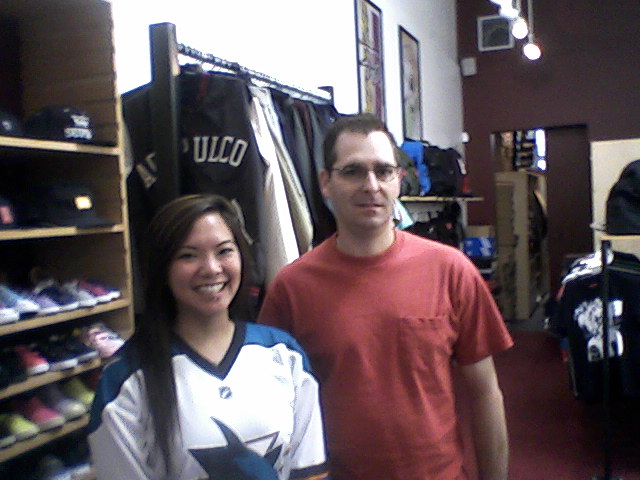
Aaron Biner and his assitant store manager Nes helped me find a pair of Clydes that make me look cool. Cool enough, as I noted in previous post “Shields and Yarn: a review of “Reality Hunger’ to crash the Picasso opening at the De Young severely under-dressed.
Nes says she also works for San Jose Giants in concessions. We agreed that the churros are top notch — something I recall from too long ago, but am relieved is still true.
(Note: I have to admit or reveal that they gave me $1o or ten percent off or so on my Puma’s. I don’t feel too bad in that it seems they had been sending various email and social media discounts and sales notifications to their prospective customers. Nes also shot a nice portrait of me in my “new shoes glee” look, using an instant camera that seems to be filling the void left by the demise of Poloroid).
edit to add, eight years and eight days later: Aaron moved his store to San Mateo. I rarely wear the black Pumas. I loved the Picasso show. Have not been back to San Jose Giants, nor had their churros again. But the big news: Aaron gifted me the autographed ball, and I added signatures by Mildred Howard, Marcus Shelby and then-mayor Sid Espinosa. I will try to swede that in.
Here I am reviewing David Shields “Reality Hunger” book of essays although I have not actually read the book. I spent five minutes sitting with it
at Books Inc at Town and Country in Palo Alto. Earlier today I heard David Shields being interviewed by Sedge Thomson for West Coast Live, for about twenty minutes. I did not buy the book at either of those two commercial opportunities owing to the fact that I have 75 books (mostly procurements, some like a “Rashomon” story collection by Akutagawa I grabbed impulsively from a display at the Palo Alto Main Library yesterday, on loan that is) stacked on top of the “new arrivals” bookshelf in my humble abode, plus another 20 or so on the floor nearby (that bookcase itself, on three shelves, probably has 150 new books, plus another 500 or so in the room, on two other cases, plus some in storage; not a huge collection, but considerable, owing to my quasi-nomadic nature: I am a renter, and I’ve de-accessed some of my books, over the years) . The Shields book is only $15.00, out on Vintage paper since February, so normally I would take the plunge. I am like a squirrel stocking nuts for the winter; or, I am rather nuts for books, magazines and news clippings, if that is the etymology.
I spoke to David Shields briefly after the show; I spoke to the subject of buying the book then and there but instead asked him to sign my program from the event. He actually wrote “My signature on a very short book.”
I asked him about his comments in support of the work of Christian Marclay, a recent work “The Clock.” He said he liked it better than the much-lauded “The King’s Speech”, for which, he said, for example, that Colin Firth “phoned in” his performance — this Shields, if not jaded, is tough to impress. It reminded me, enough to mention, of something I thought I had read reference to, which I believed to be a film by Douglas Gordon called “Deja vu” which I also think of, thanks to an article in 2006 Artforum by Michael Fried, as a re-pasting or re-mounting of the film noir chestnut “DOA” (1950, by Rudolph Mate, I had seen recently at Stanford Theater).
Actually although I could not find it skimming the back issue of Artforum, the search engines easily point me to what I really must have been thinking*, and more on point, Gordon’s 24 hour version of “Psycho“. It seems to pre-date Marclay and influence his clock.
Shields book seems to be about the nature of truth and reality, about the little lies, biases and distortions inherent in everything. He also is saying something related about copyright and originality. (And I just stuck a dollar into a box to buy a USA Today that had a picture of Obama they credited as “influenced by a poster by Shepard Fairey” — referencing the land-mark or quite notable “fair use” case).
In our brief but promising conversation, I was more certain, and related such, that what I was thinking of was by the filmmaker in some circles perhaps better known for the 2006 film called “Zidane: a 21st Century Portrait,” which, I was also rather certain, enough to mention, features music by the rock band Mogwai. (It uses 17 syncronized cameras to tell the story of one UEFA soccer match, or at least the great French-Algerian player’s role in such; by Gordon and Philippe Parreno). Shields took note; he said he likes soccer. (But I also noted, later, that his credits include a book on Ichiro; even better). I am meaning to follow up and send him the precise links.
“Reality Hunger” is a self-described manifesto consisting of 618 short treatises, loosely organized under 24 (i.e. A to Z) headings, that also feature sub-heads (not corresponding to the letter; not sure what they mean) such as “hip hop”. There is also, pages 210 thru 227, if memory serves, an appendix that serves as source notes to the passages. But it also has instructions, which Sedge and David noted on air, that David would prefer if people in possession of the book (probably more book buyers than local librarians) cut out that section with a scissors.
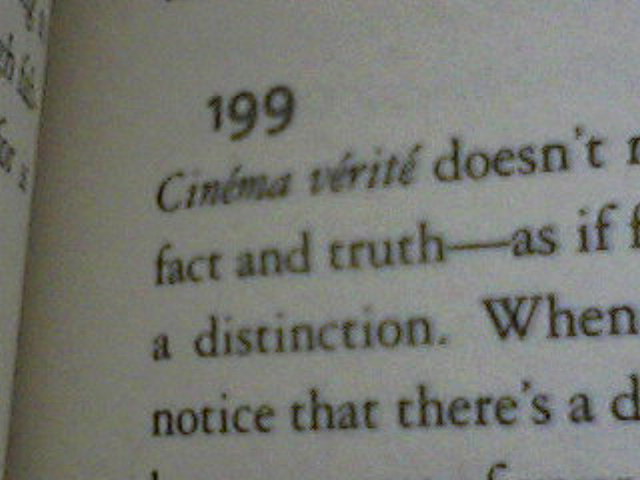
I skimmed to find Werner Herzog’s name in appendix then backtracked to read a short treatise (maybe #199) about cinema verite and documentary. Herzog blurs the distinction between truth and fiction, it would seem. According to Shields. Or Herzog himself.
cinema verite doesn't blank fact and truth as if a distinction says shields
I found myself inspired during Shields talk with Thomson. Something about Kafka and the Jewish community. He seems to be on to something (as opposed to merely on something) about modernism, post-modernism et al. I was a bit upset with myself for having temporarilty miffed Mike Park with a recent mock-interview for another site but then felt better after hearing Shields describe his take of the new terrain caused by modernism, new media and the chaotic nature of things. Also, I noted that naturalist writer Amy Stewart said a similarly thing, when she came on after Shields, about how his comments had affected her.
Good poets borrow. Great poets steal. At least according to either or Elliot, Picasso or Shields.
He also gave an example of Shakespeare’s King Henry histories being comprised of some 6,000 lines of which some 4,000, he said, were lifted directly from Holinshead’s Chronicles. (It reminds me that, in 1983, I wrote a paper for James Shapiro‘s freshman seminar about Marlowe’s “Edward II”. Because Dartmouth had two different editions of this famous history book, about twenty years apart if memory serves(1577 and 1587), I noticed by comparing them discrepancies and something I termed “an obscure Latin riddle” that spoke to the subject of the King’s shall we say, pecularities, by digressing into Latin, from English, but then was omitted entirely in the next edition. Man, I digress. 28 years, even).
Speaking of Picasso, above, Terry and I snuck into the preview for Picasso at DeYoung and she had a two word review at least of the cocktail party: Botox (for the ladies, although she also noted four or five pairs of cool shoes); Bow-ties (for the men, although I also stopped a man and called attention to his Rodin “thinker” tie, the long kind, you know Windsor knot and all that, although I was slightly under-dressed with an open shirt, cotton slacks and the black Clyde Puma’s I had bought recently and meant to blog about from Aaron Biner’s store). Terry called me from work — I am actually at her computer — after I wrote the first draft of this to implore me to mention she is “bullish” on the show itself.
I played a mnemonic game and forced myself, while watching the end of the Giants win, to try to recall these 18 pieces, of the 150 in the show, all from Picasso Museum of Paris:
1. cat eating bird (easy, because I bought a $1 post card)
2. bust of woman (near painting of couples on a beach)
3. couples on a beach (near #2 above)
4. sculpture at end of show that is like bent cardboard but is actually sheet metal (two, actually).
5. Musician seated with guitar (at first I was looking for a matador).
6. Matador (later in show).
I was thinking of Death of The Toreador, 1933
7. Dora Maar (quite colorful, but is it the won I saw in a different catalog that has one green and one red eye; I bought the Chronicle today specifically for the preview, which has this image).
8. self-portrait that I thought at first might be Paul Robeson.
9. some couple (probably he and a wife but I thought of Diego and Frida).
10. Firing squad a al Guernica. (we had heard Sy Musakers account on NPR on the way in, although I thought he said there was a whole room of Guernica and Franco related material; I seemed to note, and I admit I was in kind of a hurry, to get to the party, that the Guernica room seemed split with a collection of animals — although clearly even I get that the Cat and Bird refers to Franco and a dove of peace).
11. pregnant woman sculpture hanging in pieces on a wall.
12. Large bronze of Picasso and either a goat or a sheep — and I wondered if I saw same or similar piece in a book Terry has about his dog.
13. drawing of man and sheep.
14. horse or cow heads, bronze.
15. wooden, African-inspired, carving of human figure
16. metal Calder-esque maquette of a monuent.
17. stage near end of six or seven anthropomorphic figures
18. etude or study or half-finished salmon and robin colored dancers? Ok, so I am no Peter Selz, but I did vow to return to the show to take a better look. It would be a goal of mine to see the show on successive visits such that I can someday recall, say, 40 of the 150 works. (I had a similar goal for the remounting of the Cantor second floor, Oliveira et al, to list some of the works from memory).
These two experiences, the Shields book briefly mentioning something attributed to Picasso and the Picasso show at De Young, going to the opening party, also make me want to read NY Times I clipped about Woody Allen movie (includes a Picasso character and maybe a copy of Picasso’s portrait of Gertrue Stein).
Shields and Yarnell were a comedy team from the seventies, of mime. Researching that point it seems that Lorene Yarnell had recently passed away, in July 2010, at age 66.
It was my first time seeing an event at the JCC in Palo Alto although I had toured the facility.
Besides Shields, I got autographs (I like the ritual of asking, post-event) of Thomson, Cassie Gay (box office stalwart), Stewart, author Thor Hansen (who drew a feather) and producer Kathi Kamen Goldmark who I had met years earlier when she was a driver or escort for authors and also says she still plays in a rock band mostly covers (she steals material from songwriters rather than bothering to write her own material, which I mean to talk to her about, to suggest they try to write their own stuff) called The Rock Bottom Remainders. I asked if she has played the music festival SXSW and she said no only book festivals.
Sedge Thomsom and director Ron Childress during broadcast of WCL from Palo Alto
I also liked the music guest Go Van Gogh featuring husband and wife (or I am surmising) Jesse Walkershaw on bass and Connie Walkershaw on reeds — she did a solo with tenor and soprano saxes ala Rahsaan Roland Kirk — for a minute I was thinking more like Steve Lacy and Irene Aebi
I said hello and spoke briefly with my grammar school and high school classmate Sylvia Brownrigg (although we deduced that we only were classmates 5th, 6th, 11th and 12th grades).
*I keep thinking “David Brooks” for “David Shields”; Brooks was on Charlie Rose the other night talking about neuroscience and our unconscious.
edit to add, July 29: I’ve been to the Picasso show now three times and can recall about 100 pieces now…Not that mere recall is the same as appreciation or getting it, but it’s a start…also, I was pleased to hear that the painter Altoon Sultan read this post, although she thought it odd that I haven’t read the book (Shields) beyond that one page…she is right. I will return to Books Inc and read another page!!! Also, I thought of this essay, indirectly, when I met Palo Alto Film Festival’s Alexandra Ippolite, who, like myself, was speaking out about The Varsity Theatre initiative. I was trying to describe “24-hour ‘Psycho'”.
edit to add, Aug. 11, 2011: in a stylistic and philosophical nod to David Shields, I quote unattributed from Langston Hughes (who I do mention in my first graph) at the end of my preview of SFMT’s “2012” and I come see his muddy bosom in the golden sunset, for Palo Alto Patch. I think of fiction, nonfiction, poetry, drama and all forms of storytelling as existing on a rather wide continuum, at one end fantasy (J.R.R. Tolkien and the like) and at the other end are an extremely literal-minded register of life, such as a guy in Eastern Washington, named, as fate would have it, Shields, who until his recent death had kept the longest or longest-running diary, endless accounts of everything he did all day. An awful lot.
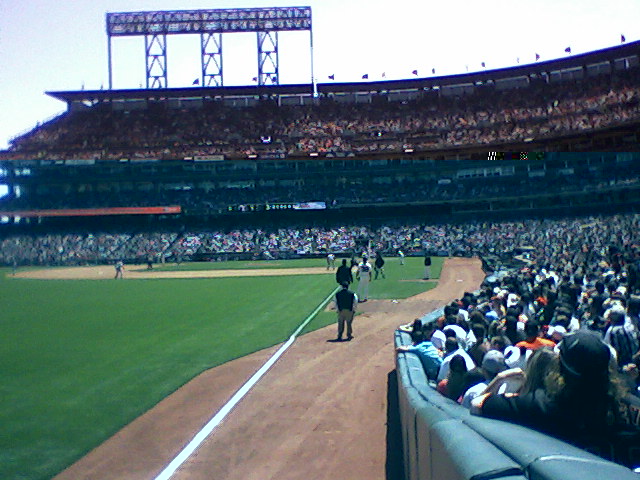
Giants game no. 27, Wednesday afternoon June 8, 2011 from LB135 R12 S11
I caught the ninth inning of today’s 3-1 Giants win over Washington Nationals and snapped this picture of Brian Wilson warming up, from Anne Jensen’s excellent seats right outside the left field foul pole. She worked at Terman Middle School when I was a student there and was a fixture at Palo Alto youth athletic events, usually in the ticket office, for many of the ensuing years. I ran into her on the train and we spent a good amount of time telling stories about famous Palo Alto youth athletic exploits spanning four decades and as many as three generations. Our Caltrain was delayed for two hours so we missed the first 8 innings of play.
Meanwhile, I also noted that Brian Wilson was described by Scott Ostler of the Chron as a harmonica player who joined coach Tim Flannery at a gig at the Irish Cultural Center. I would like to hear, as I alluded in a previous post, his version of “Help Me Rhonda.” (Meanwhile, for actual baseball fans who find themselves here, Matt Cain was the actual hero and got a complete game win, with 9 or 10 Ks. But I doubt I was the only person on this otherwise perfect –minus the Caltrain tragedy — the announcer said “there was a trespasser…struck by the train” — baseball day to enjoy watching Wilson merely warm up. Actually, Cain had 11 strikeouts).
I feel a little like Mark Twain in this passing reference to the day’s main event. Huck is late to see Aunt Sally because a steam ship engine explodes. She says “Good gracious, anybody hurt?” and young Huck replies “No’m. Killed a n—– .” I hope to not learn any more about what actually happened today in Burlingame but certainly my enjoyment of the day was tempered by thoughts about what some of my one million Bay Area brothers and sisters must be feeling. I don’t recall if it was before or after the incident that in Anne and my conversation the recent Palo Alto suicides came up. Overall we probably mentioned 100 names of whom a dozen or so are no longer among us, for instance, the man who founded Winter Lodge (although I didn’t refer to him by name) or the former Gunn and Cubberley teacher who also frequented in recent years Printers’ Ink. I also spoke to about 10 strangers, mostly baseball small talk, for what that’s worth.
It’s not a great picture but if you look carefully at it you can see more joy than pain, certainly, more order than chaos.
Robert Dawson photo from his book on San Jose water treatment
When Robert Dawson spoke at the Palo Alto Art Center a few months ago I was seized by the idea of producing a concert at the San Jose Waste Water Treatment center in honor of his excellent work there; but the trick or the twist is that I want to bring an obscure, not quite active, geographically-undesirable band, based almost entirely on their name, the Twin Cities’ Bring That Shit. (Someone else, concert promoter Eric Fanali actually, suggested Okkervil River instead).
The twin of this idea would be to bring Harriet Tubman (featuring Melvin Gibbs, Ron Miles and DJ Logic) to Lytton Plaza in Palo Alto regarding High Speed Rail proposal; I am specifically reacting to the racist counterproposal in terms of signs going up on the corridor that, as Ray Bacchetti points out, seem to mock our segregationist past, that people like he still remember (it was before my time, although I am from the South Side of Chicago). The signs say “THERE GOES THE NEIGHBORHOOD”. I want to make and offer counter-signs (or counter-offers?) that feature a likeness of freedom activist Harriet Tubman and the words “UNDERGROUND RAILROAD” (some people prefer that if there is a High Speed Rail it goes under the ground rather than over our heads, if the reference just did).
I cannot resist a quick post about The Baseball Project, featuring Steve Wynn and Peter Buck, performing last night at the Cubby Bear in Chicago. I believe the first line of above song references the day that Campy Campaneris played all nine positions for the Oakland A’s.
Also, Eric Cohen alerted me to what I thought was a pretty mediocre rundown of 50 baseball logos. I replied to him that I gave away about 500 shirts for “The Cubberley Sessions” featuring what I always have assumed to be an unofficial Cubs logo from a 1911 T205 “Gold Border” baseball tobacco card (mine was a Mordecai Brown, before the burglary). Jamie Stewart of Xiu Xiu (IBOPA at the time) dubbed the character the obvious moniker “Cubby the Cub Bear”. The shirts were printed at the uberhip print shop in Oakland.
My shirts have basically all worn through. Their highest moment was when Mac MacCaughan of Superchunk wore his on stage at Great American, in 1999 or so (which is like Kurt Cobain wearing a Frigthtwig shirt on “MTV Unplugged”, in more ways than one).
I mention The Baseball Project in reference to my proposal that there be a compilation of NorCal and Texas songwriters in honor of the 2010 World Series, Giants w. Rangers. Or as Yogi might say, it ain’t over till its over.
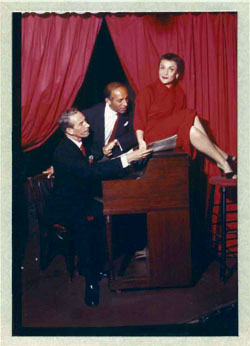
Publicity still from 2010 Terry Abrahamson and David Kaplan production "Jazz Funeral for Stella Brooks" or is that actually Stella?
I have been corresponding with Chicag0-based writer Terry Abrahamson about sundry topics not limited to his recently produced tribute to Stella Brooks, which debuted last year at the Provincetown Tennessee Williams theater festival.
Stella was a jazz singer in the 1940s who cut a side with Moe Asch for Folkways (now Smithsonian Folkways, as in it’s in the Smithsonian) and enjoyed a time in the lime light before returning to her native San Francisco for a long, slow, apparently often difficult decline.
When I saw her obituary in the Chronicle, in 2002, which included an appeal for remembrances, I contacted her Stella’s niece Deb Wright in Santa Rosa and was eventually contracted to represent Stella posthumously in terms of working on her legacy. I felt there was something sad about her not being more well-known. Perhaps there is something in Stella’s story that would inspire today’s singers; maybe its a cautionary tale about the fickle and fleeting nature of fame. My basic strategy was to talk up Stella among today’s jazz aficionados; I think there would be a market to reissue her songs along with an updated booklet that tells the rest of her story. There’s something very San Francisco about her.
Eugene Chadbourne wrote a nice entry about her for All Music.
There’s a bit at Bread and Roses website about Stella’s twilight years, at the Jewish Home for the Aged in SF, and meeting Wesla Whitfield.
There used to be a citation linking her to Bobby Short.
She is in the movie about San Francisco’s Hungry I cafe.
Apparently she was the body double for the sculptural bust used in “Sandpiper” the Elizabeth Taylor movie. I picked up a book about the Big Sur artist who created the bust.
Not to take too much credit for such a tiny role — and I admit that is often my weakness, simultaneously denying causality in the zeitgeist but mentioning which random occurences I may have observed if not influenced — but I did put Tennessee Williams expert David Kaplan in touch with Deb Wright at the inception of what became “Jazz Funeral for Stella Brooks” after his research put him across my limited trail.
Kay Kostopolous and I briefly schemed or dreamed of producing a performance piece about Stella — with Kay, of Black Olive Jazz and Stanford theater fame — as Stella. It might utilize her songbook (“I’ll Never Be the Same”, “I’m a Little Piece of Leather”, “Ballin the Jack”) and excerpts from both the SF Chronicle coverage (by socialite reporter Blake Green) and Stella’s letters, which Deb shared with us one afternoon.
There’s also a letter of endorsement from Woody Guthrie — like Stella, a Folkways act, and apparently her pal — that changed hands among document collectors recently, that puts her work in context, I think.
I was imagining that a collection of Stella’s songs could be used to raise money or awareness for causes of interest to her or her followers, like social services. Maybe it could be a small fund at Bread and Roses or Bill Graham Foundation, for artists needs or health care, or just to lobby for universal care for musicans (or for all of us, for that matter).
I thought of Imperial Teen and Jone Stebbins, another SF legend singer and haircutter (Stella’s post-limelight career). Come to think of it, the lyrics to “Yoo Hoo” could somehow reference, or be sung in tribute, to Stella: “back to Beatnick/ I want partner/A big shot Rock Star”. Stella was sort of the missing link between Billie Holliday and Courtney Love. She yoo hoo’d, surely. Or to paraphrase Tom Robbins, it’s never too late to have a happy afterlife.
edit to add, a New Year, 2012: we also put up this social media page for Stella Brooks:
I ran into Addi Somekh the Balloon Bass guy, at Peet’s in Menlo Park and traded stories about the life. In the biz. On Plastic Alto. Discovery Channel. KFJC. All that.
addi sans balloon hat
Here he is in the Big Apple with his fellow UCSC grad, the drummer Kenny Wolleson (and notice, if you click through or watch this on Youtube, it suggests going from Addi Somekh to Bill Frisell):
Actually, not sure if he is Balloon Hat guy or Balloon Bass guy: he traveled the world and made balloon hats for people in 38 countries, giving away, believe it or not, 200,000 balloons. I could file this under “Vietnam” for instance.
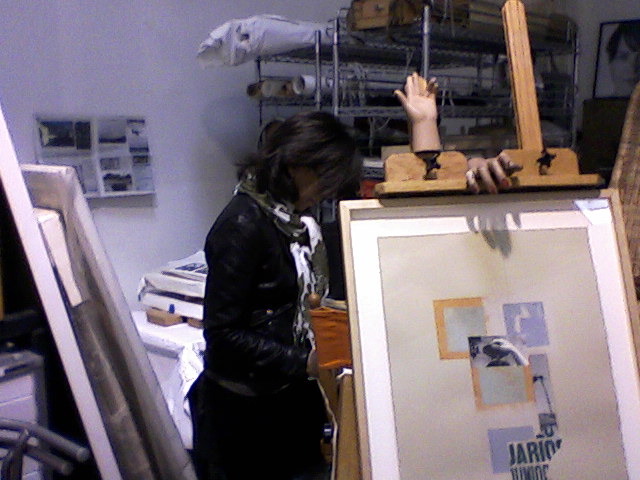
Terry Acebo Davis has been too committed to her role as chair of the Palo Alto Public Arts Commission to make a trove of new work, but I cajoled her into showing one piece at her studio, at 4030 Transport (near San Antonio) in Palo Alto, which we turned into an installation, with the doll hands and the French easle. Studio-mate Cherisse Thompson noted a couple nibbles of interest but no Jonah-and-the-Whale gulp, nor even a Matthew Barney circa 2006 fake ambergris flow of support. Yet as her collector I find these pictures worth 132 words.
Radius artist Terry Acebo Davis of Palo Alto
Terry Davis plus her work plus her studio equal installation
Daniel H. Pink, “Drive: the Surprising Truth About What Motivates Us,”, 2009, Penguin, New York and London, took me about four months to open and amused me for about an hour. Two hours if you add this exercise. The book was a gift from my brother, for my birthday. Maybe it was his not so subtle way of telling me he thinks I am an under-achiever. Maybe he is projecting his own dissatisfaction as a Silicon Valley salaryman. (He seemed bent out of shape to hear and repeat the report of a high school classmate of his whom he was told pulled down $16 million on Wall Street one year; I in contrast thought about how to hit up said stud for a philanthropic project I was spear-heading; okay, I’m a little jealous too, and maybe constantly rationalizing).
Here are my notes on “Drive.” My list of somewhat promising (but ultimately disappointing, by a tally of 3 to 11 against) biographical citations in the index.
1. Peter Drucker, p. 197, something about “knowledge workers” and “self-management”; coincidentally, I met a guy recently who claimed albeit reluctantly to be Drucker’s son and had a keen interest in San Ildefonso pottery, circa 1910.
2. Julius Erving, p. 125. A quote in relation to Army studies on “grit” and persistence and discipline as predictors of success;
3. David Halberstam, especially “The Amateurs…” regarding 1984 Olympic rowers, training at Princeton; reminds me that my brother and I both read “The Shell Game” and that I was pleasantly surprised to learn that George Jenkins, brother of rock star Steve Jenkins, like myself and my brother all Gunn grads, has been coaching collegiate crew for many years, notably at USC, UC Davis, Kansas and Texas;
4. Brian Eno, p. 158, regarding “Oblique Strategies” and the set of 100 cards for such, that one can order from him, devised by Eno and Peter Schmidt, in 1975. “Oblique strategies” is practically my middle name.
5. Robert B. Reich, p. 121 — actually three references, which I broke up into seperate entries rather than reading serially;
6. Fritz Scholder, p. 119, “walking the tightrope of accident and discipline.”
Scholder, “Zia” from El Paso show, circa 1976
7. Reich, p. 139, on “the pronoun test”: do people refer to their work and organization with “we” or “they”?
8. Mark Twain, “The Adventures of Tom Sawyer”, pp. 36-37, refers to “Aunt Polly’s 810 square feet of fence” to whitewash: I was surprised by the quantitative detail. They, people like Pink I mean, refer to a Sawyer Effect of trying to turn work into play and vice versa.
9. Malcolm Gladwell, “Outliers…”; p. 190. Have not read but feel I have, by osmosis.
10. Reich, pp. 166-167, pronoun test again. (I struck through in my original notes.
11. Mark Twain, p. 211, more on Sawyer Effect.
12. Paul Cezanne, pp. 126-127: did his best paintings late in life; cf. a David Galenson, economist, University of Chicago (my Dad’s alma mater, BTW, and that of my Pop-Pop and namesake) studies the careers of artists; I recall another cite I am meaning to track down of a Princeton prof mentioned or quoted in New York Times — finally something I may be able to use, in comparing actual social scientists’ work, albeit from the Ivory Tower, to my own observations about the careers and satisfaction of artists. This section made me think of Steve Lacy, for his continual adaptation and growth over a long music career.
13. it takes a certain amount of discipline to learn to spell Mihaly Csikszentmihalyi, severally, especially re “Flow” pp., 186-187; I wrote “stretched to limits” as in an important part of the process.
I also, diverting from my plan, noted Peter Senge, p. 194 quote “approached life as an artist would approach a work of art” and the phrase “take a Sagmeister” refering to the practice of taking five sabbaticals mid-career instead of retiring at an early age. I have taken about twenty Sagmeisters in a row at this point, thank you.
Pink’s main conceit is something about “Type I” personalities (for “intrinsic motivation”, versus “Type X” for “external” — it all sounds too much like Binet — I wish he had looked into Alecia Moore, Dr. Dre and Linda Perry, really).
Speaking of math (Pink, me) he reminds us that an asymptote is something we don’t quite reach, like a limit, but in his case he means that some people continually strive for improvement as opposed to resting on laurels or plateuing or reaching their goals. In the case of my brother, it also makes me think about how he does not like to hug anybody.
Now I also wonder if he paid $26.95 for this book, or got it cheaper. If he had waited until today (or until reaching the asymptote, even better), he could get it at leading online bookseller in paper (since April) for less than ten bucks. I note that 200 people have reviewed it there; and that RSA has a video derivative seen by 5 million people and commented on 3,500 times. Actually, not sure I had heard of RSA until just now. But willing to plug it probationarily.
It would probably take me more than 20 hours to actually read this more closely, but I would rather put the energy into the other 100 or so titles I’ve procured lately including (and these are the ones piled above) Al Young, “Kind of Blue”; William Davidow, “Overconnected”; Tim O’Brien, “Things They Carried”; Louise Erdrich, “Books and Islands”, a work of non-fiction; a biography of Martin Luther King I found in window of Red Hill Books in SF by M. Frady; Ray Bradbury collection of stories lent me by my sister’s boyfriend called (the book, not the friend) “Cat’s Pajamas”; Rebecca Solnit “Infinite City”; Sun Ra “Pathways..” edited by John Corbett; Elif Batuman, “Possessed…” (actually, I will have to return and ETA the full title especially since when I found this book and author, thanks to a review in the Stanford Daily, drifting like a tumbleweed across campus, the title was mis-spelled, or miss-edited — it was spell-checked wrongly); Patty Smith, “Just Friends” — which reminds me that I grabbed a pretty mediocre or perhaps laughably bad Taj Mahal cd from the library, on Grammavision from 1986 solely on the basis of the Mapplethorpe cover art — too much trendy at the time synth; William T. Vollman, “Ice Shirt”, for my ongoing dialogue with the local Nordic couple; Wes Stace, “By George” and “Charles Jessman Considered as A Murderer”; and lastly, here at least, (and on my way to stall my coughing by heading to the bubbler here at Palo Alto Library, and it’s two-hours of free computing time, I snagged David Byrne “Bicycle Diaries”) “No Exit” by Sartre, but I am afraid it is not the Paul Bowles translation I saw reference to.
Not necessarily as a Nick Hornby reference but I buy maybe 50 books a year and read a couple hours worth from each rather than doing fewer books cover-to-cover. I go through phases at the library where I grab something that is on display or a new arrival, check it out, maybe flip through it or sit with it for an hour, keep it until it is overdue, then reluctantly feed it back to the machine — I am happy with the fines.
The W.H. Auden quote was worth spending another half-minute on. “how beautiful it is/ that eye-on-the-object look” from “Sext”, 1955/
I am worse with my music in-box. Three songs, first 90 seconds each, then on to the next.
edit to add, three years later: have not cracked the book, by Daniel Pink, but I got admitted to a private function at, at all places, Palantir, who I call “Palo Alto’s hipster spooks”, and advancing that, found this photo of Pink, who gave a lecture to them:
pink at palantir
I could probably update this with ideas about the various books I have presumably, made progress with. In terms of my technique or bad habit of making everything a “shaggy dog” story, Webster’s tells me this practice, or term, started in about 1946 although another source said to check Mark Twain, not TS, but “Roughing It” for earlier examples of the genre. I know I read RI as undergrad and not sure if I still have the actual text. But a writer who wants to “drive” to improve his or herself, or her craft, might want to read and re-read Twain. My prof, James Melville Cox, suggested underlining the parts that make you laugh.
Bailiwick Theater in Chicago presents “Passing Strange” starring JC Brooks of JC Brooks and the Uptown Sound as the Narrator (Stew’s role). Hedy Weiss, no relation, but I did leave her a voice mail regarding Dao Strom at Uncommon Ground when I was last in the Windy City, gives it props.












 Plastic Alto with Mark Weiss