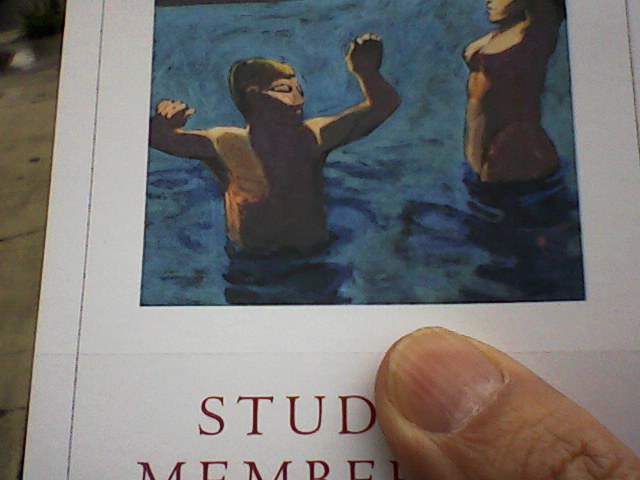
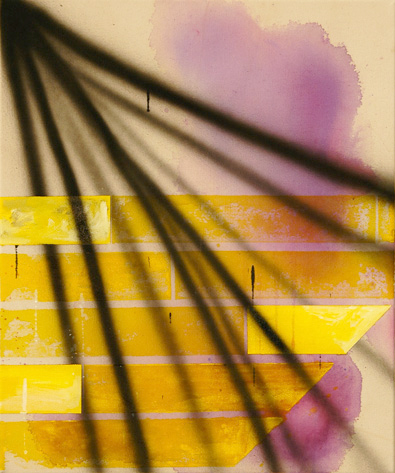
Agreeing to a green.
I used to know what this means.
edit to add, two years later, March, 2013:
My Parents Went to the Promised Land And All I Got Was This Amazing Dreamcoat, 94304; or, Why Magritte Didn’t Open a Smokeshop
Cause I have other things to fill my time/
You take what is yours and I’ll take mine
There are two common misconceptions about Samuel Yates’ “The Color of Palo Alto“: one, that the work consists of a treatment to 250 Hamilton, City Hall, Palo Alto, that was up for a matter of six months or so and then removed, that tinted the building or its windows roughly blue or green, wherein with your binoculars or theirs you could make out the shape or character of your actual abode or anybody’s, confirming the piece works, finding yourself among the 17,000 or so “others” or “neighbors”; or two, that the piece was a funky garage or office or structure or container that had landed in a planter in front of City Hall, fifty feet and a couple years in front of Mildred Howard’s “Clear Story”, that someone, the artist, Sam, lived in, worked in or parked his scooter in or near, or maybe was imprisoned there, like a high tech and modern age, yet uber-hip stockade. As either 1) the wrap or 2) the garage “The Color of Palo Alto” by Samuel Yates -abridged would have made a pretty good public art piece, good for a chuckle or two or food for thought about various and sundry issues and concepts, like the green power aspects. But I say “misconception” in that it would be an extreme reduction, a crime really, to think of the piece merely in these terms. like an “Allegory of the Cave” situation. To my mind, at the time and now inspired to rethink my relationship to the piece, my role, my small part, my 421 of 17,000 role or what not, the heart of the matter, what I thought my 17 cents were paying for, what made me smile most was the thought of poor Sam (as compared to Poor Tom’s a-cold, or Poor old Jim, from Shakespeare or Mark Twain, or Sisyphus, ) on his scooter back and forth up Addison and down Alma, or what not, shooting 50 houses per day, every day, for a year, his process. This is or was (I think it still is, right? COPA lives!, right? Our cup still runneth? ) a process piece, a conceptual piece, a performance even, and a good story, a yarn. But was I being cruel to think of Sam Yates as our arts prisoner, or arts martyr, with a mythic type of labor? (I knew meanwhile, or observed, that he was brilliant and charming and full of life; he’s actually from Sacramento, went to Berkeley for his undergraduate degree and Columbia for an MFA; he’s among the best and brightest surely).
From a pure real estate photography perspective, I calculated recently, that we could have or still could hire, for example a guy named Justin Adams in San Jose who presumably would shoot 421 Pepper, or 820 Chimalus or 1788 Oak Creek Drive, for $140 each and maybe cut us a deal to do all 17,000 parcels for about $2 million (compared to Sam’s $15,000 stipend) and would be that much more professional, we presume.
I remember meeting Sam in front of his garage — our garage — and saying something pseudo-knowing and enthusiastic about his piece, and its implications, and what it reminded me of and then being blown back by his further explication and things I couldn’t quite grasp in real time, like when you are traveling in a foreign country and use a few words of the local language and then get a rapid response that you can’t quite follow, from the locals.
I got to know him a little bit during the project’s more active phase and drove him to the airport for example early one morning; he also was kind enough in more recent times to respond by text to a couple of my random messages and brainstorms: about wrapping Palo Alto in “red tape” ala Christo; about turning our $500 million infrastructure backlog into a public art opportunity – can we somehow thematically link or colorize all the potholes we may fill? I also just yesterday had the idea for a counter-project, a derivative event: “Discolor of Palo Alto.” I’m tempted to reimburse or compensate any Palo Altan who would meet me and, well okay, here is what I texted Sam, at 2:51 on March 3, 2013: With your permission, I’d like to start a project called “The Discolor of Palo Alto” in which citizens can sign an affidavit that they don’t understand Duchamp, Lewitt AND Yates in which case I will personally compensate them the 25 cents per capita given SY here. Ok? Mark Weiss. Within a minute (despite being described in local and recent media coverage as being hard to reach and unresponsive) he wrote back: Hahaha!!! I started thinking I could recall Victor Frost by setting up a booth in front of Whole Foods or Piazza’s with a sign saying “25 cents” — I would be handing out quarters not panhandling, however. (Sam later wrote back to say that “Discolor of Palo Alto” was a bad idea…Agreed).
Certainly there is no disputing matters of taste (De gustibus non est disputandem) but my concern is that beyond the issue of whether or not Palo Altans or art lovers ever figure out or learn to appreciate this one piece, or this one artist, that there seems to be some sort of concerted effort by the bureaucrats or the plutocrats or the oligarchs here to undermine most modern art, conceptual art — ANYTHING, BY EXTENSION, THAT FORCES OR INDUCES OR INSPIRES THE AVERAGE PERSON TO THINK, OR DREAM OR IMAGINE — our public art commission or the public sector — Democracy even — altogether. My concern for Samuel Yates — like my concern expressed previously and above for Bruce Beasley, Mohammed Soummah, Joan Zalenski — is related to my concern that “neoliberals” — the people who apparently believe Democracy should be reformed by giving more power to Corporations, privatizing public assets, smashing unions — are selling the farm. Further, when new mayor Greg Scharff states that he wants to expand “percent for art” programs to include private sector development, I don’t believe he is being sincere; I think it is some sort of trick or tactic to confuse activists and residentialists, to give developers another card — like pc planned community zoning — in their hand, and not in ours.
I was reassured to find sympathetic and thoughtful or at least not mindless condemnations of Yates COPA in the New York Times and KQED. Refusalon Gallery’s archive also links to a favorable contemporaneous writeup in Dwell.
Today I took an hour out of my work day (actually, out of my sabbatical and stay-cation) to try to organize my thoughts on this matter; I am sitting in Peet’s at Charleston Center, where David from Harold Ray Live in Concert (on Alternative Tentacles) made me a mean or a mean of means mocha, tapping away on TAD’s laptop, wearing, for the occasion: blue Keen sandals (in March, 58 degrees F) some overly fancy and ultra-nerdy in this case non-sartorial designer striped green dress socks (two shades of green, plus a beige, from Heimie’s of St. Paul, where on the weekend of my young cousin’s Bat Mitzvah my Dad bought my brother and I jackets, as well; my cousin, who got her middle school to celebrate a
Green Day, to wear green en masse; the story was told that a carpool driver the mom said “Annie, is this real or are you making this up” to which my cousin said “it is real AND i’m making it up”), Patagonia nylon shorts, a t-shirt, a black Arhoolie hoodie, a grey-blue retro Cubs cap and, getting to the point, and racing my wireless access curfew,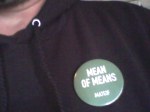 I am wearing a button, an official part of “The Color of Palo Alto” that is green with white lettering, that says, on front “MEAN OF MEANS #4A753F” (and on the verso “VOTE ONLINE BY 11/04/08 WWW.THECOLOROFPALO ALTO.ORG (C) 2001-2008). As such, I am part of “The Color of Palo Alto” or it is part of me, et cetera — I also, for good measure, scrutinized the illustration on his website to ascertain roughly, or relatively to the other 364 bits of info, what shade or blue/green/brown today is, in this language system or world.
I also wonder, as referenced above, if “The Color of Palo Alto” could be seen as a dance in that could a performer or agent or person retrace Yates path, in whole or more likely in part and call it some kind of a dance? With or without a camera, with or without any other dramatic or amusing Pina Bausch gestures or memes. I actually, come to think of it, had a project or moment, circa 2006 i.e. post-Yates-contact in which I would play “Palo Alto” by Lee Konitz in a loop and proceed to drive from park to park, from Bol Park to the Lawn Bowling Center, and photograph the parks or their new signs — not sure what I was thinking the effect would be, but it killed an hour and a roll of film — some of these are also mock-Muybridge gestures. Ben Marks in the piece linked to above suggested that another comparison for Yates is Ed Ruscha’s early work, a collection of photos of Sunset Strip.
Meanwhile and hopefully back on point I noticed that in front of the new high profile computer store on University not only has parking been eliminated but two large cement bollards are installed — I am guessing someone’s risk manager, ours or theirs, suggested it. That the bollards are painted an unusual grey — I am wondering if they can be given a public art make– (here another 12 minutes of writing and maybe 200 words and 20 ideas got lost when, indeed, the Peet’s curfew came and ate my words…I continued on to Palo Alto Main where they let me log in to their two-hour timeshare only after reminding me that I seem to owe bookoo bucks for a Flaco Jimenez cd that I thougth I had returned but might be lost in my home stacks; I know I even if gratuitously referenced Kathy Aoki and her trip to Belgium — Magritte is Belgian, if that is an excuse. I think of my blog posts as rough drafts in that they are so easily amendable and there is very modest readerships, hence the style experiments).
I was saying that we could paint the bollards in front of the high profile computer store –the former Liddicoats site for us original G Palo Altans — with a “color of Palo Alto” intentionality or at the very least can we put a marker or tag that describes that gray they used in terms of its Yatesian coordinates? Lo, beyond just a wrap or shed or product line, Sam created a virtual world, a real world of color and thought, not unlike, In terms of the Mumford and Sons video — gratuitous and a reach, but they say it is based on Plato and please do note the scooters. They are in Goa, India, by the way. The analogy to “Joseph and the Amazing Technicolor Dreamcoat” or Genesis “coat of many colors” is strained and underdeveloped but it is true I saw the show on Broadway in Fall, 1982 AND had already threw in the bit about Heimie’s of St. Paul.
Conclusion: Whether or not the art piece is useful as data base to public safety or the history association, and whether or not Yates does any more work on our behalf, we could start splashing his colors around, or describing things in the language he created. The piece is ongoing — maybe immortal and evergreen, even — and not merely current because some individuals or bureaucrats or pols who apparently stuck their “mean of means” badges in unfortunate places, it would seem and then started squawking. In a flurry of recent news articles it was learned a City staffer suggests withholding $7,000 she thinks we owe Yates until or unless he delivers the database extension (or is it merely a simulacrum, art imitating science or business or bureaucracy, like in “Brazil”) — maybe we are confusing this brouhaha with the state’s struggle to upgrade (to the tune of $200 million, clearly misspent) its DMV and payroll software. And aren’t we the people who gave Enron $20 million even after we knew they were crooks and bankrupt? Actually, if I can still trust the 2005 SF Chronicle, it turns out that the City of Palo Alto assistant attorney who said we should pay Enron rather than fight them is also the author of a demand letter sent to Yates last year. Way to chose your battles, dude! Actually the Chron helpfully (to my way of plastic thinking) offers that Grant Kolling when not kowtowing to corporations or hassling artists likes to ride motorcycles while humming “Born to Be Wild”. Maybe this whole ordeal could have been avoided if Sam had offered Grant a ride on his scooter?
Meta-note and gratuitous post-script factoid: the “47” referenced in the original headlines is purely random in that initially I was numbering my posts to “Plastic Alto”. This initially very brief entry, the photo and two lines (“agreeing to a green”, “I used to know what his means”) was my 47th post, that is — before that I used Roman numerals like does the Super Bowl; by the time I “edita”‘d with a more comprehensive discussion of Yates, I had already posted some 500 items here. I did note and briefly suss out the fact that yes 47 is a prime and learned for the moment at least that there are 47 Mersenne primes (something squared minus one). Also, feel free to skip the Chihuly items I added here for no reason months ago, below, in self-comments. (I was self-commenting before I learned to “edita” edit to add…)
edita, later that March, 2013 eve: I posted to the other leading source of local news and defamation:
Maybe rather than hassling or defaming the starving artist to get our $7,000-worth, we should claim that we and Samuel Yates invented what became “Google Street View” and dun that $270 Billion corporation for our fair share…The “neoliberal” mindset keeps saying government should act like a business but what they really do is kowtow to corporate power and treat the average citizens or Democratic ideals like so many little blots of ink or data points and blah blah blah blah blah
edit to add, March 6, 2013: I added another few words to Palo Alto Weekly site, and archived that here.
Six months after that, I recommended Sam Yates for an ambitious new media piece at City Hall:
For $850,000 we may be able to get Sam Yates. He’s good with new media; he’s good with new math. It would be fun to turn all 8 floors of 250 Hamilton into some type of temporary — for the next couple years at least — installation art with people pretending to push papers around and acting inscrutably — like something in a Tom Stoppard play or based on Guy DeBord — and then figure out a way to let certain well-connected or frankly desperate computer or social media firms put their twist on this and showcase their private enterprises and gadgets at our expense. Maybe some people will not even notice the difference, if it’s done well (and I mean very droll).
Or have we already been doing this?
edit to add, five years later, Monday, August 15, 2016, as Palo Alto will consider revisions to its art policy, and I am thinking about the Yates case, I found this I had posted on PAW:
Posted by Mark Weiss
a resident of Another Palo Alto neighborhood
on Apr 19, 2013 at 3:22 pm
If the color of Palo Alto is green, then the color of the Weekly is yellow, in that its coverage of Sam Yates and his public art project has been pretty shoddy, especially its Feb. 19 report.
If we indeed withheld $7,000 due him, we should be ashamed.
That we can’t force him to agree to our terms any faster in terms of the copyright of 22,000 pieces of his work, that’s understandable.
I doubt that Google has a free product that does what this does. I presume the people at City Hall who feel this information has value know what they are talking about.
But let’s keep in mind this is an art project, that has some value as data. If we had started with trying to come up with a data-base per se it probably would have cost us considerably more. A real estate photographer shooting all our houses, for instance, would probably cost more that a million dollars.
The staff report had errors of fact and cynical characterizations that were the nidus of this dispute. The two letters by members of the history associations likewise were wrong-headed and cynical; my understanding, for example, is that Steve Staiger of staff worked closely with Sam and does not agree with all the finger-pointing.
But that the Weekly is part of a professional field with standards, I find them culpable in their repeating of these arguably slanderous falsehoods, mostly in their previous reports.
For the record, Yates is a Berkeley grad from Sacramento and not a Canadian, as the reporter implies here. If he spoke to Yates at midnight or 1 a.m. last night, it is the first time he has done so, as I understand it, despite having written on this several times now. Sam’s cell number was published in the original documents if anyone had tried to call.
And to the posters who did not give permission for Yates to shoot their houses, I would say , yes, if he or the City started selling prints of their lovely abodes they would be entitled to a share of the revenue stream, as would their architects, probably. You could also of course put up a fence for more privacy, neighbor.
Sam Yates spent hundreds of hours on this art project; I find it amazing that people can think about it for ten minutes, dismiss it, complain and not realize how they look. Certainly we are all entitled to our values and tastes, of course.
I recommend going to a PAPAC meeting, watching it on tv or the archive, applying for the PAPAC, and working to bring even better public art, or to assert your tastes and values against the the rest of us — that’s positive. That’s civic engagement. That’s democracy. But to merely read the Weekly’s coverage and take (mostly anonymous) pot-shots is not adding much to our community.
But the most simple problem to fix in this instance is to ask the Weekly to do a better job.
Sam Yates thanks in his report hundreds of Palo Altans who supported and contributed to this art project; I presume most of them — and other supporters like myself — still believe in he and this project, despite the negativity, which is limited and largely unfounded.
I’d like to paint those bollards in front of the big computer store a different shade of grey or green, or label them in terms of the Yates nomenclature of COPA. There are lots of ways we can expand this project, in his spirit. If you think about it. And getting past this brouhaha.
I wrote further on this on my “Plastic Alto” blog, first in Dec. 2010 then more recently:
Web Link (to here)
Also: I have this idea of hiring Grant Kooling (sp), our city attorney, to ride his motorcyce retracing Sam Yates three-year trek, up and down every street and avenue in Palo Alto, in alphabetical order, while blaring “Born to be Wild” on his radio. As process art.








 Plastic Alto with Mark Weiss