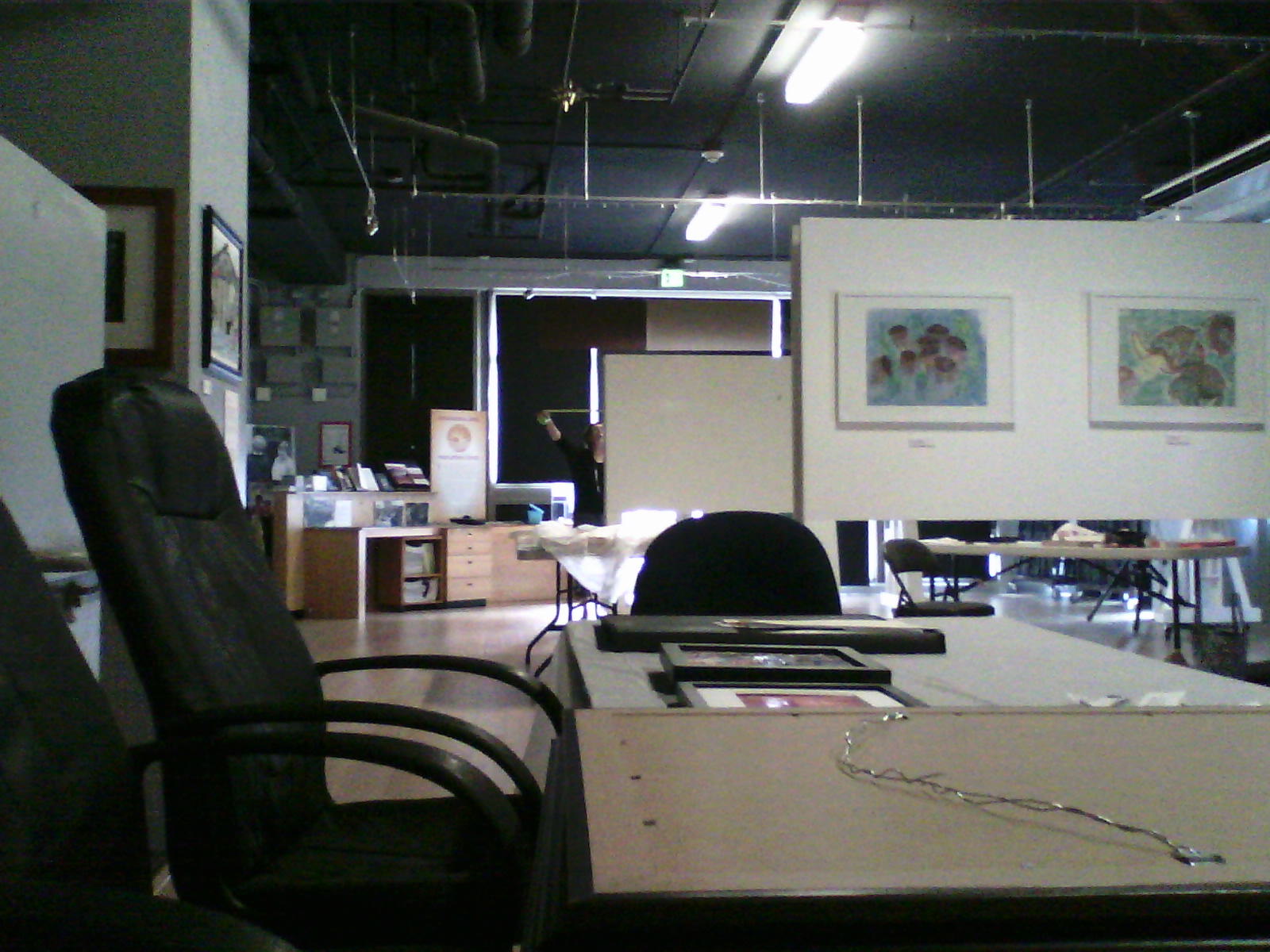
In the city in the gallery across the room with her arms spread, the artist
Terry Acebo Davis (sometimes known as Terry Acebo-Davis) installed five or her own works plus two by Minerva Amistoso at San Francisco’s historic I-Hotel Manilla-town, at Kearney and Jackson. I helped her load in and kept her company during her four hours there yesterday. Plus I was the driver (although it was her car TADART, not my little cheddar).
Last week we saw a film by Marissa Aroy there, The Delano Manongs. Terry is part of a group show that continues thru the summer, with special events and hopefully a closing reception. Terry is showing monotypes but since she re-arranged and re-hung the show it is like an installation of hers.
We had sesame chicken at Peter Fang’s House of Nanking, kitty-corner. I also had a bubble tea with almond from Quickly on the corner, to tide me over. I worked my way further into Salerno and Shields “Salinger” from Jean Miller to Cornish, to the Claremont Eagle publishing what he thought would be in the high school paper. I wondered if I never noticed J.D. Salinger at a Dartmouth basketball game, looking for zen.
Today, if I have my way, although I am actually acquiescing to her plan — that’s how relationships work — we are checking out SF ArtMarket (ARTMKT), maybe Paule Anglim (to see Clare Rojas and Ala Ektabar works), maybe Seussical at Palo Alto children’s theatre, and maybe Francis Ford Coppola’s Grand-daughters “Palo Alto” with James Franco.
I like the photo above because Terry, while measuring the walls, looks like, um, another icon.
WHY WAS HE BORN SO BEAUTIFUL…??? Today is Brian X. Gaul’s 50th birthday, which precipitated a flurry of text messages between us, and the near-chugging of a bottle of Guinness on my end, in his honor. “And you are making Dartmouth proud!” was prompted by something fairly sophomoric, thinking back to the 1980s. I was also thinking of the Wallace Stegner short story about two old college chums talking after a long while: “how’s the boy?” and all that. That’s a vague reference to “Beyond the Glass Mountain” a story by former neighbor wrote for Harper’s in 1947, before our time about college chums meeting up a mere 17 years later — I am excerpting some of it below, at the very bottom.
As my further gift to my old roomie and our Alma Mater, I am reprinting here, or recontextualizing two old posts into this one, which I am imagining I would send to a Dartmouth professor of studio art named Soo Sunny Park (whom I’ve never met or spoken to, but something sent me surfing towards a video of her recent work).
I am thinking she should produce a video installation, or an installation piece or performance piece based on the Rolling Stones song “She’s Like a Rainbow” which, as I understand it, is about Marlinda Fitzgerald coming to some party dressed in a wild get-up, covered with little mirrors, and a spotlight hitting her just so, refracting a bunch of rainbows, and the song is born, so to speak. That plus Dartmouth should underwrite my “Cherry Colgado Pie” concept; plus my little ditty about Thomas the guard being a frustrated artist, and his photo.
Recipe for Cherry Colgado Pie
1. While in Minneapolis, near or at the Walker Art Center and Walker Sculpture Garden, do not fail to notice the giant Cherry on a Spoon, by Claes Oldenburg. Take a picture, or get your hands on the brochure. (aku “Spoonbridge and Cherry 1985-1988″)
2. In Hanover New Hampshire, the Hood Museum at Dartmouth College has a sculptural piece by Juan Munoz (1953-2001) called “Hombre Colgado Pie (Man Hanging From His Foot, 2001)”. If the piece is not to be found on display, the little gift shop usually has a post card of this work.
3. In your mind, or with a scissors and paste, or some high falluting high tech thingamajig, juxtapose or put together as in a dream or a mash, these two concepts. Cherry plus colgado pie equals cherry colgado pie.
4. Serves one to six billion. Store the rest in a container, well-chilled for future use, reissue, a caprice.
5. For a little more spice, listen to “Symphony for improvisers” while you work, or certain hockey broadcasts, BUT NOT BOTH. See also.
Note may also be served with couscous van bruggen
A two-hundred-foot-tall anthropomorphic being
I shot this photo and am bequeathing it to Dartmouth in honor of Brian X. Gaul ’86, signed his roommate Mark B. Weiss ’86
descended on LACMA recently and examined the nut part of Michael Heizer’s “Levitated Mass” with his two fingers. He said his name was Thomas and had studied art in other galaxies.
BUT ICE AND INDY CAN BE CANBY!?
“Hello, you poop-out,” he said. “This is Canby.”
The old password came naturally, as if he were back
seventeen years. In their college crowd everybody had
called everybody else Canby, for no reason except that
someone, probably Mel, had begun it and everyone else
had followed suit. There had been a real Canby, a sort of
goof. Now he was a CPA in Denver, and the usurpers of
his name were scattered from coast to coast.
“Well, Canby!” the filtered voice said heartily. “How’s
the boy?”
There was a pause. Then Mel’s voice, more distorted
now, beginning to be his clowning voice, said suspiciously,
“What was that name again?”
“Canby,” Mark said. “Cornelius C. Canby.” He raised
his head, grinning and waiting for the real recognition.
“Cornelius C. Canby?” Mel’s thickening, burbling voice
said. “I didn’t get the name.”
“It’s a hell of a note,” Mark said. “Your old friend
Canby was here, and you didn’t even get the name.”
We don’t have a code-name like “Canby” but when we talk, even 30 years after first meeting, he do use terms and phrases and intonations that we generally don’t tap into in our current day to day.
(Note I did not publish this until a week later but did catch up to my old roommate via phone as he was driving up to Eagles Mere for the weekend and a small gathering with his wife. God bless them both, and all the Gauls. Slainte. I remember that Michael Gaul had in his Gonzaga High yearbook: “Michael played while Joan prayed”. Most were answered.)
I ran into Kevin Skelly, the out-going (meaning he is leaving, not that he is approachable or gregarious, which he also is) PAUSD superintendent at a yogurt shop the other day, and had the opportunity to express my sense of disappointment in his tenure here, and to wish him well. I was actually kinda hoping he would stick around and run for City Council; somebody like him should run. Run, but not hide. And not sell the home front.
So I was disappointed, again, or further, to see this little line in the Weekly, the other day:
3560 Whitsell Ave. K. & C. Skelly to D. Heyler for $2,200,000 on 4/17/14
That sounds like he is leaving.
In today’s Other Paper (we have three, plus an publicly traded -owned online service and maybe two other online sites, plus of course this here Plastic Alto thingy) it says the school board is excited about who is catching the falling knife that had been cutting Mr. Skelly’s hands in recent years, and also reported that as part of Skelly’s package, he received $296, 643 and a $1 million interest-free loan toward purchase of what was, in 2007, perhaps including upgrades by either he, previous owner or one of our eager-beaver residential developers a $1.8 million home, in Barron Park, one of our older and more quaint neighborhoods. (REVEALED: I lived in Barron Park, in a rental, in 2005 and 2006 and still sometimes go to block parties there; and it’s of course near Gunn, my alma mater, where I still sometimes root on home team and organize alumni fritterings)
Skelly, by the way, is not an elitist or an egghead as commenters on main news source sometimes portray him to be. He in a blue-collar Bostonian, perhaps a Southie, like the Matt Damon character in “Good Will Hunting”, and or the Affleck one, and majored in economics and Harvard and played varsity tennis (perhaps with or against Gunn graduates and former Harvard players Tom Savides and Matt Porteus). He has a PhD from our great (perhaps the world’s greatest) public school, University of California, in education.
I had met Skelly several times and had little side-bar discussions with him about this or that and was always (am always, still) impressed by him. Considering that I am merely an alumnus and not a parent — or even a neighbor – he didn’t really have to give me time of day. So when I read about his resignation I wondered what more there is to the story than would be reported in The Weekly. (And I put that in the context of believing, with more authority, that what passes for politics and policy in Palo Alto in recent years, from about 2009 to 2014 at least, although I’ve lived hereabouts off and on since 1974, is not what they teach in high school civics, in my case from Clayton Leo and John Attig, for example, about Democracy and generally not what they print in the Weekly; Or, put another way, how corrupted is our school board and district relative to the flaws in our leadership per se, Council, Commissioners and 250 Hamilton staff?)
I thought about posting on this topic under the too-incendiary title “Kevin Skelly’s grassy knoll” as in: what volley from strange places actually did him in, beyond his supposed failure to act regarding the achievement gap, counseling or bullying?
The Post reports made me do the math: if Skelly sold his house for $2.2 million and put $1.8 million in, he walks away with a $400,000 lagniappe, as they say in Old New Orleans.
He earned it.
(Not sure why I flashed to “Vieux Carre” the place, the Old Quarter, The French Quarter, but will think through how to write a satire on the Tennessee Williams play, which I read at Dartmouth, substituting Kevin Skelly for the Protagonist/Tennessee Williams surrogate, and his wife and kids for the other characters in the play… will edit to add)
edit to add, ten minutes later: I am sticking with “corrupted” but since I am including a reading list with this 700 word essay I will add a link to “The Unwinding” by George Packer (Gunn High class of 1978). The metaphor implies that Democracy is something we need to keep adding energy to, like winding the clock, or it will run down and become…not sure the polite word for it, or am afeared to say it here.
edit again:
I read Henry David Thoreau, at Dartmouth, with, I think, James Melville Cox and upon re-reading 20 years later, I think what his editor but not he called “civil disobedience” is not the rank-and-file marching in the streets and being martyred by smoke-bomb-cannisters sent by the state to their face but engaged citizens with access to leadership demanding that they do a better job of emulating our Founding Fathers Washington Jefferson Adams, Hamilton or step down and let us try. It’s more like Move On than Kent State. Thoreau was expressing his lament that fifty years after 1776 the succession to power was such a come-down from the founders (he was talking about Mexican-American War and indirectly slavery). So “Au Revoir Kevin Skelly Reading List Items 3 is:
edit to add: if he were a Dartmouth guy, I would interpret this as a coded message about beer:
PALO ALTO UNIFIED SCHOOL DISTRICT
Message sent – 11/24/2009
Happy Thanksgiving
Dear Parents,“A thankful heart is not only the greatest virtue, but the parent of all the other virtues.”A few years ago I read this line as a preface to a play about the first Thanksgiving. My children and their cousins were dressed up in pilgrim and Native American costumes. Captain Standish, Squanto, and assorted pilgrims made appearances that day. The event was duly recorded for posterity and still stands out as one of my favorite Thanksgiving memories.
While Cicero wrote those words over two thousand years ago, their wisdom still applies today. What greater gift can we give to our children than a grateful heart? Besides giving thanks, how do our lives reflect our response to all the gifts we have? My children are teenagers now, and I look forward to asking them these questions on Thursday (11/25/2009). They have opinions on everything!
I wish you and your family a Happy Thanksgiving filled with fun events and lively conversation. I feel grateful to be doing this work, at this time, in this wonderful community.
Sincerely,
Kevin Skelly, Ph.D.
Superintendent
Edit to add, I will check your Cicero and raise you a Zinn, a Hofstadter and
If you are serious about my reading list to contextualize “The Skelly Affair” (or as I call it, “Kevin Skelly and Vieux Carre” because I lacked the guts to call it “Kevin Skelly’s grassy knoll”), do as I did and skim thru Howard Zinn, “A People’s History of the United State”(New York, 1980/2001) and especially chapters 7 thru 9, which I found by glossing Thoreau, chapters with the following titles:
7. “As Long As Grass Grows or Water Runs”
8. “We Take Nothing By Conquest, Thank God”
9. “Slavery Without Submission, Emancipation Without Freedom”
pp. -148- 210, so that’s about 62 pages, which takes me about two hours; it’s a commitment.
It’s roughly chronological, the book is, at least, covering 1492 to current day, or the collapse of the Soviet Union.
Selected citations in these 62 pages, that may or may not shed light (lux et verities) on PAUSD shenanigans: Indian Removal, Andrew Jackson, Louisiana Purchase, California and Texas joining the Union, The American Anti-Slavery Society, Thoreau’s “Civil Disobedience”, Mexican-American War(which he calls “Mexican war”), the “Bear Flag Republic”, “the Mexicans forced the American garrison there (Los Angeles) to surrender in September, 1846; Santa Fe, Taos Rebellion, the Civil War, the Underground Railroad, “when Sojourner Truth rose to speak in 1853 at the Fourth National Women’s Rights Convention”,
Ralph Waldo Emerson, not an activist himself, said of the execution of John Brown, “He will make the gallows holy as the cross”,
Abraham Lincoln, Walt Whitman, W.E.B. Dubois “The Gift of Black Folk”, Frederick Douglass,
The Fugitive Slave Act passed in 1850, President Millard Fillmore, Nat Turner’s Rebellion, Harriet Tubman, Robert E. Lee, Stephan Douglas, Horace Greeley, the Emancipation Proclamation, the Thirteenth Amendment, Judah Benjamin, President Davis of the Confederacy signed a “Negro Soldier Law”, General William T. Sherman, “Special Field Order No. 15”, President Andrew Johnson, the Fourteenth Amendment repudiated the prewar Dred Scott decision, Fifteenth Amendment, a Civil Rights Act of 1875, the Freedman’s Bureau, Republican Ulysses Grant, Hiram Revels and Blanche Bruce, both from Mississippi, Black Reconstruction, Frances Ellen Watkins Harper, founder of National Association of Colored Women, American Equal Rights Association, Supreme Court, Supreme Court Justice John Harlan, Plessy v. Ferguson, Rutherford Hayes, Southern Homestead Act, the Compromise of 1877, J.P. Morgan, and Booker T. Washington; selected citations: 7, Dale Van Every, “The Disinherited: The Last Birthright of the American Indian” New York, 1976; 8, Smith, George Winston, Judah, Charles, eds., “Chronicles of the Gringos: The U.S. Army in the Mexican War 1846-1848, Albuquerque, 1966; 8, Aphekar, Herbert, “American Negro Slave Revolts”, New York, 1969; Hofstadter, Richard, “The American Political Tradition” New York, 1973.
Amy French, who works for the City of Palo Alto (COPA?) and was a year ahead of me at Gunn, told me that the band her husband was affiliated with, Pacific Mambo Orchestra, had won a Grammy recently, but I only got as far as typing his name, “gustavo cortez” into my stupid cell phone, when the lady from the City, another lady, wanted to interview me. So it took me awhile, and two posts to connect the dots, thanks to fellow wordpresser Eat Paint Dance.
edita: like most things,the story is more complicated than at first glance. Like, why is the Times article datelined “Oakland” rather than, por ejemplo, Redwood City?
It truly is a small world! In September I went to the local Salsa festival and happened upon an ad for the Pacific Mambo Orchestra. Looking at it I noticed that the band leader is Christian Tumalan. I recognize the name but I doubted that the guy I know by that name was the same guy. The Christian Tumalan I know is the father of my daughter’s friend. She is in the girl scout troop for whom I was the leader and he teaches piano. And, yes, the Christian Tumalan I know is the director of the Orchestra.
I missed the Pacific Mambo Orchestra’s show at the festival unfortunately, but I got invited to Club Cocomo the following Monday where PMO was playing. And this is a great band. It is a 20 piece band with a huge horn section. Generally when I see a big horn section walk on…
I was Cathy Hubbell West’s first customer Thursday at Monique’s Chocolates of Palo Alto. Due to my furious chatter, it took her 30 minutes to make me a cold hot chocolate drink. It took me less than a minute to drink the chocolate.
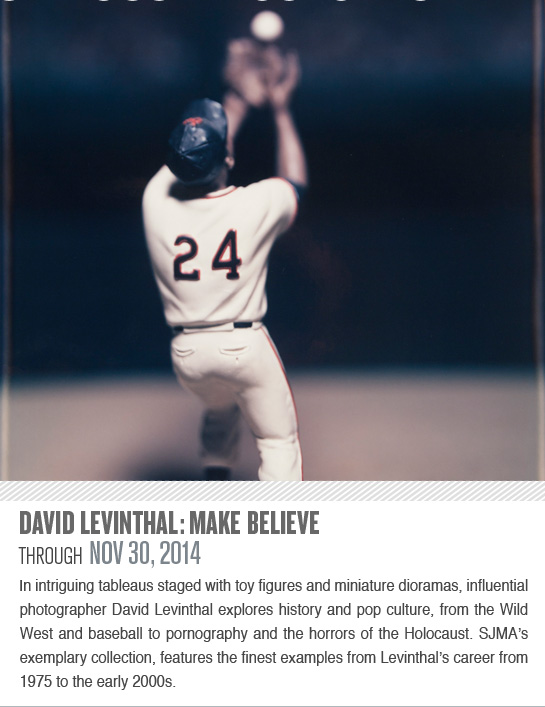
I had noticed, or been noticed, from San Jose Museum of Art that David Levinthal has a show there. The blast had a picture of 24 Willie Mays hauling in a little scrumptious bon-bon from Vic Wertz back in ’54, before my time. Levinthal, it seems, makes photographs of toys that have a peculiar life-like feature. I had to suss around to learn that where I had seen his previous work, glossing baseball and war, was at Stellar Somerset Gallery in Palo Alto, at 539 Bryant. (It was also Just Desserts for some years).
That plus the sign on the door drew me in: MID JUNE WE ARE LEAVING FOR FRANCE AFTER FIVE EXCELLENT YEARS. AU REVOIR MARK CATHY MONIQUE.
This being 11:15 on May 15, I figure that I have a month to send off Monique Chocolate properly. Whereas heretofore, which I have a hard time realizing is five years now, I had used Monique as a device to prove to myself that I had a quintessence of discipline. I walk by it every day and repress my urge to eat chocolate.
Now at 11:15 I am at Coupa, who, incidentally, or not, besides their coffee and famous deals written on backs of memos, second stage angel buy-ins and all that, for billion dollar apps and other disruptiveness, sell bon-bons and truffles, from Venezuela (or so they say; they say the Giants’ J.C. Gutierrez is also from Venezuela, and I believe them too Puerto La Cruz). I am sitting at an outlier table, not drinking coffee or eating chocolate, although my card is out, on the table, in case the help wonder why I am here, besides the wifi (which, incidentally, works if you need to check your email from nearby Phyllis dress shop).
To blog, or post or write, and not eat or drink leaves more band-with to eavesdrop and maybe get in on one of those deals, finally.
Monique is the daughter of Mark and Cathy West. She is graduating high school, Paly I think, and off to university, which is another reason they are letting their lease lapse. I oddly was able to recall the names of Cathy’s siblings, Nancy Hubbell and John Hubbell. They were all tennis stars at Gunn it its athletic heyday, whereas I say I was #13, which was also #4 JV, although I only competed in three not four matches and therefore did not actually letter. (My undoing was riding shot-gun on Tim Harris’ visit to Corvallis admit weekend and not getting back in time Monday to attend class before the match — senioritis).
I enjoyed hearing Ms. West’s perspectives on the weirdness that has been going on among our youth and their schools in recent years. I am childless (or “child-free”?) but follow doings thru the papers or the occasional Gunn Alumni events; I certainly get a lot of mileage from my freakish recall of people slightly older and slightly (or dramatically) better than me at this or that.
I told Nancy Soferenko of Phyllis’ dress shop that one year Gunn boys tennis had seven players who went on to play college tennis and that a guy who went on to #11 in the world was only #4 on his high school team. Whereas the number #1 that year only reached about 50th in the world (Chip Hooper and Nick Saviano).
I had a similar riff that I never published about the guy who owns or manages Stanford Park Hotel, Greg Alden, once being a CCS doubles champion runner-up, for Menlo (1990) and that the guy who is the pro at Oak Creek Michael Jessup was a two-time singles champ for Saratoga High.
Nancy said that her neighbor is Mark Smith who I recall as a very strong top ten player for Gunn, a year ahead of me and, as of 2008 or so, had a software product that “flashed not streaked” or “don’t streak if you can flash” whose only taker, it would seem was Phil Winston.
Tim Wong, Amy French and I posed for a photo, not a selfie but taken by Tom DuBois on the strength of me meeting Wong perhaps for the first time and him telling me he is a Gunn 1983, (to my ’82 and Amy’s ’81). Amy reminded me that her husband is Gustavo Cortez and he won or was nominated for a grammy for Latin Jazz. (I said that I had him figured for The New Varsity Latin Jazz Orchestra of which I was the flounder). I was supposed to bump Consuelo Hernandez, CDBG Planner, formerly with Bell, CA to bump Amy about using that photo for whatever propagandistic uses Shannon Burkey and Claudia Keith might devise, regarding Our Palo Alto.
And back to Our Bryant Street Palo Alto, a sign maker is installing four signs for the various not-art-galleries and not Vian Hunter there, but he is not related to the no parking signs which come into effect, May 19. And Frank Klein of Palo Alto, who I met when I had three clients who used to play his blues club in SF, has sold his Bryant street corn beef smoker to someone doing business as GB Chefing. (a name which reminds me of the notice on the former Edge/Icon that announced the new establishment as a “Super Club”.)
I entered Phyllis’s store because I wanted to ask Phyllis herself what she knows or recalls of the jazz pianist Cedar Walton. I know Phyllis well enough to know that she had heard Charles Mingus live, and I had lent her my book of Al Young’s recollections of Mingus. I woke up pondering the minor squabble between Either Iverson of the Bad Plus (TPB) and William Yardley of the New York Times (NYT). EI in response to Yardley’s obit of the piano player says “when I think of Cedar Walton I think of Cedar Walton — I don’t think of Art Blakey”, which I translated as something like: Iverson is mad that the Times could not describe the man’s work in its own terms, or kinda like saying that Orlando Cepeda was notable for having played with Willie Mays and Willie McCovey. I was pretty struck almost dumbstruck reading his blog, Do The Math and especially his interview with Walton and all the details and nuances he could recall or claim to discover in the tones and the phrasings and the sounds: phantom solos you could hear only in headphones that proved that certain parts everyone else hears were surely overdubs, the names for combinations of sounds that know one else plays or played before you, et cetera. Iverson claims that Cedar Walton, who was 74 at the time, came to a club at which Iverson’s band had just finished, and drank with the younger generation of players until 5 in the morning then drove Ethan home. Ethan asked a cluster of bass players (a bass cluster — is there a name for that?) who wanted to accompany him on “Bolivia” a song Walton either wrote or was known for playing (with its creator, or Dave Williams or Billy Higgins — I’ve never heard of it as far as I know, an unknown unknown or maybe an unknown known). The bass players begged off and eventually departed (i.e., sometime between 1 a.m. when the music would have stopped, in New York, and 5 a.m. when EI got tired of discussing or playing or writing about jazz; i like the play between i.e. and Ei and am working on a name for that, fyi). So EI played it solo, as a tribute to Cedar (who’s name does not sound like radar). Then Walton “showed him some things”. Did I mention that I am probably blackballed from Do The Math — although I do carry a picture of a Fields Prize in my cellphone and in fact, if my stupid cell phone was not acting up, I might post it here, for yucks? I doubt I merit inclusion in Ethan Iverson’s ongoing making of jazz history or chronicaling it, but I am going to mention that i once drove to Berkeley, picked him up, brought him to Palo Alto, to a little art gallery at Hamilton and Alma, which is now a start-up maybe H-4 or something, but not Dragon Theatre, or Premier Property or Lolly Font’s — and I am also, for no real reason, thinking of Russ Gershon’s Either Orchestra — the guard at, not Hamilton and Alma but Lytton and Alma is from Ethiopia and I was trying to tell him about the Either Orchestra Ethiopia Project –then I drove Ethan Iverson back to Berkeley for his Cal Performances hit with Mark Morris. I am sure I talked his ears off and for all I know that was the start of Do The Math, he escaped from my blather by ruminating on more pressing jazz matters, or mentally transcribed some jazz solos — I was telling him about Don Herron’s tour of places featured in Dashiell Hammet’s stories — and for that reason, that I feel bad about bugging him, that I went to the ball game instead of writing Ethan or hitting him on Twitter about offering the Billy Hart combo (with drums, EI piano, Ben Street bass and Mark Turner fly reeds) a clinic or special appearance, like a nooner at Lytton Plaza, like Magnolia Sisters did, or a meeting with the Mayor, or something with Music For Minors in Los Altos or Redwood City like Danilo Perez once did, between their Santa Cruz and Oakland shows, instead of them being off or in Fresno. I also contemplated being their driver from Oakland Yoshis to the Blue Whale in LA, which I doubt I’ve heard of but am wondering about Frank Gehry’s new Jazz Bakery. Ethan Iverson was once a student at Stanford Jazz Camp before he was on the cover of Downbeat, which is sorta like Russell Wilson admitting to Peyton Manning that he looked familiar because he was at Manning’s camp. Although I think Ethan told me this before he told Jim Nadel. I asked: “does Jim Nadel know this?” and said “I don’t think so.” But when I mentioned this to Jim Nadel he pretended or at least told me he did already know this.
Sam Whiting wrote about art initiatives at Stanford, including the Dispatch show at Frost this weekend, the May 17 I think, and that it has a pretty serious group of student art installation, including a metal whale you can or cannot not walk thru, and students took a two quarter class to present work there ($25 for Students, $40 for townies — sounds a little high, for Dispatch, who also played in Dinkelspiel in about 1999, when Wes Radez was at SCON). Whiting did not fit into this article, or does not know, that Stanford, perhaps most amazingly, is building to display Nathan Oliveira’s large works, Windhover, named for Gerald Hopkins Manley poem. The Windhover Contemplative Center — and it is being built — and this is a total scoop, that i should sent to Leah Garchik, especially if she is back from vacation — the builder of the Windhover Building, SC Builders, Sam Abbey, attended with my Dartmouth classmate Greg Hulbert (big at a bigger builder) a concert by rock band Train at Cubberley Community Center that I or my Earthwise Productions produced. I remember asking him something vague yet ambitious about whether his firm could or would rebuild for Palo Alto Cubberley or Cubberley Theater and he said that sector — public facility? Is there a word for that? — was something they did not do, a pond in which they as a metaphorical phish did not swim. (I guess Stanford is private so that’s different). Speaking of Phish, it is news to me that John Paluska, the former Phish rock band manager, is retired from music but owns a small mexican restaurant in SF that has “god sound”. I recognized the name and then sussed to repair the synapse gaps. Don’t know him but knew slightly Jason Colton who also was a Stanford SCON guy, around the era that Peter Drekmeier et al did Earth Day concert with Michelle Shocked and Peter Apfelbaum (who played with Don Cherry who played with Ornette Coleman, who Ethan Iverson, three-fourths or seven-eighths of the way thru his 2010 interview with asked Cedar Walton about), works with Red Light and Colin Meloy (who plays with former members of Calobo who also played the Cub, the Cubberley Auditorium i.e. temporary library, which has no AC and they played on a rare super-hot day, like we have yesterday and probably today — it is now 12:10 so I’ve been spitting riffs for about 40 minutes straight now.
And just as I am certainly the only person who saw Nathan Ford throw behind the runner for Paly and saw Mindy Kaling field a deus et machina screenplay as Matt Damon (score that 6-4-3- (infinity symbol)), I may be the only person who played “h-o-r-s-e” with Bill Yardley (circa 1981, he was 10 years old, at Stanford’s Escondido Village, while his mother Rosemary Yardley was a Knight Fellow, or what is Iverson’s term, “the patronage system”?) and gave Ethan Iverson a copy of the collected letters of Dashiell Hammett.
Actually I wanted to see if the potential routed date (if thats the word for that, it’s a word for something) for Billy Hart et al would fit with the note I got from Paula Kirkeby about bringing music to a local senior center — maybe they could break away either or ethan way.
Also, there’s a guy in San Jose Tom Berry who is a big Christopher Moore fan and either will review his new book here and or either or rebate me if I buy and read Moore for first time but don’t agree with his greatness.
“Play your shit” as Monk would say, according to Cedar, and Ethan. (I think Nat Hentoff says it more like: TK
edit to add, later that late late afternoon around midnight i mean 740:
i forget what i call that, but i like to play two videos here on wordpress format simultany-like, like with these two, both about 9 minutes, an album version of early TBP — the only album I really know,and thats a relative term in that I cannot name the tunes even — and some random bolivan
1. before I got on this chocolate kick, I was going to note Do The Math’s Palo Alto connection in Ethan’s noting the passings of Herb Wong (Palo Alto Records, PA Jazz Alliance) and Fred Ho (born here):
Herb Wong, whose Palo Alto and Blackhawk record labels turned out several important mainstream discs at a time when that music didn’t have many worthy venues in America. There’s a photo of Wong with Duke Ellington and some stories from musicians in Gabe Meline’s memorial essay.
If you find yourself under-dressed on your way to a Giants game, stop in to see Ernesto “Neto” Solis at his new Top Line Apparel gallery and salon / hang at 5009 3rd Street.
as i did
photo by Neto
go giants
edit to add: Giants won the game, 10-4, with Madison Bumgarner garnering the win despite some rough spots. I bought a $6 ticket on the leading online exchange around 11:20 and decided against walking from Peet’s Menlo Park, to Kinkos (to print my ticket) to the 11:44 CalTrain, and instead decided to manage my little white 4-cylinder Chevy up the roads. One benefit, I rationalized, of driving is that I could listen to Marcia Ball “Roadside Attractions” meanwhiles. (And maybe writing about Ball was what had planted the seeds of my impulsive maneuvers, the pun on her name).
As I drove past Candlestick and up 3rd Street, I spied the Bayview Branch of the Sf Library and pulled to the curb, and popped a quarter into the meter (which gets you about 20 minutes in that neighborhood). The library wasn’t to open for another half hour, so I ducked into Topline Apparel to ask around about where else I could possible check my email and print my ducat. I ended up hanging 5000-block of Third Street style, and also procured the coolware.
The librarian was very helpful navigating the free computer and the 10 cents a sheet printing. (I didn’t catch her name).
I ended up parking at South Park (for $14, or $7 per hour) and hoofing it to the game, but not before glomming a tuna sandwich from Caffe Centro — as if anybody really cares what I had for lunch; I did not, for example, eat at Baby Bull’s Barbecue spot.
The game highlight for me was Morse’s homer, breaking his skid of Ks.
I’m a fan of Palo Alto ceramicist Laura Jacobson (whose brother Mark was a year behind me at Gunn but 12 places ahead of me on the tennis ladder). I checked out some of her new work at her Palo Alto studio, on Transport, near San Antonio and East Charleston, where Terry also has a studio, Sunday open studios.
Just now something flashed the search-engines about H.R. Giger passing, the Swiss artist most people think of, if they know him at all, for “Aliens”. (And I just saw him and his work in a recent documentary about Dojorowsky’s Dune, and mentioned this to another neighborhood artist Lessa Bouchard, who also saw the film).
Here is a link to a famous album cover by Giger, from 1974, Emerson Lake and Palmer, “Brain Salad Surgery”
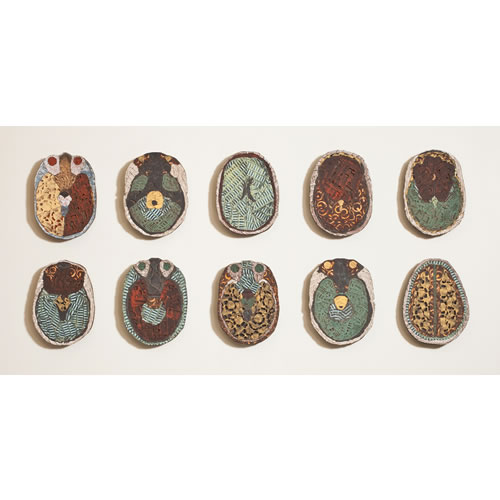
Laura recently hung at Stanford neuroscience a set of work based on MRI images, if that connection works for you.
And finally, thank you for mentioning my Brain Scapes in your blog — totally cool — and super interesting link with Swiss surrealist!!
Laura
The pleasure was mine; somebody should map my Brain Scape — it would tilt the machine. Mark
Tribute to Jacob Koopee by Barbara Weiss and Mark Weiss
Jacob Koopee was a great Hopi potter who died recently at a very young age.
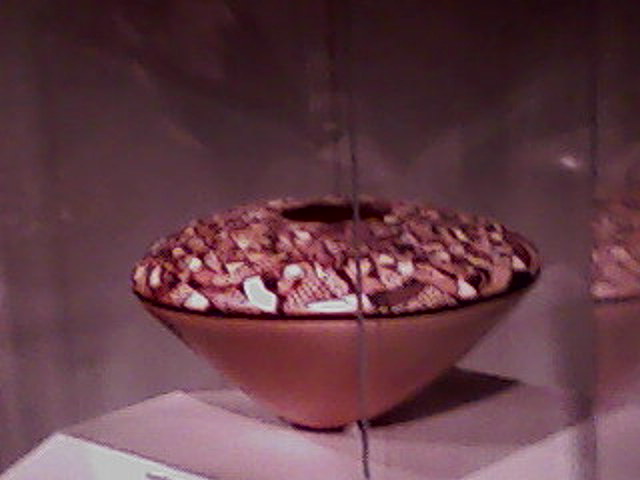
I never met him but I have seen several of his masterful works.
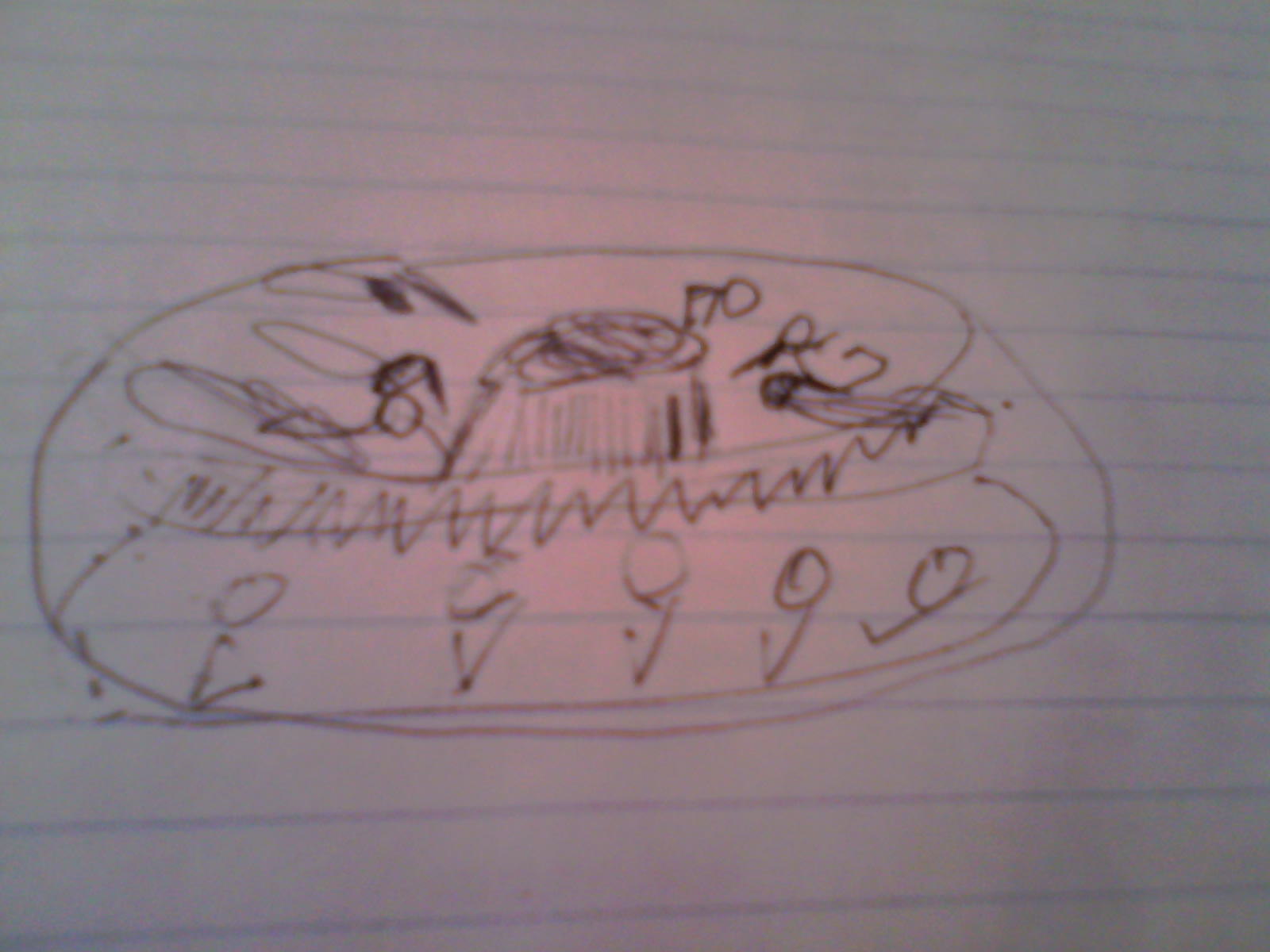
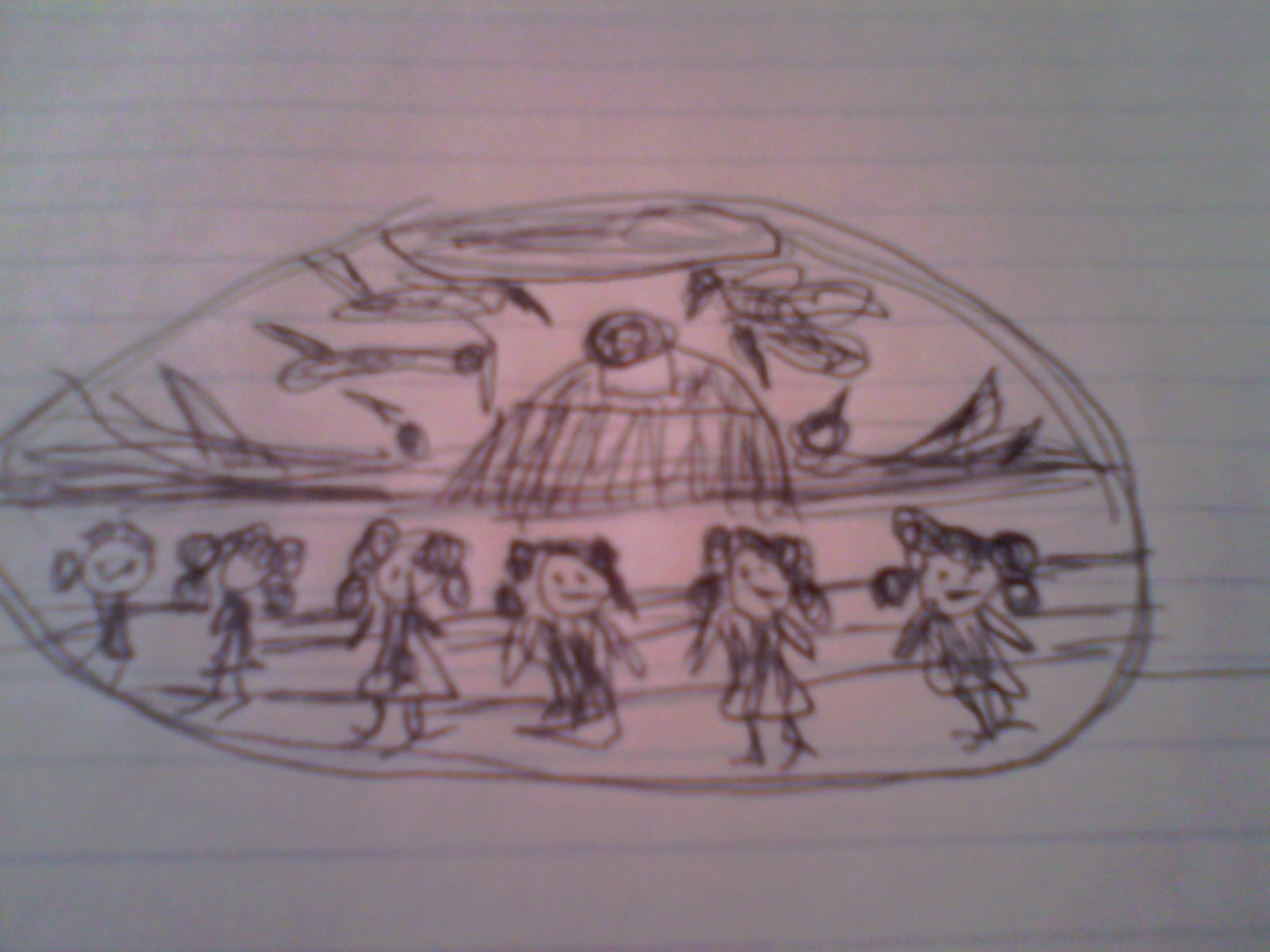
My mom and I killed an hour one day not too long ago by making quick sketches of some museum-quality “Pueblo pottery”.
Here are are respective versions of one of Jacob Koopee’s last works.
Sketch of a Jacob Koopee pot by Barbara Weiss
Sketch of a Jacob Koopee pot by Mark Weiss
I believe that the eminent dealer and historian, a tour guide, Martha Hopkins Struever, represented Mr. Koopee and once owned or handled this particular work, and featured it in her catalog. (For instance, I may have first seen the piece in her SWAII Indian Market showcase, at a fancy hotel near the plaza).
There’s a nice Jacob Koopee at the DeYoung Museum in San Francisco. Sarah Bailey Hegarty posted about it or him for the DeYoung blog (she’s describing a different piece than the one Moms and I were checking out):
Pueblo pottery is an important Native American art form that was first brought to the attention of the Euro-American art world at the turn of the 19th century. In the Arizona pueblo (or village) of Hano, a young Hopi woman named Nampeyo began making pottery inspired by ancient Sityatki pottery sherds that she discovered lying on the ground around her home. She sold her pottery to the hotels and restaurants lining the Santa Fe Railroad, the majority of which were owned by the Fred Harvey Company. Recognizing a marketable commodity in Nampeyo and her finely crafted pottery, the Fred Harvey Company encouraged and promoted the artist, featuring her in advertisements for Southwestern tourism and sponsoring pottery demonstrations for visiting tourists. In this way, Nampeyo of Hano put pueblo pottery on the map. Today she is widely recognized as the original matriarch of pueblo pottery and was the first Native American artist to be recognized by name.
Jacob Koopee is Nampeyo’s great-great-great-grandson, and his pottery exemplifies the evolution of style and originality for which his family is famous. Taught by his aunt, renowned potter Dextra Quotskuyva, Koopee demonstrates through his work the height of innovation in pueblo pottery today. Although he continues to use the traditional methods of coil construction and stone polishing, Koopee employs inventive shapes and patterns to create contemporary works of art.
Jacob Koopee at DeYoung
The overall “shattered” format of this seed jar’s surface design references Nampeyo of Hano’s resourceful use of ancient pottery sherds for inspiration. Koopee has visually represented the rejoining of a variety of sherds to create this pot’s intricate facade. Throughout the abstract design, Koopee has scattered cartouches revealing the geometric faces of kachinas. Kachinas make up a vast pantheon of spiritual beings in Hopi religion. Each kachina is associated with a specific aspect of Hopi life, such as agriculture, hunting, or warfare.
The combined elements of community and family are integral to understanding this unique art form. Traditional techniques and designs are paramount to the continuation and preservation of pueblo culture and native art practices. Ancestral patterns and methods handed down through generations identify artists as members of a particular family, reinforcing both heritage and aesthetics. Contemporary pueblo pottery illustrates the fluid fusion of past and present used to create striking new forms.
On your next visit, learn more about Jacob Koopee and his family’s long history in art. Pottery by Koopee, his aunt, Dextra Quotskuyva, and their ancestor, Nampeyo is on display in the Art of the Americas Gallery at the de Young.
Part of my conversational riff or rifflet with Marcia Ball and her crew included name-checking “Inside Llewyn Davis” while speaking to bass player Bennett, who hails from a part of Texas depicted in Joel and Ethan Coen’s film, based on a Cormac McCarthy story, “No Country for Old Men.” (the logical leap works for me). He hadn’t seen the movie. Noting on the back of one of the titles for sale and mercy table that Marcia had worked with Stephen Bruton, I tried to change the subject to the 2009 movie “Crazy Heart” in which Jeff Bridges plays a struggling singer-songwriter. Bruton, who produced Ball’s cd, has several of his songs in “Crazy Heart” but it’s protagonist was not really based on him. (He died in 2006 sometime while the movie was in production). I didn’t quite catch it, but it sounded like Bennett or Ball were saying that the “Crazy Heart” guy was based on a particular person, they may have known.
Or she might have just been changing the subject to “Tender Mercies” the 1978 movie written by Horton Foote in which Robert Duvall sang a batch of songs, mostly covers but some written for the film (and or sung by Betty Buckley). I don’t recall seeing this film; certainly it was before music opened up for me, or cinema even.
Meanwhile, another thread of my continuing studies, kinda sorta crosses here: in David Shields’ and Shane Salerno’s experimental biography of Salinger, I learned that a 1948 short story of his “Blue Melody” is a fictional treatment of a rumor about the dire circumstances involved in the death of blues legend Bessie Smith.
But that anecdote also reminds me of a story told to me by a Dartmouth alumni who took a class there from Lucky Thompson, in which Mrs. Thompson supposedly was denied treatment or given bad medical advice by a white doctor while traveling the South.
I’m getting a wee bit ahead of myself here because this is Gary Nicholson playing the Stephen Bruton song “Fallin’ and Flyin'” that Jeff Bridges sings in the movie “Crazy Hearts” — Nicholson who produced and co-wrote four tracks on Marcia Ball “Roadside Attraction”
There’s also an Edward Albee play that deals with death of Bessie Smith:
At the dances I was one of the most untiring and gayest. One evening a cousin of Sasha, a young boy, took me aside. With a grave face, as if he were about to announce the death of a dear comrade, he whispered to me that it did not behoove an agitator to dance. Certainly not with such reckless abandon, anyway. It was undignified for one who was on the way to become a force in the anarchist movement. My frivolity would only hurt the Cause. I grew furious at the impudent interference of the boy. I told him to mind his own business. I was tired of having the Cause constantly thrown into my face. I did not believe that a Cause which stood for a beautiful ideal, for anarchism, for release and freedom from convention and prejudice, should demand the denial of life and joy. I insisted that our Cause could not expect me to become a nun and that the movement would not be turned into a cloister. If it meant that, I did not want it. “I want freedom, the right to self-expression, everybody’s right to beautiful, radiant things.” Anarchism meant that to me, and I would live it in spite of the whole world — prisons, persecution, everything. Yes, even in spite of the condemnation of my own closest comrades I would live my beautiful ideal
1931 quote which is the source for people saying variations of “I only want to take part in the revolution if I can dance to it”.







 Plastic Alto with Mark Weiss