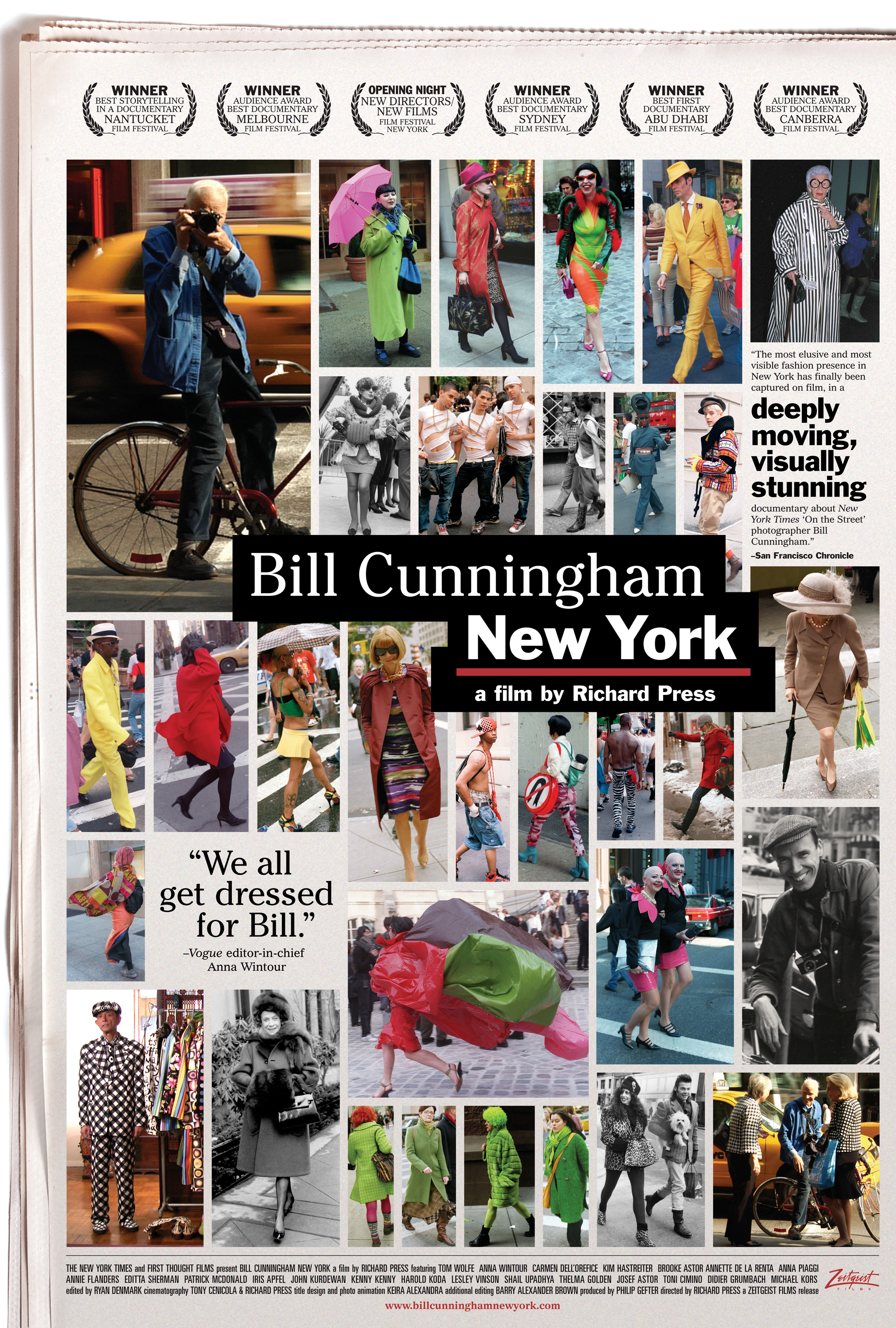
Bill Cunningham is not a basketball legend but in this case the New York Times photographer whose assortment of candid fashion photos comprise the popular Sunday feature “On The Street.” He is also the subject of a documentary by Richard Press that I ducked into yesterday at the Aquarius. (I have a New York Times fixation, starting with being given a copy of Gay Talese “Kingdom and the Power” as a high school journalism award and including having trained not one but two eventual Timesmen on my high school and college newspaper staffs; I probably have 2,000 stories clipped and filed from the venerable “fit to print.” ).
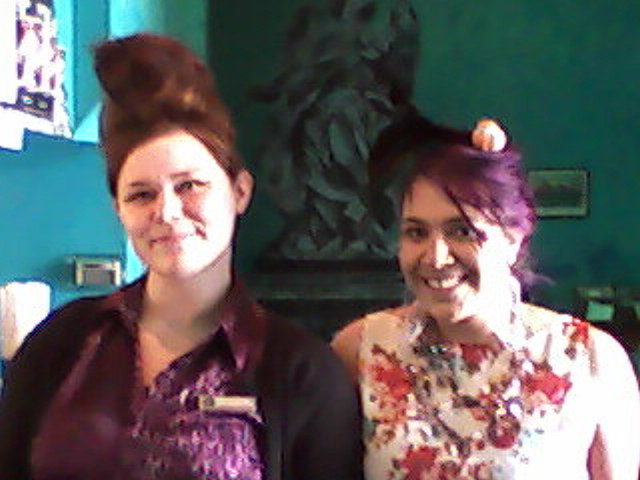
I got a kick out of the fact that the staff at Landmark’s theater dressed in honor of Bill. I snapped (on my crappy cell) this shot of Rachael and Carolina, then got Carolina to indulge me, and further our respective and overlapping odes
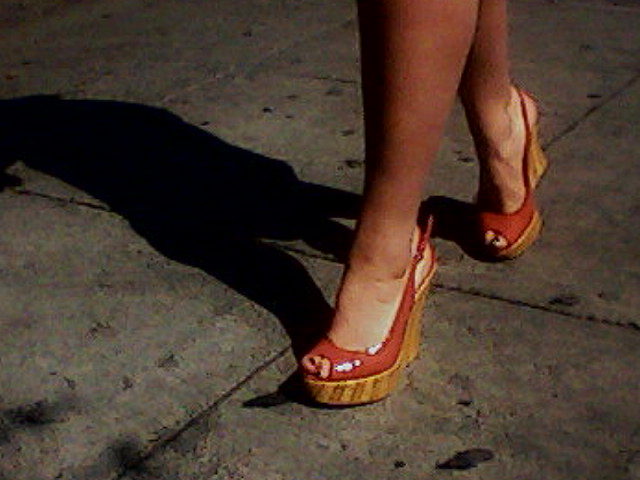
to Bill Cunningham, by walking by me on Emerson as I crouched to catch her shoes.
Here is Bill’s post for today; I counted 46 shots:
The film had a subplot about artists (including Bill Cunningham) being evicted from their life-work space studios at Carneghie Hall which reminds me of my own lobbying for a Nathan Oliveira studio at 209 Hamilton here. Also, that Cunningham started as a hat-maker reminded me of my old friend Mary Michelle Little, the Raleigh-based milliner.
I also liked the music, which I noticed was done by my friend Brooke Wentz at Rights Workshop, especially the John Lurie stuff. (Carolina said she liked the Velvet Underground stuff; I wondered what the song-parody was they feted him with on his 80th birthday)
I once barged into an interview that Steve Horowitz of Pop Matters was conducting in the lobby of the Driskill Hotel in Austin during SXSW2009 and put Nellie McKay on the phone with Ian MacKaye and just noticed, two years after, that the incident made it into Steve’s piece.
At this point in the conversation a stranger intrudes and asks who we are and what we’re doing. This is one of the perils of doing an interview in a public place during SXSW. His name is Mark Weiss. And he’s a concert promoter. When Weiss learns who McKay is, he volunteers that he’s a friend of the musician Ian McKaye (Fugazi) and proceeds to get him on the telephone because the two share the same last name. The two musicians have never met before and chat briefly. I hear a mention of Washington D.C. and the names of shared friends. The two people share a history of combining their music and social activism. After the call is over, I ask McKay what they talked about and if it felt like an historic moment. She laughs.
“He’s in San Francisco at a party with Shirley McLaine. So it’s a “Mc” kind of day. The Scots must be out in force now that St. Paddy’s is over.”
I had met Ian a couple years earlier when I had presented The Evens (Ian MacKaye and Amy Farina) at Terman Middle School Auditorium in Palo Alto, and, although I had no business doing such, I had saved his cell phone number in my handheld. But Ian took the call and I put him on with Nellie. Steve’s account differs slightly from what I heard, but I thought Nellie said, punning on their mutual prefix, “It’s a ‘muck’ kind of day.” or something (Steve has it spelled out “mc” more literally, but easily confused with the abbreviation for “master of ceremonies”).
Ian’s The Evens show was notable for having taken place in a room that years earlier was the scene of a school dance in which, or so he told the crowd, he was too shy to ask anyone to dance: Ian had lived in Palo Alto that one year, for him eighth grade, when his father was a fellow at Stanford. The Palo Alto Weekly reported this, about Ian’s Palo Alto connection. It is also true that Ian or someone in his camp had seen listings about my all ages series at Cubberley and had tried to rent the space for a show but was refused.
Besides seeing Fugazi at Ian Brennan famous co-bill at Dolores Park (with Sleater-Kinney, Greil Marcus described it in the New York Times
check p 202 for mention of Sleater-Kinney in this new book, as I saw it in Mountain View store
) I also happened to visit the second floor of the Whitney Museum in New York in 2000 at the precise time Jem Cohen’s “Instrument” was sceening, which I took as a sign and took in the film.
It was Ian Brennan (pronounced “EYE-an”, and not the guy from “Glee”) who put MacKaye (“mick EYE”) in touch with me, and he also produced the show the following night at Cafe DuNord (that featured BARR as openers — at that show I recall Kim Chun of the Bay Guardian introducing me to Joanna Newsom as “an old ‘G’ concert promoter”!!!).
Ian MacKaye, as memory unwinds like an onion or salt-water taffy, also graciously did a “meet the artists/ career in music” lunchtime appearance at the middle school day of show. He later said he had lost his yearbook of that year but fellow Palo Altan Gina Arnold had had a mimeographed copy made, which he keeps. (There is supposedly an archive at Palo Alto Library, via Steve Staiger, called “Palo Alto Rock and Roll Archive / Jerry Garcia Day” and I add musicians to it as I find them — The Donnas, Third Eye Blind, the dude, Chris Appelgren from the Pee Chees, who did one year in PAUSD — and I hope to get a copy of the copy of Gina’s gift to Ian — maybe now that Karen Holman is on City Council the Palo Alto Historical Association will actualize my concept here, but I really, really digress…)
Here is a brief excerpt from the Fugazi film:
Edit to add, the next day: not to digress too far from Ian and Nellie, but Greil’s long review of the Sleater-Kinney Fugazi show is actually for Food Not Bombs 20th anniversary, fitting in with Steve’s socially conscious theme.
Edit to add, forty five minutes after previous — 2:30 Friday, April 29, 2011: I am going to paste in Molly Tanenbaum’s 2000 preview of The Evens in Palo Alto because there is some vagary in the way it is archived on the Palo Alto Weekly site; there is also a less relevant (!) review of cd by Marc Burkhardt and I found a blogger review and photo of show itself — and kinda fits, in “plastic alto logic,” because Horowitz notes that Nellie McKay appeared on a panel about concerts in unusual venues:
Terman Middle School proves just the right venue for Fugazi founder Ian MacKaye
by Molly Tanenbaum
It’s hard to beat paying $5 for an evening of live music in Palo Alto. But punk rocker Ian MacKaye will tell you that’s exactly how it should be.
MacKaye will perform with his new band, The Evens, next Tuesday evening at Palo Alto’s Terman Middle School. All are welcome — and the price is right.
Performing in a school auditorium is nothing new to MacKaye. As singer-guitarist of indie-legends Minor Threat and Fugazi, Mackaye’s anti-corporate reputation set him apart from the crowd. Believing in music for music’s sake, Mackaye has released $10 CDs, favored community concert spaces over rock clubs and turned down numerous lucrative offers from large record labels over the course of his career.
“What it does is it inhibits innovation and new ideas,” said Mackaye, the co-founder of Dischord Records, a 25-year-old independent label. “The thing with new ideas is they have no audience. They haven’t been thought of yet. I think it’s important to have access to spaces. The idea of free spaces is very important,”
MacKaye’s new group, The Evens, is comprised of himself and drummer Amy Farina of The Warmers. The two are longtime friends who met through MacKaye’s brother, Alec, the Warmers’ guitarist and singer.
Farina and MacKaye have performed over 50 shows since forming a year ago. The Evens will arrive in the Peninsula after a week of touring in Los Angeles.
When asked about The Evens’ style, MacKaye replied, “That’s the thing about music. If you could put it into words, you wouldn’t have to play the music.”
But he did provide some hints.
“I will say this: We’re not super loud. We sing. Lots of singing going on. And we’re definitely not interested in playing in rock clubs. We’d like to reclaim music and let it come back into spaces that are a little less commercially oriented.”
The Evens selected the Palo Alto concert venue because of MacKaye’s history in the area. Born and raised in Washington, D.C., he attended seventh grade at Terman Middle School while his father was on fellowship at Stanford University.
“That was the only nine-month period that I didn’t live in the District so it’s significant in my mind,” he said.
MacKaye was dismayed at how difficult it was to find a concert space in Palo Alto, but he is pleased to be able to play in Terman’s auditorium, the locale of his very first school dance.
The concert will bring back memories, both fond and a bit painful, of the time he spent in Palo Alto. He remembered the difficulties of being the new kid in school.
“I had really long hair and was pretty tattered. I was a hippy kid. It was 1974. I walked into junior high and these kids were wearing corduroys and Adidas and Izod. I felt like I was dropped off in another land. It was intimidating. No one would talk to me and I thought they were all snobs but it turned out everyone was scared of me because I was from the East Coast,” he recalled.
Prior to the concert, MacKaye will give a lunchtime talk to interested Terman middle-schoolers. But, from experience, he doesn’t expect the students to have heard of him, The Evens, Fugazi or Dischord Records.
“I’ve only spoken to one younger school and they’re like, “Who is this guy?”
MacKaye won’t bring a prepared speech; he just hopes interested students will attend and ask him questions. But MacKaye has an inkling as to why producer Mark Weiss asked him to talk to the students.
“I just don’t practice the general American business ethic, which is to grow and sell, grow and sell, grown and sell. And I actually have a really different approach. So maybe he thinks that it’s a voice that has been overwhelmed by the din of avarice,” MacKaye said.
Palo Altan Weiss, producer of the upcoming show and fellow Terman graduate, set up the afternoon Q&A session because he views MacKaye as a potential role model for the young audience. He was impressed when he heard MacKaye speak in the past.
“He’s not a really famous musician on MTV but I think kids can tell who is an interesting person when they meet an artist or a musician. He’s an interesting guy and he’s done interesting things with his life and I think kids will find that rewarding and inspiring,” Weiss said.
MacKaye’s modesty and down-to-earth attitude about creating music may be just the right message for middle schoolers who have grown up on MTV, “American Idol” and the fleeting stardom of countless performers.
“If you think back to when you were 10, 11, 12 years old, kids are just coming to grips with music and they’re engaging with the music that’s being spoon-fed to them.”
MacKaye admitted to liking The Monkees as a youth, pointing out that simply the idea of music fascinated him at a young age, and that was what was available to him at the time.
What’s important for young aspiring musicians, MacKaye said, is sticking to their passion and not prioritizing money over art.
“What’s more discouraging to me is when people make decisions based on what’s expected of them and that’s crippling in the long run in terms of creativity. It’s more important that people actually believe in what they’re doing,” he said.
“If me and my friends could do it then anyone could do it. My advice is not to get caught up in the way things are supposed to be and focus on the way you want them to be,” he continued.
Recalling his middle-school days, MacKaye said he felt discouraged about the possibility of becoming a musician.
“I had given up at that point that I’d ever be able to play rock because at that time it seemed like rock and roll was out of reach and that people doing it were anointed by the queen. They were so high falutin’ and so far removed and unreachable by a kid like me,” he said.
It wasn’t until 1979 when high-schooler MacKaye taught himself to play the bass, and then the guitar. It was the freedom of punk rock that revived him.
“That was what was so deeply important about punk rock in the late ’70s…For me, punk rock was a free space where new ideas could be presented because profit was not the primary motivation.”
His late high-school band, the Teen Idles, launched his music career. From those roots, MacKaye formed Minor Threat in the early ’80s and Fugazi in 1987. The band, comprised of Mackaye, Brendan Canty, Joe Lally and Guy Picciotto, was known for its austere, mid-tempo punk sound. They toured for 15 years but have been on hiatus since 2002, allowing members to attend to their personal lives.
Although The Evens will release their self-titled album March 8, they decided to tour the Bay Area in February. When asked why he wasn’t waiting for the album’s release to tour, MacKaye said, “I’m of the mind that records support shows and not the other way around. The industry has skewed that idea.”
Editorial Intern Molly Tanenbaum can be reached at mtanenbaum@paweekly.com.
Who: The Evens, featuring Ian Mackaye and Amy Farina. The concert is open to people of all ages.
Where: Terman Middle School Auditorium, 655 Arastradero Road in Palo Alto
I wrote a letter to Palo Alto Weekly about how we as a community (town and not gown) should do something to honor the legacy of painter and teacher (and father, and husband and neighbor) Nathan Oliveira, 1928-2010. At the Palo Alto Public Arts Commission meeting last night, staff liason Elise DeMarzo announced that Gail Price and City Council will issue a proclamation on point at their May 7 public meeting. Meanwiles I have been floating the idea that we as a community, perhaps a public-private enterprise, should buy 209 Hamilton Avenue and make it a museum and art studios.
209 Hamilton art studios, future home of Nathan Oliveira Center for The Arts?
Nathan worked there for several years in the 1970s, according to his friend and colleague Paula Kirkeby of Smith Andersen editions.
Here is the draft of the letter I wrote to Palo Alto Weekly, which was timed to respond to the article Karla Kane wrote about public art:
Dear Editor:
I appreciated the excellent article on public art by Karla Kane and the accompanying photo essay by Veronica Weber depicting or referencing some twenty examples of art in our midst. The fact that you included the “Kura” carving at Stanford’s New Guinea folk installation – which for a second I did confuse with the City’s former holding “Foreign Friends” (from Sweden) – triggers me to suggest two more public arts ideas for our community to imagine and consider:
1)I think Palo Alto should do something substantial and ambitious to honor the passing of Nathan Oliveira (1928-2010) and his legacy here in town. Although the university (where Oliveira taught for more than 30 years) is said to be planning an impressive legacy project, we as a public community should do something to match. There is precedent in the form of the great painter’s in-town history: for example, Oliveira was honored with an Avenidas Lifetime Achievement Award in 2003. He lent his work for a comprehensive show at the Palo Alto Art Center in 2008. Perhaps most significantly, a large body of his earlier work was created at his downtown studio at the corner of Hamilton and Emerson. We should do something larger and more permanent than the loan of his sculptural piece in the courtyard of 1313 Newell.
2)Speaking of “Foreign Friends”, in honor of our new mayor Sid Espinosa I think we should ask our siblings in our Sister City of Linkoping to try again – the first installation was attacked by vandals (several times) and ultimately removed from the city art collection. Although Espinosa has a Latino surname, he has also spoken publicly about his family’s Scandinavian heritage.
We budget about $25,000 of our $147 million dollar municipal budget for the Public Arts Commission, a tiny fraction. We voted in recent years to have developers set aside “one percent for arts” for civic capital projects –for example, the Bruce Beasley sculpture at the renovated Mitchell Park complex constitutes roughly $250,000 of a $25 million project. But to me the overall impact of our community arts efforts seem much greater. We are getting a lot of bang for our art buck. Although many question the value of the arts in recessionary times, our local arts are part of what makes us unique, what makes Palo Alto Palo Alto, what makes us human even. Even when we disagree about the merits or meaning of individual pieces (or the program as a whole), the debate itself is part of the commons, what makes us a community, what makes us us.
Although we are on a budget, there may be considerable and propitious public-private, project-specific, and philanthropic support to honor Oliveira and Espinosa via the arts.
Mark Weiss
This Oliveira bronze was on load to the Palo Alto Art Center
edit to add (and thanks to “State of Grace” blogger Grace Davis for converting me from a self-commenter to the more user friendly “edit to adder”): At the Earth Day Bill Bliss trailhead biker dedication of a work by James Moore ceremony today,
Sid Espinosa
Mayor Sid Espinosa was buzzing not about his visit with Obama the day before but a film he saw at Cubberley by middle school students “The Badger Brothers” who made a spoof on the recent James Franco film, about a boy who gets his arm stuck in a recycling bin for “127 Minutes.”
edit to add, August 14: Joe Oliveira sent notice of a Nathan Oliveira Memorial art show at Berggruen Gallery in San Francisco, starting Sept. 8 and seeming to feature 35 works.
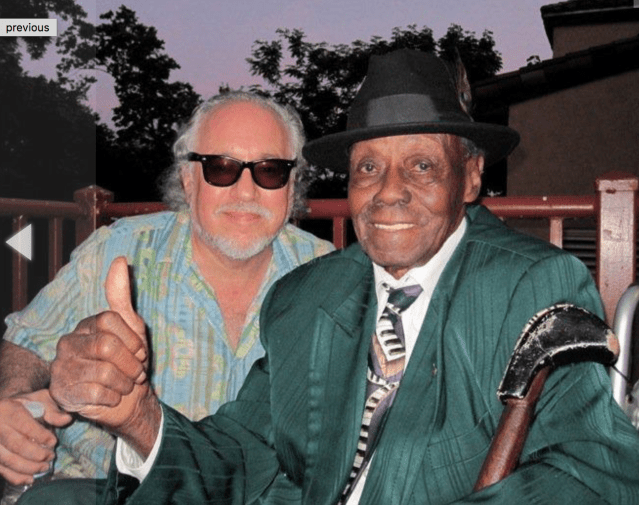
Blues diva Candye Kane poses with Pinetop Perkins; photo courtesy of Candye Kane
I was at Gryphon Stringed instruments today when Paul Jacobs there mentioned that he had seen the Pinetop Perkins concert I had produced at Cubberley in 1997. He broke me the news that Pine had passed away (it was actually a month ago already, unknown to me).
As I ate a quick couple bites of chicken for my lunch today I recall that Pinetop from my experience was fond of chicken. I believe it was on his rider. I recall Pat Morgan backstage practically shouting in his ear “Pine, would you like some CHICKEN?” — Perkins I observed was practically deaf when I met him, but boy howdy could he tickle them keys.
edit to add, July 7, 2011: Today would have been Pinetop Perkins’ 98th birthday. I realized this because blues diva Candye Kane was kind and reverent enough to send this reminder to her email list, along with the above photo. Coincidentally I am interviewing blues pianist and band leader Steve Lucky today, apropos of his upcoming free show Saturday in Palo Alto. I had seen Steve a couple years ago when my then-client Gary Floyd opened for Pinetop Perkins band at McNears’ Mystic Theater in Petaluma. Steve was at the show because his wife and partner Carmen Getit was in Pine’s band, and on the Grammy-nominated cd (she of the 1956 Gibson guitar). I was trying to briefly recommend Gary Floyd (The Dicks, Sister Double Happiness, Black Kali Ma, Buddha Brothers) for the blues circuit under the name Gary Floyd’s Hard Again. I met Gary through my actual client Doug Hilsinger, who produced the Muddy Waters’ influenced session. We all drove up to Petaluma together, Doug, Gary and I. I recall that booker Sheila Groves of Notable Talent was a little aghast that I included on the blues demo an archival punk piece called “Saturday Night in The Bookstore“.
Getting it straight, which is like the blue joke that Jimbo Mathus told me about an old guy shooting pool with a piece of rope: Pinetop won the Grammy for his latest release “Joined at the Hip” co-lead by Willie “Big Eyes” Smith the drummer, vocalst and harp player, 2010 release, 2011 Grammy, oldest-ever Grammy winner. And now I see that Downbeat Critics poll, online but pre-dated August, 2011, has same cd as Blues Record of the Year — last year was Eric Bibb. (7/12/11). Carmen Getit played guitar on 2004 release “Ladies Man” which put her aside Deb Coleman, Madeline Peyroux, Ruth Brown and many lovely others.
Not to brag (and it ain’t braggin’ if its true): the poster I made for Pine’s 1997 concert in Palo Alto at Cubberley, was also a Howard Finster tribute of sorts in that I took a newspaper photo of a recently deceased Negro League baseball player and wrote in my faux naive scrawl all the concert data: that the band included Pinetop Perkins “He’s 86!” and Bob Margolin and Rusty Zinn (and I think Willie Smith, the poster should have noted) but also Hershel and Wendy (Yatovitz and Waller), the openers. The brag part is that some dude called me from Fresno wanting to order three more posters — we handed out the original run of about 200 at the show. And then Men’s Wearhouse on University Avenue kept it hanging in their storefront for more than a year after concert! True dat. So far I have not been sued by the original AP photographer for my fair use. (The majority of my concert posters I used art directors; although I repeated the concept of my scrawl over found object for a Femi Kuti concert a year or so later– no one seemed to like or notice).
edit to add, 8 years and 6 days later: I just announced that Bob Margolin who has a new cd out, will play the new Mitchell Park Community Center “El Palo Alto Room” on July 6, 2019. Don’t hold me two it but I believe that Mitch Woods will do an opening set on piano, then Bob and his pal Jimmy Vivino will trade licks and stories. Here is a picture of Bob and Pine, circa 2010:
I was researching a post about P.J. Harvey but completely missed the fact that she played at the Warfield last week — I was still processing Mingus and Cajun music.
My neighbors went and I am like so jealous.
I started this riff after seeing a review in the New Yorker in January.
But until I get to it — I wrote to Beth Lisick for advice, and am awaiting a response; I may have to stalk Beth’s Sunday Solo showcase in SF to expedite request — here is NPR offering a free streaming of that Golden Voiced affair, smiles all around, or what I should do is buy drinks all around at The Lex (coincidentally or not, down the street from Smiley’s old office), and not just artwork by Michelle Muldrow off the wall: http://www.npr.org/2011/04/21/135519051/let-san-francisco-shake-pj-harvey-in-concert&sc=nl&cc=mn-20110421
edit to add, april 29, 2011: My thanks to Noah Shemtov of Noamdora Blog for burning me a copy of “Let England Shake:” I might suggest to him that we send a dollar or so to PJ Harvey’s publisher for mechanical rights to the compositions; also, I will try to remind myself to buy a hard copy of the cd from Rasputin’s Records in Mountain View, along with TV on the Radio’s “Nine Types of Light.” When I get a minute I will recap my thoughts on this cd and what little I know of her career, in response partially to Sacha Frere-Jones New Yorker article (I didn’t know until just now that Sacha was a dude; I noticed he also wrote about Merril Garbus pka Tune-Yards, who I am interested in, and like Polly just missed locally). Meanwhile, I am pasting or posting this video:
(note: this is a version of something I was writing for Dartmouth Alumni Magazine in 2006; there is or was a revised version with a lead that referenced “The Pied Piper” myth. DAM ran a condensed version making the lead my aside about the jocks calling Don Cherry’s class “Pots and Pans” the way we also, even 15 years later called into Geology courses “Rocks for Jocks”. I have a rather thick file that didn’t directly percolate or precipitate as cogent ideas or praise for Don Cherry. Also, a side effect of this work was the re-isse I played a role in–and think “role” in the French sense with a mark about the vowel — “Human Music”, for the Cherry completist) I bought an extra copy of Brotzmann to present to one of my sources here, the guy who moved to India. Yes, Fuck the Boer.)
DON CHERRY AT DARTMOUTH:
THIS SPECIFIC SILENCE, 1970-
By Mark Weiss (2006)
Don Cherry, African-American, avant-garde of the jazz avant-garde and
Choctaw Indian from Oklahoma, taught two ten-week courses at Dartmouth
College in the winter and spring of 1970. He came to the College at the
invitation and instigation of Jon Appleton, a young music professor and
early adopter of electronic music, who was interpreting and acting on a
college-wide self-conscious and deliberate attempt to bring more black
perspectives to the faculty and curriculum. Cherry’s stint was actually
part of a jazz recruiting trifecta that also yielded short fecund
sojourns on the rural New Hampshire campus from tenor sax legend Lucky
Thompson in 1973 and bassist/French horn player Willie Ruff in 1974.
Cherry’s visit was by far the most fruitful, leaving indelible
impressions on his colleagues and students, who can clearly recall that
intriguing chapter of Dartmouth (and American:
think Woodstock, Kent State and Vietnam) history even decades later.
Cherry’s offerings were by far the most popular music department courses
in Spring, 1970, their enrollment surpassed the combined total of all
other music classes combined.
When questioned about the story, Appleton retrieves from a file the
curriculum vitae that Cherry submitted at Dartmouth’s request. The two
musicians had met the previous year at a recording session in New York
of Charlie Haden’s Liberation Music Orchestra (Appleton was an
observer). Suitably impressed, Appleton put the wheels in motion to
bring Cherry to campus.
DON CHERRY
STUDENT OF LIFE UNIVERSITY OF LIFE
headlines the document which is typed on a manual typewriter with
charming hand-written addendum.
Although 33 when he wrote it, Cherry’s 1969 c.v.
recounts an already legendary career:
In 1955 I won a scholarship to LENOX SCHOOL of JAZZ.
(“Boston, Mass” is handwritten in the margin).
Directors: JOHN LEWIS, GUNTHER SCHULLER, GEORGE RUSSELL.
I moved to New York in the winter of 1959 with Ornette Coleman’s
ensemble.
In 1960 I began studies with Director, JOHN COLTRANE.
The five-page document continues to list other accomplishments such as
his recording contract with Blue Note – then, as now, the world’s most
prestigious jazz label –, and studies or collaborations with a pantheon
of jazz greats such as Sonny Rollins, Archie Shepp, John Tchicai,
Thelonious Monk, Albert Ayler and Pharoah “Little Rock” Sanders. It also
lists travels, studies or commissions in Turkey, Sweden, Denmark,
Germany and France, and his co-founding of an elementary school music
program Arbetarnas Bildings Forbunde in Stockholm.
The last page – “1969*” – is written in quite legible cursive prose and
mentions more Ornette Coleman (Cherry’s original collaborator and
band-leader, acknowledged as a pioneer of “the new thing”, still with us
and gigging at age 74), and lectures at Long Island University and at
five elementary schools “with small children ages 7 to 10.” The “essay
section” here ends with a note:
Jon-
I hope this information is satisfactory. So sorry I was so long. Have a
Happy summer. Don Cherry (the signature includes a trademark doodle of
three doves over the Y.).
Although Appleton had his secretary, reformat the document, it augurs a
jazz course akin to having a religion course taught by someone present
at the Last Supper.
Cherry was accepted and came to campus. The following people have
offered vivid and animated recollections about the course:
Fred Haas, ’73. He is a professional musician, a saxophone player,
living and teaching in Vermont. He actually took all three of the
courses offered by this initiative, those of Cherry plus Lucky Thompson
and Willie Ruff. He remembers practicing individually with Cherry in
Cherry’s office. Cherry would make him play a piece of music then flip
the score upside down and make him play it backwards. Haas remembers
hearing that Cherry was coming to campus, going to the record store,
buying Symphony for Improvisers (1966) and being blown away by the lp.
“It was the first jazz music I had ever heard that did not take a
traditional song format.”
Nelson Armstrong ’73, who has worked many years in the alumni office of
the College, was an undergraduate football player and music major, as
well as one of the fews African-Americans in the student body. Armstrong
says that Cherry had a “Pied Piper” effect on students – he developed
quite a following. He said that Cherry was like “apple in a bowl of
grapes” among the other Dartmouth faculty of the day.
Steve Herzfeld ’73 took the course as a freshman, and eventually dropped
out College to travel to Europe with Cherry. He is either by far the
best example of Cherry’s students, or the worst. He, too, took
Thompson’s course. (Thompson, by the way, recently passed away at age
81. He was a legendary sideman, accompanying a dizzying array of
luminaries like Count Basie, Lionel Hampton and Dizzy Gillespie. He is
famous for his disgust with the music business – and American society in
general. After leaving Dartmouth he taught one year at Yale then dropped
out of society completely. In the last ten years before his death in
August, 2005 he was said to have lived as a squatter in Seattle;
music-community members there rallied to get him preferential treatment
in Seattle social services and adult day care, but he died pretty sad
and lonely, and disoriented. Herzfeld remembers several outbursts and a
terrifying account of racism that Thompson claimed he and his band
including his pregnant wife experienced touring in the South in the
1950s. Herzfeld recalls these classroom sessions as if they were
TiVoed).
Jonathan Sa’Adah, ’71, is a professional photographer based in Vermont
and Montreal who others remember as copiously documenting on film
Cherry’s course as well as several public performances. He too traveled
to Europe either with or for Cherry.
Many people, if they don’t know
Cherry, may have heard of or heard songs by his children Neneh Cherry
and Eagle-Eye Cherry, both of whom had Top 40 pop hits on commercial
radio in the 1980s and 1990s. The Dartmouth Cherry students and Appleton
remember the very young Cherry kids crawling around on stage during
classes and during performances, or banging on the drumkits. Cherry
moved to Europe in the sixties, part of a larger trend of jazz
musicians, especially blacks, who received better treatment there, and
wished to protest Vietnam War by their absence. Cherry married Moki
Cherry, a Laplander from Sweden (i.e. She was indigenous minority in her
country; Neneh is actually Don Cherry’s step-daughter, while Eagle Eye
is the child of Don and Moki).
Appleton claims that more than 100 students took Cherry’s courses. In
his letter to the dean of faculty Leonard Rieser on January 23, 1970 he
asks the College to extend Cherry’s stay an additional term. Appleton
pointed out that Cherry’s course had more students than the other music
courses combined.
“I feel that the retention of Mr. Cherry is highly desirable for the
following reasons: 1) The number of students enrolled in his courses
during this term exceeds the total enrollment for all other courses
presently being offered by the department. 2) Having visited two of Mr.
Cherry’s classes I feel that he brings an entirely new dimension in
musical instruction that should figure prominently in the way all
colleges and universities approach the teaching of music in the future.”
Rieser wrote back to Cherry (cc:
Jon Appleton) on March 5 stating that he was “delighted” that Cherry
would extend his stay, and that beyond their popularity the courses
“enjoy the high regard of your colleagues” in the music department.
Beyond his voluminous stories and expertise regarding Don Cherry,
Herzfeld recalls his relationship with a Cherry sideman, the South
African bassist Johnny Dyani. Cherry pre-arranged then used some of his
teaching stipend to lure his international trio to perform and teach
clinics on campus. Herzfeld recalls Dyani making a point of
extinguishing a cigarette with his fingers to highlight the callouses
that a committed bass player would grow on his fingers.
Summing up what is obviously a special memory to him as mentor, Herzfeld
said of Dyani: “What made him unique is that when he heard hoof-beats he
naturally thought of zebras.”
Another musician who Cherry brought to campus for his combo is the
Turkish percussionist Okey Temiz. An avatar of “world music” Cherry
studied in Turkey with a trumpet player with the irresistibly
mentionable name of Muffuka Fallay (better known as Muffy Fallay
— Dizzy Gillespie met Fallay in Turkey and implored him to come to the
U.S. Saying “People will book you just for your name.”). Cherry was also
known for travels in, an music mastery of, Asia and Africa.
Cherry’s relationship with the percussionist Temez came out of his
studies with Fallay but truth be told I only walk this factual tangent
because I cannot resist that name, again, that Muffuka Fallay.
LADIES AND GENTS, PLEASE WELCOME…MUVAFFAK FALAY
Herzfeld remembers Cherry teaching a new way of listening. He would
train his students to continue listening to the “specific silence” that
followed that particular sounding of an in-class Chinese gong.
While on campus, Appleton and Cherry cut an album together that featured
Appleton on Synclavier and Cherry on horns and percussion. The two men
gathered every morning for two weeks for 15-minute improvisational
sessions, eventually releasing a four-song album culled from the
sessions. Appleton described the session in a July 1971 article in Music
Journal. He said that he wanted to contrast the world’s most modern
music – from a recently invented electronic keyboard, a synthesizer that
he helped design – with the primal sounds that Cherry had studied
worldwide and could bring forth. They also borrowed from Dartmouth
collections a rare African xylophone and a Native American flute from
the Hood Museum collection.
Cherry was so taken by the sound of the Hood wood flute that he borrowed
it from the college and took it with him to Europe in the summer of
1970. Appleton has correspondences in which Cherry is apologizing for
taking liberty with the loan:
Dear Carol:
We have finally arrived and all are well.
Yes, I do have the Taos flute. I borrowed it to use in radio shows in
Europe.
I plan to return it in the fall for I am to return to the USA in
September.
I hope that Mr. Whiting of the museum would understand How important it
is that I can play the flute and it must be heard and that the flute
will be returned and taken care of.
If necessary I will send it back immediately.
Miss you all.
Much love,
Don Cherry
June 25, 1970
In New York City, in October, 2005, there was a three-week, 20-show
tribute to the music of Don Cherry marking the 10th anniversary of
Cherry’s death. Blue Note in 2005 re-issued re-mastered versions of
Symphony for Improvisers (1966) and Where is Brooklyn(1966). Appleton is
negotiating the reissue of “Human Music”, done at the Dartmouth computer
music lab for Flying Dutchman label. Although not an essential part of
the Cherry’s catalog, it is inimitable and unique and a sonic
encapsulation of Cherry’s visit to Dartmouth, and the era. The gong that
Cherry struck years ago for Herzfeld, Haas and the other Dartmouth
students – and for many other musicians, fans and people – reverberates.
“Human Music” was re-issued shortly thereafter via Pat Thomas and Water Music. I also remember suggesting to the Dartmouth Alumni Magazine that they should put out a jazz cd insert featuring parts of “Human Music” plus the Dizzy cd recorded live at Dartmouth, plus various other Dartmouth related tracks.
I just got back from sitting in with Sue Webb and Joel Betts at Lytton Plaza. I played three songs on keyboards and then sang “Before You Accuse Me” by Eric Clapton (Joel on electric bass and Sue on backing vocals and acoustic guitar; actually although the fake book says Clapton I had to look it up to realize it is actually a Bo Didley tune from 1958; there’s always so much more to learn about repertoire). I didn’t know where or how the song ended so I started improvising some rap lyrics as they continued to play. I said something about spending money on tacos and pizza and wars. I also made a plug for the upcoming Kurt Elling concert Saturday, April 23 in Berkeley. The song is in keys of E and A and somehow I was also channeling “Wednesday Night Prayer” by Charles Mingus and “Your Mama Don’t Dance” by Loggins and Messina.
I was also affected by hearing the news of the death in Libya of photographer and filmmaker Tim Hetherington (“Restrepo”) and the news that members of Code Pink were demonstrating about the wars in Afghanistan and Libya nearby earlier today at the corporate offices of a large social media company where President Obama was speaking
TV on the Radio was on tv on Letterman April 14 and here via dvr and my cellphone but even more relevantly will play two nights at Another Planet Entertainment The Independent (managed by Glenn Hartman of NOKAS), April 29 and April 30 (BUT SOLD OUT, THANK YOU).
Kyp Malone
edit to add: sad reports of a death of their bass player Gerard Smith, from cancer:
I don’t cover these waterfronts the way I once did — for example, as someone who presented blink 182 at Cubberley Center in Palo Alto on Earth Day 1997 for 105 paid, but I was psyched to see a band from Los Altos on the local stage in the billing for KITS Live 105’s annual BFD at Shoreline June 5. The band is called The Relay Company and is variously described as being from Los Altos, Monte Sereno or Valley Christian High.
They are led by Adam and Stephen Mariucci, a name that pops out among (recovering) football fans because they are two children of former Cal and 49ers head coach Steve “Mooch” Mariucci.
And the music insider would note that the band is apparently signed or signing with Hopeless/Atlantic Records, thanks to uber-manager Robert Hayes of Sound Management of San Jose, who also stewards smashmouth (that also is a football reference, methinks). And that some of the tracks are produced by a Tooth and Nail affiliate, which says “Christian rock” the way that “Valley Christian” says similarly clean cut. I’d have to listen to more tracks than “Marco Polo” to see how astute that comment is or isn’t.
Also reminds me of a band I put on as support years ago called Bozac or Bozack featuring two sons of former Stanford and Dallas Cowboy Blaine Nye.
Also reminds me that I still am curious to see Theophilus “Bill” Brown (but not the ex-Viking) and his 1950s Life Magazine spread of football player paintings, I met at Smith Andersen.
Also reminds me that I saw in Cal Alumni Magazine that former Cal and NFL lineman Ed White is now a painter.
Also reminds me that I met Roger Craig the former 49er outside Wells Fargo in Palo Alto a year or so ago and stopped him and he said his son the former Texas A&M hoopster was going into the music business and I told him (being erudite and full of itfo) that Dr. J’s son was in the music biz; the young Craig was on his way to Philly for a tryout with the 76ers. Roger said he would call Julius Erving (I guess all sports stars of a certain age know each other?) and try to further the connection.
artwork by stacey carter based on photos by mark weiss
These two paintings by Stacey Carter, “Summer In NYC” series, were based on two black and white snapshots I made in 1991 or so. The one on the left features my friend Ed Burns shirtless in the foreground. (It also features a guy named Gary Greene slightly out of view, to Ed’s left). These images were part of the baseball art show series at George Krevski Gallery in San Francisco.
I feel a little funny downloading this image and then importing it to my blog, except for the fact that the art is based on and derivative of my work.
Gary Greene and I are producing an artists panel at my Dartmouth reunion in June, which is what made me suddenly think of this.

 I also liked the music, which I noticed was done by my friend Brooke Wentz at Rights Workshop, especially the John Lurie stuff. (Carolina said she liked the Velvet Underground stuff; I wondered what the song-parody was they feted him with on his 80th birthday)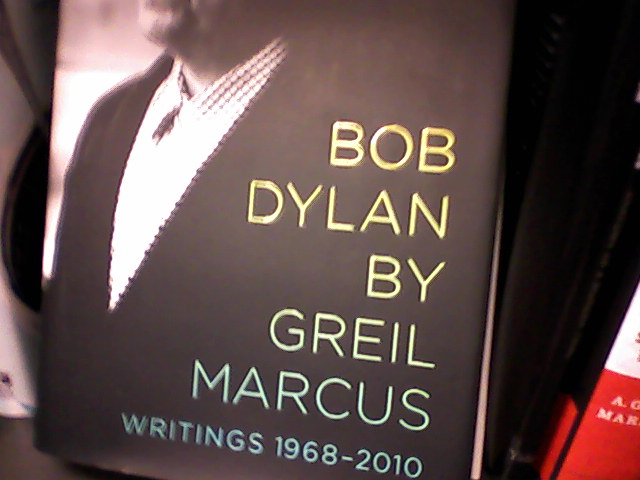




 Plastic Alto with Mark Weiss