Dude where’d you park the grand jury report?

I am struck by how underplayed the grand jury report is, in today’s Daily Post — unless they also reported on it Friday will have to check. As in: We were surprised as anyone to learn that a grand jury blasted the John Arrillaga Towers monument that we pushed so hard a couple years back. NOT.

The Weekly had already come to press Friday before they could figure out how to play this. Their cover has something softballish on it, slips my mind just what.

Council Monday should be notable for the Roxy Rapp 261 Hamilton brouhaha.

Or maybe the grand jury report is just a yawner and not a game-changer?

I will have to go to library to figure this out, back issues, current back issues.

The Post had the grand jury report as fourth lead on page one, and buried the nut graph behind a side issue about not responding soon enough to roi by Pat Marriott of Los Altos? Huh?

edit to add:

GS of the Weekly kind enough to link to an actual downloadable version of the report.

Click to access PA.pdf

When I ran into Karen Holman this a.m. happy hunting at a yard sale, and wrote above, she mentioned she had read the report, to my having only read about the report via GS and  Essinger of the Merc.

I was the sixth poster on the Weekly’s comment site, and now there are 46 posts.

edit to add, Sunday: I posted on Weekly site that the initiative to reduce council from 9 to 7 amounts to a violation in spirit of The Ralph Brown Act:

Posted by Mark Weiss, a resident of Downtown North
1 minutes ago

Mark Weiss is a registered user.

This entire initiative is in violation in spirit of The Brown Act in that it discourages public involvement in matters of governance. The Grand Jury report, among other points, describes the act in those terms. The Grand Jury report, which came out five days after this article was filed. You can link to the report here, as was reported in GS’s subsequent article.

Web Link (to Grand Jury Report)

edit to add, July sic 22, 2014, a month later: Jim Keane preliminary reaction to GJ. A formal reaction from council is due within 90 days, or by Sept. 16, 2014 or Labor Day. Neilson Buchanan told me that there was also a Grand Jury report on Palo Alto in 2004, about undedicating parkland at Terman and Rinconada (triggered by whistle blowing by Richard Placone Tom Jordan and one other).

he City has 90 days to formally respond to the Grand Jury Report and will take that formal response to the City Council for approval, as is done with all Grand Jury reports.  The City wanted to provide some initial comments on the report today, following its issuance.

“There is nothing surprising or new in the report that hasn’t been written about previously or that we have not discussed already.  The report talks a lot about inadequate process, whether the public process for the initial considerations on the 27 University site or recommendations related to public records act responses, or considerations of a possible sale of the City owned 7.7 Foothills site.

“We have already acknowledged that the public process around 27 University could have been better, and we have been clear about that.  That said, the City’s intention was always to try to guide the preliminary project in a better direction. While the project as initially proposed by Mr. Arrillaga was focused on new office buildings, the City saw the opportunity to begin to master plan and redesign the transit center and road network at this gateway entrance to the City. There was also the potential to explore the addition of a major public benefit through a regional community theater.  Funding for that work did come from the Stanford Hospital Development agreement, which specifically set aside funds to use for planning at this site.  As everyone knows, the 27 University project never came to pass and current planning for that site will be included in our very public Comprehensive Plan review process now underway.

“The Grand Jury report acknowledges the unique nature of this project, and says, ‘the developer’s proposals represented an unprecedented opportunity to address major traffic problems at an intersection where little change had taken place for many years, despite decades of planning attempts.’  

“Another concern in the report relates to City responses to Public Records requests.  The City receives many requests for information every single day and we do a really good job of responding to the public.  That said, even formal requests under the Public Records Act can come in through many different points across the City organization.  For the formal public records requests, we have added a Public Records Request webpage where there is a form that can be can filled out to better track requests.  Still, not everyone will go to the website first, so we are also looking into software that can be deployed across the organization to manage requests.

“Finally, some of the issues included in the Grand Jury report related to the Lee Gift Deed go back 30 years.  We are accountable for contemporary decisions on this land today, and to that end, on March 24, the Council has directed that the 7.7 acres be dedicated as parkland.  The City is in the process of preparing that dedication for formal Council action.”

Posted in media, Plato's Republic | Leave a comment

20 minute triple item on Mencken, Twain and Salinger

because we are leaving for East Bay, Beth Custer at Chapel of the Chimes, at quarter-past 4 on a Saturday


1. The fact is that some of the things men and women have desired most ardently for thousands of years are not nearer realization today than they were in the times of Ramses and that there is not the slightest reason for believing that they will lose their coyness on any near tomorrow…the whole earth is set off like a gigantic bomb, or drowned like a sick cat, between two buckets. (“The Cult of Hope”, from Prejudices: Second Series, in Prejudices: a selection 1919/1955 pp 85-86 I had underlined this passage, in 1984.

although mine has a picture of him by Alfred A. Knoph

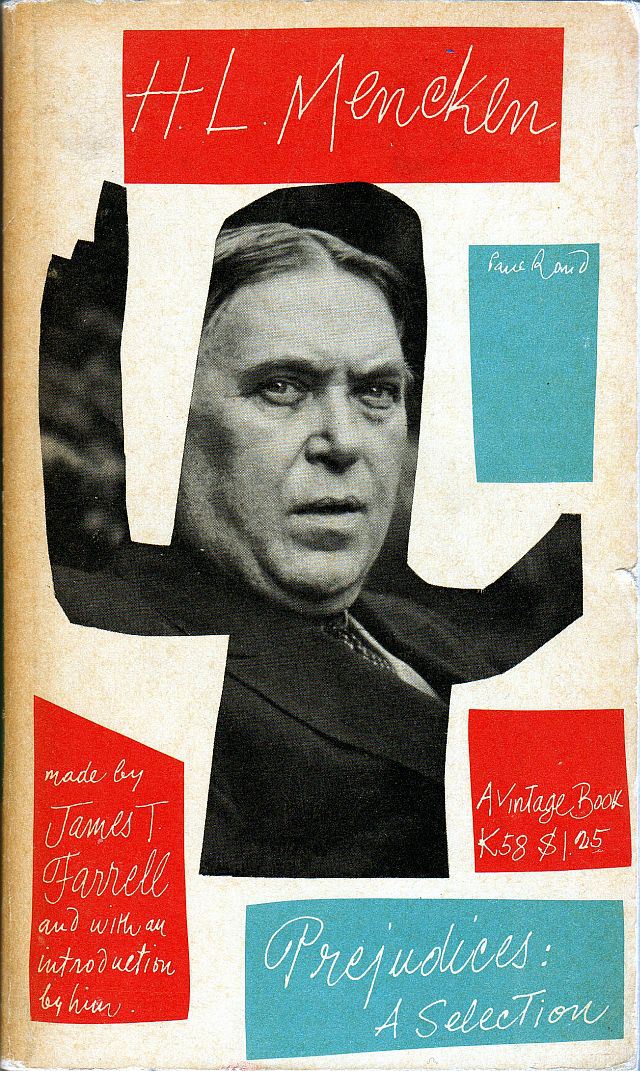
actually while searching and hoping to cutting-pasting the same photo, I found a wordpress blogger, writing on graphic design, who had the actual book cover:

Mencken paperback on Vintage designed by Paul Rand

Mencken paperback on Vintage designed by Paul Rand

2. Gentlemen, I used to have a cat here, by the name of Tom Quartz, which you’d a took an interest in I’d reckon-most anybody would. I had him here eight year – and he was the most remarkable cat I ever see. He was a large grey one of the Tom specie. an’ he had more hard natural sense than any man in this camp (natchral)– ‘n’ a power of dignity– he wouldn’t a let a Governor of Californy be familiar with him. He never ketchet a rat in his lifetime — appeared to be above it. (Roughing It, The Works of Mark Twain: Volume II 1872/1972 pp. 390-391 Chapter 61

3. I pictured myself coming out of the goddam bathroom, dressed and all, with my automatic in my pocket, and staggering around a little bit. (Catcher in the Rye, ch 14, p 104.


Posted in media, Plato's Republic, words | Tagged , , | Leave a comment

First Amendment and Lytton Plaza

I got into another cluster of conversations about Lytton Plaza and my assertion that our new ordinance banning amplifiers during business hours –which I call the Dave Heidie Laws — are unconstitutional, in the wake of the sixth Palo Alto World Music Day.

Here is the text of where I left it, a letter to four council members essentially asking them, albeit indirectly, to switch their votes:

Dear Karen Holman, Greg Schmid, Yiaway Yeh and Sid Espinosa:


I made this transcript of Daren Andersen’s report to council on Monday, Nov. 19 about the change to ordinance which would ban amplified music at Lytton Plaza, downtown Palo Alto, at University and Emerson, without a permit process or outside certain hours. I have about a dozen comments below the transcript portion.


Daren Andersen:

The plaza was renovated in 2009 and several electrical outlets were added. There was a farmers market and amplified music was to be part of the market. Gradually what happened musicians who performed started branching out on their own. There was no control or permit associated with it. They started jamming and performing on other days, and even when the farmers market disbanded and discontinued in 2010 this music continued….took on a life of its own.


And there were other unintended consequences in addition to this unpermitted music. People used electricity, to plug in portable stereos, and heaters and various other electronic equipment. And around that time the police department and community services department started to receive complaints — and it started with the business community, saying “This music is disruptive” in our business hours , you know, between 8 and 5 p.m., this loud music is carrying into our business so we can’t do our work.

And we also received complaints from local residents saying this music is going on late into the evening to midnight and its disrupting us as well.

The results of the perceptions of the surrounding businesses is that it was no longer a welcoming or safe or clean environment.

So staff attempted to solve the problem using the existing municipal codes, park rules and regulations, but they weren’t adequate to resolve the problem.

One example might be the existing noise ordinance, PAMC 9.10.650 this prohibits noise above 15 dBs above ambient at 5 feet or more. And the problem is when people are jamming and playing not all of our police officers are equipped with noise reading devices, in each police car, so when you eventually get an officer who has the right equipment to show up to the scene, set up 25 feet away, and start taking dB readings, by that time the musicians turn down, and they aren’t able to resolve the problem.

(The proposed new ordinance, banning amplifiers outright, during daylight or working hours) is a tool to resolve the issue…a little easier for police and for the musicians to understand when they can be there and when they can’t be there.

We did get some cooperation from the musicians, but not enough to resolve the problem.

October 25, 2011 at PARC (the first proposal was) to prohibit all amplified sound without a permit, PARC said amplified sound and music should be a vibrant part of the downtown and they want it…and the commission formed a sub-commission to help work on the issue. They met with the stakeholders, youth advocates and people from the business community.

The musicians wanted as much free and unfettered access to perform in this plaza as possible. Youth advocates want a place where youth can perform for free (and not necessarily have to move to other areas). The businesses said that amplified sound during the business hours is the real problem.

But they also highlighted the need to control access to these electrical outlets. The receptacles were vandalized or left open. People wanted to come and plug in all these various acoutrements, stoves and portable stereos.People would cook so there would be stains, grease stains on the plaza floor. Previously we would pressure wash once a month to (get rid of) the various stains that were everywhere.

On March 27, 2012 PARC second draft …do some additional outreach, we want some more input, keep the permit fee as low as possible, alter the system to keep the costs reasonable, essentially to provide more opportunity for people who might want to perform there. So staff went back and worked with musicians, stakeholders and the business community again and came up with a (new) plan.

Amplified sound allowed on a first-come, first-served basis, this would be free, Monday through Thursday, from 5 to 10 p.m. and Friday, 5 to 11 p.m. and Saturday, noon to 11 p.m.and Sunday, noon to 10 p.m. No permit or fees would be associated with this. Unless they wanted to reserve then the special events fee would be $90. Or outside these hours (they could get a permit, subject to review).

On June 22, 2012, staff began testing this proposed first-come, first served program.

(We connected the power system to the irrigation system. We could control remotely rather than have staff flip a switch). No problems from either business community or plaza users so far.

On August 25, by a 5 to 1 vote PARC Parks and Recreation Commission approved the new draft ordinance with commisssioner Daria Walsh dissenting because the end result she felt is that the plaza still seems too loud. But we have the general support from stakeholders and no complaints. We did our best to make the plaza safe, enjoyable and clean for as many users as possible .


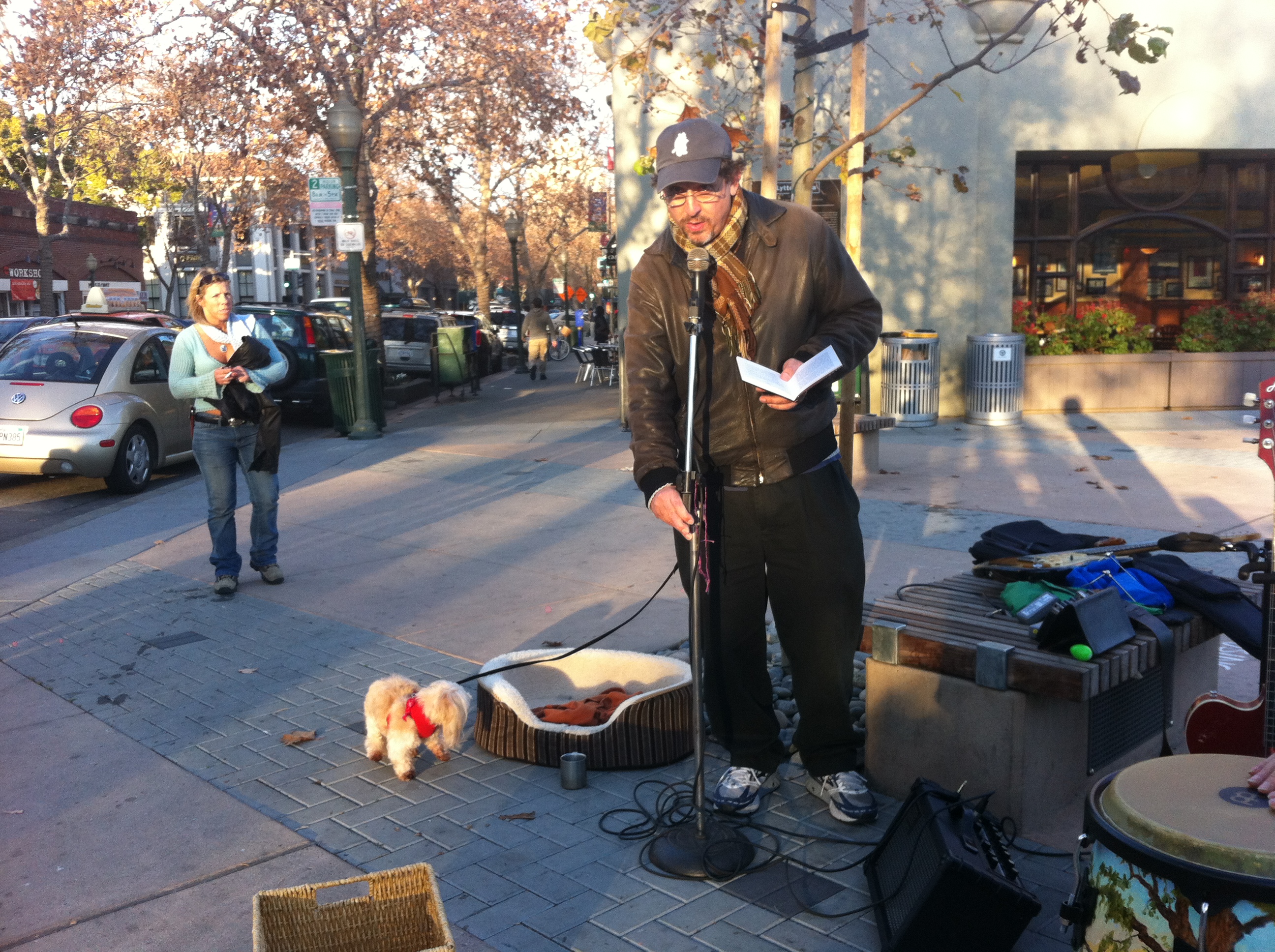
Mark Weiss, with soon to be illegal amplifier, at Lytton--photo Tommy Jordan

Mark Weiss, with soon to be illegal amplifier, at Lytton–photo Tommy Jordan

I have been following this issue quite avidly, since at least July, 2011 when Susan Webb told me that she had been told summarily to discontinue her music program. In fact, she and I met with councilmember Yeh at that time to plead the case of the value of the music program and Lytton Plaza being a park and not merely an asset to the Downtown business community or PAD.


I am concerned, with due respect, that the draft ordinance, in first reading, does not solve the problem but actually worsens the problem. I fear that while it does effectively eradicate a purported noise problem it meanwhile puts us in a position of being sued for stifling the constitutional rights of some of our community members. I am not a lawyer but have been reading the following cases for insight into our predicament:


a. Carew-Reid (New York subways)

b. Casey (Newport, R.I.)

c. Ward (Central Park, New York)

d. Stokes v. Madison, WI

e. Davenport (Alexandria, VA)


I feel our actions violate the First Amendment rights of the citizens on the following categories:


1. Is amplified music, or amplifiers per se, a type of speech?

2. Is our new ordinance pass the “narrowly-tailored” requirement?

3. Is it an adequate time place and manner limit?

4. Did we actually provide evidence, the burden of proof, that existing law, measured in decibles, is not adequate to solve the problem?


In Casey, for example, government arguably goes too far in protecting a group of residents from an obnoxious business, whose music program arguably disturbs quiet enjoyment in late night hours. Our case seems relatively novel in this field in that it purports to protect business (landlords, developers and their tenants, office workers and chain retailers) from ordinary citizens, that it does so during normal daylight hours, and in a downtown forum.


I spoke to a man named Stephen Baird in Boston area who has tracked this issue for 40 years, has a website with links to more than 20 cases similar to ours and told me that he is certain that we have gone out of bounds here, and that further our jurisdictional district, the Ninth Circuit Court of Appeals is extremely First Amendment friendly, and that in similar cases governments have had to pay out expensive penalties in court costs and damages.


It is not the case that I am threatening to sue the city but rather am trying to protect us from this unnecessary expense.


I appreciate Daren’s hard work on this but worry that it is more that he is under extreme pressure to produce a result for a powerful special interest than his findings represent the community standard here, or the best practice in balancing competing interests.


Further, in Karen Holman’s comments during Council, she refers to “two hundred complaints” and my assessment of the same data is that she is conflating total complaints in 2011 at Lytton Plaza, from Police records, with the smaller and more benign number of complaints for noise per se (19 by my count, not 200+) and that only one of those complaints came during the 9 to 5 hours.


I feel the best practice is that when anyone feels the noise at Lytton Plaza, from a musician or otherwise, is excessive he can call the police to complain and police can respond and measure the alleged nuisance in dBs and ask alleged violator to turn down, or cite them. To the extent that there were, to my understanding, no actual noise citations issued during this period, I doubt we can show burden of proof that this is a significant problem to merit burdening so much free speech, or that we have exhausted our use for the status quo ordinances. That Daren says “they weren’t adequate to solve the problem” whether he means staff per se or the laws, I don’t think his statement(s) prove the issue conclusively, not to the burden of proof required by courts in cases of Constitutional law and prior restaint.


Also, the costs of the permits, which council pushed higher than commission suggested — is prohibitive. In Carew-Reid, and or cases regarding the subway buskers of Boston, courts and analysts have said that when government claimed to be offering a permit process it was actually trying to forbid use. I have to admit that even thought I produced more than 100 events in city facilities, — Cubberley theatre, Mitchell park Amphitheatre, et cetera – my experience is that sometimes there is a bias here and an unexplainable lack of response that stifles people putting on events here. (I applied on behalf of SF Mime Troupe for a free public performance and was in effect denied; Paul George later applied the following year and was accepted; I know someone who wanted to in 2011 produce a “Save the Varsity event” and reported getting the run-around, et cetera).


My protection of the musicians’ rights at Lytton Plaza stems from my concern that the Friends committee had questionable motives in the first place. I read comments from Chop Keenan about “sketchy people” (reported in Palo Alto Campanile) and Sunny Dykwell about “undesirables” (reported in the Post) and worry that beyond merely establishing the right balance of business and civic needs, we are involved in some kind of vagrancy act. Further, the idea that three times in the meeting there is discussion of “stains” worries me. I would add that any comment on the quality of the music (“the same three chords” and similar) speaks to the point that the prior restraint is not content-neutral as would be required to pass Constitutional muster.


Also, I read the political poem “Howl” by Allen Ginsberg at Lytton Plaza, using the mic and amplifier of street musician Dave Hydie (see attached photo). Our ordinance does not distinguish between speech per se and noise.

Also, I have been in contact with the composer and recording artists Holly Herndon, a PhD candidate at Stanford who tours and performs nationally and internationally, about doing a show or appearance locally at it occurs to me that our statute would ban her instrument all together; she uses her laptop computer, played thru amplifiers.


Also, I don’t see how we can protect some amplifiers – -the speakers cranking out muzak,controllled by the pizza parlor — and ban others. Again, Daren said, to me, that someone told him that this kind of music prevents crime or what not, but that hardly seems empirically supportable or scientific.


Sunny Dykwell said at the January, 2012 stakeholders meeting that the people who feel strongly about this ban our a sub-group of the Friends, perhaps only one or two individuals which is exactly what Herb Borock asked or mentioned on the 11/19 and is consistent with the two letters about 180 University and the office tenant above. I think I may have an in with one of the founders there, a friend of a friend; I am wondering if I cannot get them to work something out with us, more tailored and less draconian than these dubious ban; maybe they would recant their testimony.


Can we at least agree to put this off 90 days, if we cannot pull from consent the second reading.


Or can we have Molly Stump read these cases and at least report that her understanding of the law includes the point raised therein?


I am also curious about Sid’s comments about visiting an office and feeling he was at a rock concert; is he talking about the same building that I reference, or can he qualify the feeling, perhaps a separate case, of this firm beyond the brief note from office manager or landlord?


It also just seems ironic and laughable that the City that produced motion pictures, oscillators, the laptop and social media would go back and ban the lowly tube amp.


Here is a little snipped from Casey that I feel hits direct on point about my objection to our new draft ordinance:

The record is devoid of any explanation of why the alternative of enforcing the City’s noise ordinance — an alternative that is on the books, is designed to address the problem of excessive noise, and has been enforced against (A&O) in the past — would not have achieved the City’s objective as effectively as the amplification ban, while placing a substantially lesser burden on speech.


I think you can get an app on your phone for about a dollar that measures dBs adequate enough for us to enforce this using status quo, despite Daren’s testimony. Sue Webb has one.


Sincerely,

Mark Weiss


Posted in Plato's Republic | Tagged | Leave a comment

Palo Alto yard hockey

City council member Karen Holman in negotiation with her neighbor Mirvat Robinson about a set of chairs

City council member Karen Holman in negotiation with her neighbor Mirvat Robinson about a set of chairs

Have you heard that joke about “I went to a fight and a hockey game broke out”?

I joked to Palo Alto City Council member, this morning at a yard sale in our Downtown North neighborhood, that we should consider this our joint kickoff event, for our respective runs toward the November election.

“Karen Holman and Mark Weiss held a joint Kickoff event Saturday, an event attended by Dave and Mirvat Robinson, two dogs, five kids and a mail deliverer, on break. The guest enjoyed a no-host lemonade bar and also were offered the chance to leave the event with some of the finest of pre-used and pre-loved functional and decorative objects. Weiss helped Holman load some slightly rusty decorative metal yard chairs into her hatchback, which Karen says the renovation of which is consistent with her longtime advocacy and impressive track record saving historic homes. Weiss, an arts activist who dates a former two -term Palo Alto Art Commissioner Terry Acebo Davis, meanwhile procured two found photographs, someone else took, of people he’ll never meet. He said buying random photos at yard sales reminds him of the recent documentary about the street photographer Vivian Mayer.

“I was intending to blog today about the photographer and conceptual artist Brian Doan, who teaches at Long Beach City College, but I happened up yesterday at Palo Alto Art Center,” Weiss said. Weiss explained that Brian and two other Vietnamese artists and arts-writers/educators we’re on their way to the Menlo Park pop-up Pace Gallery, to see the Tara Donovan, but stopped en route to meet Palo Alto Art Center artist in residence Ehran Tool, who makes ceramics that he gives away, as a way to end all war.

Dave Robinson said he was in a rock band called Hock on a small label out of Boston but is generally too busy these days as a tech entrepreneur and father to keep the band going. Weiss promised to return to meet this nice couple (and Terry’s neighbor) again to present Mirvat Robinson with a poster of a rock band M.I.R.V., who were friends of Les Claypool of Primus and briefly on his North Carolina based imprint Prawnsong Records, part of Mammoth Records, later sold to Disney, as Hollywood Records.

U.S.Mail carrier, who, like Dave Robinson of Huck or Hock, used to play in a rock band, in SF

U.S.Mail carrier, who, like Dave Robinson of Huck or Hock, used to play in a rock band, in SF

Weiss almost held a not-quite-a-campaign-announcement event 18 hours earlier when, noting the heat, he invited Doan and his two friends to come for a quick swim at the Oak Creek Apartments pool. Weiss lives in Oak Creek but spends enough time in Downtown North to be granted honorary neighbor. Many of the neighborhood dogs consider Weiss a familiar-sniff based on his five years as companion to Bryant Street stalwart Frida the Cockerspaniel (1999-2013).

Adding a dog element to any event or document enhances such, even if, as in this case, the dog, like a growing number of Palo Alto voters, and a grand jury, is skeptical about leadership, and its attempts at reform

Adding a dog element to any event or document enhances such, even if, as in this case, the dog, like a growing number of Palo Alto voters, and a grand jury, is skeptical about leadership, and its attempts at reform

Notable Downtown North movers and shakers not seen at the not-quite-a-kickoff-event yard sale included: Nielson Buchanan, Eric Rosenbloom, Marion O’Dell and Acebo Davis (working on her geraniums).

edit to add: once again Plastic Alto, run by former Gunn Oracle editor Mark Weiss, embedded in the campaign, scoops Weekly on Karen’s announcement, by five weeks!!!!!

My gloat:

Karen why don’t you prove that you are not afraid of Chop Keenen by taking the bull by the horn and get him to work with what the people want at 456 Uni, the historic and beloved Varsity Theatre — slated, with approval from ARB architects and HRB historians to become office space or a corporate lunch room: a cultural amenity for the public good.

Work with me on this and I will consider voting for you come November 5.

Win-win-win.

P.S. I think it’s great that Jim Baer IN UPPER CASE is against you. Sign of respect. If he ignores you, that means you are finished.

and then ping-backing:

On Plastic Alto blog, I scooped the Weekly on this story by a whopping five weeks:

Mark Weiss
former Gunn Oracle editor in chief
800 posts, including 200 on policy, since 2010, on “Plastic Alto”
also: running for City Council or at least qualified for ballot and blogging about that

two months later: and actually I can reveal this now but it was the fact that Karen Holman freaked out enough about my initial shock about her Steve Pierce controversy — she called me and we had a pow-wow — that made me think more seriously about running -I was among the last to pull papers, almost a month after others had; here I explain my recent decision to use one of my five votes on her, after the one for me, leaving three choices to be determined, and I also call this whack-a-troll:

For the record, I met Karen Holman while campaigning for the 2009 City Council seats. She was a planning commissioner at the time, while I was a Gunn graduate (where I was an honor student, in student government, in theatre, a varsity athlete and league champion and two-time Editor in Chief of the newspaper), dating an arts commissioner (still am), running my two small businesses and trying to follow the suggestions of people like Sid Espinosa and Peter Drekmeier who advocated “civic engagement”. I got 800 votes, but learned a lot, and started to develop a thick skin and an appetite to learn more about self-governance and Democracy in these trying times. Karen was an exemplary ally, in that she took the time to get to know some of the fellow candidates (compared to Larry Klein, who gives me, constantly a cold shoulder, for instance — by the way, Nancy Shepherd also developed a rapport with me, although I at times have disagreed with some of her actions).

For five years, as I continue to track policy, and as of fall, 2010 write about it on Plastic Alto, my blog, Karen Holman has kept a line of communication open to me.

So as I have campaigned for Council (after getting nearly 6,000 votes in 2012, all without spending a dime, in a time when seated candidates spent on average $20, 000) these last 30 days, I thought about the incumbents, especially in the wake of the Grand Jury report of June 16, 2014 and the referendum of 2013. I have seriously thought about voting for 0 incumbents (and therefore myself and four other challengers) or voting back in all 3 (because in certain ways Greg Scharff and I are experiencing a type of glasnost, although I disagreed with a lot of his actions and tactics in the ensuing years).

So, despite it’s awkwardness, I announced I am voting for Karen, after I vote for myself — in my imaginary-rank-choice ballot. She is one of my five choices, with the other three remain to be seen. There are 60 more days in the campaign.

There is no one on Council or Commissions that I would refuse to work shoulder-to-shoulder with, for the good of the community. I give them hell on my blog, here sometimes and at times it gets dicey in person — for instance when Vino Locale sat Terry and I at a captains table with Pat and Sally Burt and two other couples, on St. Patricks day, a few days after Pat and I went at it after he objected to my giving him the business online or on my blog — and ironically, or fittingly, I was questioning his tone and believability over….27 UNIVERSITY. But I still hit up Pat from time to time, for instance, I saw him at the Mads Tolling show at Mitchell Park and asked him about 456 Uni. Also, people point out that as I lobby for A NEW PARK AT VENTURA, ON FRY’S PROPERTY, 15 ACRES, Pat is given credit for bringing Heritage Park to fruition, so he may come on board as my ally.

Politics makes strange bedfellows.

I recommend attending some of the campaign events and not relying on the internet.

So, yeah, this is me. (You can check that my cross-referencing my blog; I tend to back up my posts there).

Thank you Karen for your years of service, good luck, but yeah, watch your step, sister!

Web Link
That’s for the person who objects to my use of the term “man-up”. It’s from the Broadway show by the founders of South Park.

Namaste.

Posted in music, Plato's Republic, sex, Uncategorized | Tagged , , , , , | Leave a comment

Palo Alto hardball and hidden ball trick

Posted by Mark Weiss, a resident of Downtown North
0 minutes ago

Mark Weiss is a registered user.

This is a power play or stunt to improve the odds, or so they think, of continuing the recent Real Estate rout.

Very similar, in my mind, to the vote to switch the election from 2011 to 2012.

Scharff and Shepherd will be scrutinized much more closely between now and November than they were in 2009. By us, We The People, if not by you, the Weekly, who after all let Scharff call himself “a country lawyer” when “real estate lawyer” or “real estate developer and landlord” and or “former head of acquisitions for Prometheus, a leading developer of rental property” (who incidentally are the ones trying to get upzoning and oust residents of Buena Vista). In Scharff’s own propaganda, he quoted the Weekly verbatim, minus changing “”country lawyer” to “{private practice]”.

Holman should run again, after checking in with her 20 most credible supporters, and distance herself from the ambiguity her recent statements represent.

But are there five or more quality people willing to step up here?

I texted a council person Monday and said “Good luck tonite. Keep Council at 9 not 7 in the name of Civic engagement and not an oligarchy. Mark W”

Posted in media, Plato's Republic | 3 Comments

Mencken on the Palo Alto Process

H.L. Mencken is actually the coiner, as it were, of the term “Palo Alto Process”. He was not, as some believe, talking about how long it takes to install, or get the proper permits if one wants to install, the bath tub, which incidentally was invented here, by Jane Stanford, when Leland Junior was 3 years old, at the Old Barn, which is now very fittingly a children’s hospital, with free McDonalds Hamburgers as well, poor dears.

I thought of this today, I head read Mencken some years ago, as at undergrad, at Dartmouth, with James Melville Cox, who used to play stud poker with the great columnist, because of a local pundit writing in our paper of record, the electronic probably not the pulp one.

But he paraphrased H.L, which is not easy to do. He said HL said:

Every problem has a simple solution. But it is probably, like drinking bath water towards the end of the week, wrong.

What the Baltimore Booya actually said was:

there 

is always a well-known solution to every human 

problem neat, plausible, and wrong.


IV. THE DIVINE AFFLATUS


THE suave and cedematous Chesterton, in a late

effort to earn the honorarium of a Chicago

newspaper, composed a thousand words of

labored counterblast to what is called inspiration in

the arts. The thing itself, he argued, has little if any

actual existence; we hear so much about it because

its alleged coyness and fortuitousness offer a con-

venient apology for third-rate work. The man taken

in such third-rate work excuses himself on the ground

that he is a helpless slave of some power that stands

outside him, and is quite beyond his control. On

days when it favors him he teems with ideas and

creates masterpieces, but on days when it neglects him

he is crippled and impotent a fiddle without a bow,

an engine without steam, a tire without air. All

this, according to Chesterton, is nonsense. A man

who can really write at all, or paint at all, or compose

at all should be able to do it at almost any time, pro-

vided only “he is not drunk or asleep.”


So far Chesterton. The formula of the argument

is simple and familiar: to dispose of a problem all

that is necessary is to deny that it exists. But there

are plenty of men, I believe, who find themselves

unable to resolve the difficulty in any such cavalier

manner men whose chief burden and distinction,

in fact, is that they do not employ formulae in their

thinking, but are thrown constantly upon industry,

ingenuity and the favor of God. Among such men

there remains a good deal more belief in what is

vaguely called inspiration. They know by hard ex-

perience that there are days when their ideas flow

freely and clearly, and days when they are dammed

up damnably. Say a man of that sort has a good

day. For some reason quite incomprehensible to him all his mental processes take on an amazing ease and slickness. Almost without conscious effort

he solves technical problems that have badgered him

for weeks. He is full of novel expedients, extraor-

dinary efficiencies, strange cunnings. He has a

feeling that he has suddenly and unaccountably broken

through a wall, dispersed a fog, got himself out of

the dark. So he does a double or triple stint of the

best work that he is capable of maybe of far better

work than he has ever been capable of before and

goes to bed impatient for the morrow. And on the

morrow he discovers to his consternation that he has

become almost idiotic, and quite incapable of any

work at all.


I challenge any man who trades in ideas to deny

that he has this experience. The truth is that he has

it constantly. It overtakes poets and contrapuntists,


critics and dramatists, philosophers and journalists;

it may even be shared, so far as I know, by advertise-

ment writers, chautauqua orators and the rev. clergy.

The characters that all anatomists of melancholy mark

in it are the irregular ebb and flow of the tides, and

the impossibility of getting them under any sort of

rational control. The brain, as it were, stands to one

side and watches itself pitching and tossing, full of

agony but essentially helpless. Here the man of

creative imagination pays a ghastly price for all his

superiorities and immunities; nature takes revenge

upon him for dreaming of improvements in the scheme

of things. Sitting there in his lonely room, gnawing

the handle of his pen, racked by his infernal quest,

horribly bedevilled by incessant flashes of itching,

toothache, eye-strain and evil conscience thus tor-

tured, he makes atonement for his crime of being

intelligent. The normal man, the healthy and honest

man, the good citizen and householder this man, I

daresay, knows nothing of all that travail. It is

reserved especially for artists and metaphysicians.

It is the particular penalty of those who pursue strange

butterflies into dark forests, and go fishing in en-

chanted and forbidden streams.


Let us, then, assume that the fact is proved: the

nearest poet is a witness to it. But what of the under-

lying mystery? How are we to account for that

puckish and inexplicable rise and fall of inspiration?


My questions, of course, are purely rhetorical. Ex-

planations exist; they have existed for all time; there

is always a well-known solution to every human

problem neat, plausible, and wrong. The ancients,

in the case at bar, laid the blame upon the gods:

sometimes they were remote and surly, and sometimes

they were kind. In the Middle Ages lesser powers

took a hand in the matter, and so one reads of works

of art inspired by Our Lady, by the Blessed Saints,

by the souls of the departed, and even by the devil.

.In our own day there are explanations less super-

natural but no less fanciful to wit, the explanation

that the whole thing is a matter of pure chance, and

not to be resolved into any orderly process to wit,

the explanation that the controlling factor is external

circumstance, that the artist happily married to a

dutiful wife is thereby inspired finally, to make an

end, the explanation that it is all a question of Freu-

dian complexes, themselves lurking in impenetrable

shadows. But all of these explanations fail to satisfy

the mind that is not to be put off with mere words.

Some of them are palpably absurd; others beg the

question. The problem of the how remains, even

when the problem of the why is disposed of. What

is the precise machinery whereby the cerebrum is

bestirred to such abnormal activity on one day that

it sparkles and splutters like an arclight, and reduced

to such feebleness on another day that it smokes and

gutters like a tallow dip?


In this emergency, having regard for the ages-long

and unrelieved sufferings of artists great and small,

I offer a new, simple, and at all events not ghostly

solution. It is supported by the observed facts, by

logical analogies and by the soundest known prin-

ciples of psychology, and so I present it without apolo-

gies. It may be couched, for convenience, in the

following brief terms: that inspiration, so-called, is

a function of metabolism, and that it is chiefly con-

ditioned by the state of the intestinal flora in larger

words, that a man’s flow of ideas is controlled and

determined, both quantitatively and qualitatively, not

by the whims of the gods, nor by the terms of his armis-

tice with his wife, nor by the combinations of some

transcendental set of dice, but by the chemical content

of the blood that lifts itself from his liver to his brain,

and that this chemical content is established in his

digestive tract, particularly south of the pylorus. A

man may write great poetry when he is drunk, when

he is cold and miserable, when he is bankrupt, when

he has a black eye, when his wife glowers at him

across the table, when his children lie dying of

smallpox; he may even write it during an earthquake,

or while crossing the English channel, or in the midst

of a Methodist revival, or in New York. But I am so

far gone in materialism that I am disposed to deny

flatly and finally, and herewith do deny flatly and

finally, that there has lived a poet in the whole history

of the world, ancient or modern, near or far, who

ever managed to write great poetry, or even passably

fair and decent poetry, at a time when he was suffer-

ing from stenosis at any point along the thirty-foot

via dolorosa running from the pylorus to the sigmoid

flexure. In other words, when he was


But perhaps I had better leave your medical adviser

to explain. After all, it is not necessary to go any

further in this direction; the whole thing may be

argued in terms of the blood stream and the blood

stream is respectable, as the duodenum is an outcast.

It is the blood and the blood only, in fact, that the

cerebrum is aware of; of what goes on elsewhere it

can learn only by hearsay. If all is well below, then

the blood that enters the brain through the internal

carotid is full of the elements necessary to bestir the

brain-cells to their highest activity; if, on the contrary,

anabolism and katabolism are going on ineptly, if the

blood is not getting the supplies that it needs and not

getting rid of the wastes that burden it, then the brain-

cells will be both starved and poisoned, and not all

the king’s horses and all the king’s men can make

them do their work with any show of ease and effi-

ciency. In the first case the man whose psyche dwells

in the cells will have a moment of inspiration that

is, he will find it a strangely simple and facile matter

to write his poem, or iron out his syllogism, or make

his bold modulation from F sharp minor to G major,

or get his flesh-tone, or maybe only perfect his swindle.

But in the second case he will be stumped and help-

less. The more he tries, the more vividly he will be

conscious of his impotence. Sweat will stand out in

beads upon his brow, he will fish patiently for the

elusive thought, he will try coaxing and subterfuge,

he will retire to his ivory tower, he will tempt the

invisible powers with black coffee, tea, alcohol and

the alkaloids, he may even curse God and invite death

but he will not write his poem, or iron out his syl-

logism, or find his way into C major, or get his flesh-

tone, or perfect his swindle.


Fix your eye upon this hypothesis of metabolic

inspiration, and at once you will find the key to many

a correlative mystery. For one thing, it quickly ex-

plains the observed hopelessness of trying to pump

up inspiration by mere hard industry the essential

imbecility of the 1,000 words a day formula. Let

there be stenosis below, and not all the industry of a

Hercules will suffice to awaken the lethargic brain.

Here, indeed, the harder the striving, the worse the

stagnation as every artist knows only too well. And

why not? Striving in the face of such an interior

obstacle is the most cruel of enterprises a business

more nerve-wracking and exhausting than reading a


newspaper or watching a bad play. The pain thus

produced, the emotions thus engendered, react upon

the liver in a manner scientifically displayed by Dr.

George W. Crile in his “Man: An Adaptive Mechan-

ism,” and the result is a steady increase in the intes-

tinal demoralization, and a like increase in the pollu-

tion of the blood. In the end the poor victim comes

to a familiar pass; beset on the one hand by impo-

tence and on the other hand by an impatience grown

pathological, he gets into a state indistinguishable

from the frantic. It is at such times that creative

artists suffer most atrociously. It is then that they

writhe upon the sharp spears and red-hot hooks of

a jealous and unjust Creator for their invasion of

His monopoly. It is then that they pay a grisly super-

tax upon their superiority to the great herd of law-

abiding and undistinguished men. The men of this

herd never undergo any comparable torture ; the agony

of the artist is quite beyond their experience and even

beyond their imagination. No catastrophe that could

conceivably overtake a lime and cement dealer, a

curb broker, a lawyer, a plumber or a Presbyterian

is to be mentioned in the same breath with the torments

that, to the most minor of poets, are familiar incidents

of his professional life, and, to such a man as Poe,

or Beethoven, or Brahms, are the commonplaces of

every day. Beethoven suffered more during the

composition of the Fifth symphony than all the judges


on the supreme benches of the world have suffered

jointly since the time of the Gerousia.


Again, my hypothesis explains the fact that inspira-

tion, save under extraordinary circumstances, is never

continuous for more than a relatively short period.

A banker, a barber or a manufacturer of patent medi-

cines does his work day after day without any notice-

able rise or fall of efficiency; save when he is drunk,

jailed or ill in bed the curve of his achievement is

flattened out until it becomes almost a straight line.

But the curve of an artist, even of the greatest of

artists, is frightfully zig-zagged. There are moments

when it sinks below the bottom of the chart, and im-

mediately following there may be moments when it

threatens to run off the top. Some of the noblest

passages written by Shakespeare are in his worst plays,

cheek by jowl with padding and banality; some of

the worst music of Wagner is in his finest music

dramas. There is, indeed, no such thing as a flawless

masterpiece. Long labored, it may be gradually en-

riched with purple passages the high inspirations of

widely separated times crowded together , but even

so it will remain spotty, for those purple passages will

be clumsily joined, and their joints will remain as ap-

parent as so many false teeth. Only the most ele-

mentary knowledge of psychology is needed to show

the cause of the zig-zagging that I have mentioned.

It lies in the ‘elemental fact that the chemical consti-


tution of the blood changes every hour, almost every

minute. What it is at the beginning of digestion is

not what it is at the end of digestion, and in both

cases it is enormously affected by the nature of the

substances digested. No man, within twenty-four

hours after eating a meal in a Pennsylvania Railroad

dining-car, could conceivably write anything worth

reading. A tough beefsteak, I daresay, has ditched

many a promising sonnet, and bad beer, as every one

knows, has spoiled hundreds of sonatas. Thus in-

spiration rises and falls, and even when it rises twice

to the same height it usually shows some qualitative

difference there is the inspiration, say, of Spring

vegetables and there is the inspiration of Autumn

fruits. In a long work the products of greatly differ-

ing inspirations, of greatly differing streams of blood,

are hideously intermingled, and the result is the in-

evitable spottiness that I have mentioned. No one

but a maniac argues that “Die Meistersinger” is all

good. One detects in it days when Wagner felt, as

the saying goes, like a fighting cock, but one also

detects days when he arose in the morning full of

acidosis and despair days when he turned heavily

from the Pierian spring to castor oil.


Moreover, it must be obvious that the very condi-

tions under which works of art are produced tend to

cause great aberrations in metabolism. The artist

is forced by his calling to be a sedentary man. Even

a poet, perhaps the freest of artists, must spend a

good deal of time bending over a desk. He may con-

ceive his poems in the open air, as Beethoven conceived

his music, but the work of reducing them to actual

words requires diligent effort in camera. Here it

is a sheer impossibility for him to enjoy the ideal

hygienic conditions which surround the farmhand, the

curb-broker and the sailor. His viscera are con-

gested; his eyes are astrain; his muscles are without

necessary exercise. Furthermore, he probably

breathes bad air and goes without needed sleep. The

result is inevitably some disturbance of metabolism,

with a vitiated blood supply and a starved cerebrum.

One is always surprised to encounter a poet who is

ruddy and stout; the standard model is a pale and

flabby stenotic, kept alive by patent medicines. So

with the painter, the musical composer, the sculptor,

the artist in prose. There is no more confining work

known to man than instrumentation. The composer

who has spent a day at it is invariably nervous and ill.

For hours his body is bent over his music-paper, the

while his pen engrosses little dots upon thin lines.

I have known composers, after a week or so of such

labor, to come down with auto-intoxication in its most

virulent forms. Perhaps the notorious ill health

of Beethoven, and the mental break-downs of Schu-

mann, Tschaikowsky and Hugo Wolf had their origin

in this direction. It is difficult, going through the history of music, to find a single composer in the

grand manner who was physically and mentally up to

par.


I do not advance it as a formal corollary, but no

doubt this stenosis hypothesis also throws some light

upon two other immemorial mysteries, the first being

the relative aesthetic sterility of women, and the other

being the low aesthetic development of certain whole

classes, and even races of men, e. g., the Puritans, the

Welsh and the Confederate Americans. That women

suffer from stenosis far more than men is a common-

place of internal medicine; the weakness is chiefly to

blame, rather than the functional peculiarities that

they accuse, for their liability to headache. A good

many of them, in fact, are habitually in the state of

health which, in the artist, is accompanied by an utter

inability to work. This state of health, as I have said,

does not inhibit all mental activity. It leaves the

powers of observation but little impaired; it does

not corrupt common sense; it is not incompatible

with an intelligent discharge of the ordinary duties

of life. Thus a lime and cement dealer, in the

midst of it, may function almost as well as when

his metabolic processes are perfectly normal, and

by the same token a woman chronically a victim

to it may yet show all the sharp mental competence

which characterizes her sex. But here the thing

stops. To go beyond to enter the realm of

constructive thinking, to abandon the mere application

of old ideas and essay to invent new ideas, to precip-

itate novel and intellectual concepts out of the chaos

of memory and perception this is quite impossible

to the stenotic. Ergo, it is unheard of among classes

and races of men who feed grossly and neglect per-

sonal hygiene; the pill-swallower is the only artist

in such groups. One may thus argue that the elder

Beecham saved poetry in England, as the younger

Beecham saved music. . . . But, as I say, I do not

stand behind the hypothesis in this department, save,

perhaps, in the matter of women. I could amass

enormous evidences in favor of it, but against them

there would always loom the disconcerting contrary

evidence of the Bulgarians. Among them, I suppose,

stenosis must be unknown but so are all the fine arts.

“La force et la foiblesse de 1’esprit,” said Roche-

foucauld, “sont mal nominees; elles ne sont, en effect,

que la bonne ou la mauvaise des organes du corps.”

Science wastes itself hunting in the other direction.

We are flooded with evidences of the effects of the

mind on the bodv, and so our attention is diverted

from the enormously greater effects of the body en the

mind. It is rather astonishing that the Wassermann

reaction has not caused the latter to be investigated

more thoroughly. The first result of the general em-

ployment of that great diagnostic device was the dis-

covery that thousands of cases of so-called mental

disease were really purely physical in origin that

thousands of patients long supposed to have been

crazed by seeing ghosts, by love, by grief, or by re-

verses in the stock-market were actually victims of the

small but extremely enterprising spirochaete pallida.

The news heaved a bomb into psychiatry, but it has

so far failed to provoke a study of the effects of other

such physical agents. Even the effects of this one

agent remain to be inquired into at length. One now

knows that it mav cause insanitv, but what of the


lesser mental aberrations that it produces? Some of

these aberrations may be actually beneficial. That

is to say, the mild toxemia accompanying the less

virulent forms of infection may stimulate the brain

to its highest functioning, and so give birth to what

is called genius a state of mind long recognized, by

popular empiricism, as a sort of half-way station on

the road to insanity. Beethoven, Nietzsche and

Schopenhauer suffered from such mild toxemias, and

there is not the slightest doubt that their extraordinary

mental activity was at least partly due to the fact.

That tuberculosis, in its early stages, is capable of the

same stimulation is a commonplace of observation.

The consumptive may be weak physically, but he is

usually very alert mentally. The history of the arts,

in fact, shows the names of hundreds of inspired con-

sumptives.


Here a physical infirmity produces a -result that is

beneficial, just as another physical infirmity, the

stenosis aforesaid, produces a result that is baleful.

The artist often oscillates horribly between the two

effects; he is normally anything but a healthy animal.

Perfect health, indeed, is a boon that very few men

above the rank of clodhoppers ever enjoy. What

health means is a degree of adaptation to the organ-

ism’s environment so nearly complete that there is no

irritation. Such a state, it must be obvious, is not

often to be observed in organisms of the highest com-

plexity. It is common, perhaps, in the earthworm.

This elemental beast makes few demands upon its

environment, and is thus subject to few diseases. It

seldom gets out of order until the sands of its life

are run, and then it suffers one grand illness and dies

forthwith. But man is forever getting out of order,

for he is enormously complicated and the higher

he rises in complexity, the more numerous and the

more serious are his derangements. There are whole

categories of diseases, e. g. 9 neurasthenia and hay-

fever, that afflict chiefly the more civilized and delicate

ranks of men, leaving the inferior orders unscathed.

Good health in man, indeed, is almost invariably a

function of inferiority. A professionally healthy

man, e. g., an acrobat, an osteopath or an ice-wagon

driver, is always stupid. In the Greece of the great

days the athletes we hear so much about were mainly

slaves. Not One of the eminent philosophers, poets or

statesmen of Greece was a good high-jumper. Nearly

all of them, in fact, suffered from the same malaises

which afflict their successors of to-day, as you will

quickly discern by examining their compositions.

The aesthetic impulse, like the thirst for truth, might

almost be called a disease. It seldom if ever ap-

pears in a perfectly healthy man.


But we must take the aloes with the honey. The

artist suffers damnably, but there is compensation in

his dreams. Some of his characteristic diseases

cripple him and make his whole life a misery, but

there are others that seem to help him. Of the latter,

the two that I have mentioned carry with them concepts

of extreme obnoxiousness. Both are infections, and

one is associated in the popular mind with notions

or gross immorality. But these concepts of obnox-

iousness should not blind us to the benefits that appar-

ently go with the maladies. There are, in fact, mala-

dies much more obnoxious, and they carry no com-

pensating benefits. Cancer is an example. Perhaps

the time will come when the precise effects of these

diseases will be worked out accurately, and it will

be possible to gauge in advance their probable influ-

ence upon this or that individual. If that time ever

comes the manufacture of artists will become a

feasible procedure, like the present manufacture of

soldiers, capons, right-thinkers and doctors of philos-

ophy. In those days the promising young men of

the race, instead of being protected from such diseases

at all hazards, will be deliberately infected with them,

as soils are now inoculated with nitrogen-liberating

bacteria. … At the same time, let us hope, some

progress will be made against stenosis. It is, after

all, simply a question of technique, like the artificial

propagation of the race by the device of Dr. Jacques

Loeb. The poet of the future, come upon a period

of doldrums, will not tear his hair in futile agony.

Instead, he will go to the nearest clinic, and there get

his rasher of Bulgarian bacilli, or an injection of

some complex organic compound out of a ductless

gland, or an order on a masseur, or a diet list, or

perchance a barrel of Russian oil.


Posted in Plato's Republic, words | Tagged , | Leave a comment

Harry Hillman of Dartmouth

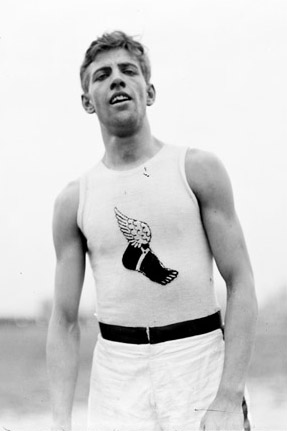
Harry_HillmanI have Harry Hillman’s scrapbook, which he started in 1899 and kept adding until about 1910 or so. Plus when Glenn Cunningham ran a 4:04:04 indoor mile, on a course designed by Coach Hillman at Dartmouth’s Alumni Gym, he added that lone free clipping as well, about 1932.

I have a file on my notes and research, including some letters from Dr. Donald Burnham, who was coached by Hillman and was a national champion miler for the Indians (The Big Green we would say, today).

I also wrote about Gunder Hagg, who Hillman trained with, according to Burnham.

I thought of all this today after meeting Aaron Vanderhoof yesterday, who made a bronze tribute to his friend Eric Martinez. I wrote about earlier.

I have another photo or two in my file that I can “swede” in.

Above is something borrowed from crowd-sources.

I also just posted a comment on a woman’s blog, and her version of Hillman-Robertson.

Someday we will hear that today’s athletes finally bested the 1909 result in which Harry Hilman and Lawson Robertson ran 100 yards in 11.0 flat, while their legs tied together. Don’t try this at home unless you are already national-class and have hours to train with a partner, the way that Harry and Lawson did.

Posted in media | Tagged | Leave a comment

Aaron Vanderhoof goes all out for art tribute to fallen friend

vanderhoofStatue


aaronVanderhoofartSpine


Michelle Barbaria and Aaron Vanderhoof, in front of the good doctor's office, on University, posed with their life-size-plus tribute to their friend Eric Martinez. That it features an enhanced spinal chord pushes it from monument or statute to public art,  in my opinion.

Michelle Barbaria and Aaron Vanderhoof, in front of the good doctor’s office, on University, posed with their life-size-plus tribute to their friend Eric Martinez. That it features an enhanced spinal chord pushes it from monument or statute to public art, in my opinion.

I did chat up Aaron and Michelle for quite a spell Wednesday, and his tale about producing the runner statute is quite impressive, methinks. I will have to edit to add later. Meanwhile, here is what I had posted previously before I had the skinny.

From an earlier post about the David Levinthal show in San Jose Museum:

My brain kinda flashed to having seen a new piece of sculpture down at the East extreme of Palo Alto University Avenue, past House of Bagels and Tamarine (the most Easterly culture haunts on my map), a large bronze of a life-size or super-sized or at least super-sturdy looking athlete, a runner, or maybe a sprinter.
The man is hunched forward like he is in a sprint. He has a logo for the leading sports shoe manufacturer on his shoes. He also has the name of the business/tenant on a name-tag (in bronze) on his shorts and shirt. The sponsor of the work — somewhere between public art, sculpture, a statue and a monument — is a chiropractor or a sports chiropractor. And his name fittingly is Vanderhoof. (Hoof being a reference to “feet”, in my mind, maybe he is a podiatrist, as well, like my Gunn contemporary Amol Saxena). I was thinking of chatting up the guy about doubling down on monument but adding some kind of value like could the statue, the next statue, that he and I could co-produce, with some fellow travelers and art-sports-scene hoofers, be of someone or something more specific. Think John Carlos and Smith as seen by Rigo, at San Jose State. Think Major Taylor in Worcester. Think Heisman Trophy winners at not-much-else-going on large public schools in midwest and south. (Chris Wuelpher?) Think weird tribute to electronics pioneer, eugenicist and pseudo-inspiration to Silicon Valley mavericks in Cali Avenue Area — could this runner be the same artist – fabricator? I am also still looking for an outlet for my Harry Hillman or my Hillman-Robertson jones. I will edita with pic of runner. And hopefully some informed (shaped) comments on Levinthall and or “Ida”. Dr. Aaron Vanderhoof at 616 University.

The most obvious correction from above is that Aaron designed and produced and installed this work himself, thanks to finding online a fabricator overseas. And his motivation was to honor his friend and colleague Eric Martinez, a recently deceased trainer and athlete.

What popped into my gray-matter this morning was the untimely demise of Bill Green, who for Cubberley High in 1980 broke a national record in the 440. He would have gone to the Olympics, and maybe taken home to Palo Alto one or more gold medals, if Jimmy Carter had not called for a boycott of the Games, in Moscow. Bill died recently, a rare disease that presented with him unable to move his legs, ironically enough. Maybe, if Aaron feels a second wind as art provocateur, we can team up to honor Bill Green In Action with a similar treatment. Earlier I had chatted up Joey Piziali, a former Paly footballer, about creating a colorful mural on Cubberley campus grounds re Green. (I was picturing gold, black, green, red, white and blue or something). Maybe it’s not to late to pitch this idea to Mandy Lowell et all, albeit a bit like putting on a blind fold and winding up with the 24-pound hammer, then letting it fly.billGreen

Harry Hillman was a Dartmouth coach who along with Lawson Robertson hold the World Record for 100-yard dash as a tandem — the so-called Three-Legged-Race, 11 seconds flat in New York in 1909, more than 100 years ago. Today’s runners are much faster, but arguably their ego’s would not permit them to team up the way Harry and Lawson did — that duo came out of a military track team that performed many events that combined precision and fun and selflessness.


Posted in art | Tagged , , , | Leave a comment

Hannah may Hannah will

Gunn grad gone country Hannah May Allison in front of Lululemon, at Palo Alto World Music Day, 2014

Gunn grad gone country Hannah May Allison in front of Lululemon, at Palo Alto World Music Day, 2014

Hannah May Allison was one of the classier and most promising acts to lively up downtown Palo Alto Sunday for the annual street music event. I shot her from a distance, and got close enough to scrutinize her new EP, but did not stick around to chat her up, as I did two years before.

Paul Freeman of the Daily News had a fairly extensive interview yesterday with Hannah about life in Nashville. She is a rising junior at Belmont College, majoring in Songwriting. He say she say:

There’s a Southern hospitality in Nashville. But still, there’s so much competition, more than I ever imagined there would be. Everyone’s there for the same reason — and that gets hard sometimes. But everyone’s very friendly and wants to help you. And that makes me want to help, too. In Nashville, it’s all about musicians helping each other. And that’s a great thing. And that’s especially true in the Belmont community.

They should put her on the tourism board. Come to think of it, fellow Gunn grad (like Allison, like me) Yiaway Yeh is working in the Mayor’s office down there in development so maybe those two should do a Titensity huddle or some such. Maybe Hannah and Yiaway can team up to tune some of those (not very effective) football cheers: we got the power to, we got the power to, we got the power to, WHOOP-YOU! A lot of the football cheers had an urban tinge but maybe what would help the teams is a little twang.

I hope to attend an upcoming show and catch up with her about how it’s going. She plays the Cali Ave farmer’s market early — 9:30 hit — on June 29 Sunday.

edit to add: this conflicts with the Mexico-Holland soccer match, unless I can catch part of it on Cali Ave, tape the rest and or see her after the match, which goes to about 11). Here is Palo Alto’s finest Hannah May Allison covering her fellow Belmont songstress Trisha Yearwood:

2nd edit to add: I am opting to tape the second half of Mexico “Ned is Dead” so as to catch our Miss Hannah. Also, she can be seen and heard at Cats in Los Gatos on Tuesday, July 1 from 6 to 9, and Gilroy Garlic Festival before heading back South. She plays Monday Aug. 4 at Commodore Grille, for instance.

I have in my bag a Hannah May Allison ear-training kit that I doubt I will actually have the  nerve to lay on her, things I had lost at my girlfriends house that I gathered this a.m: Sasha Dobson, Bill Frisell doing Lennon (and featuring Jenny Scheinman), Marcia Ball, Inside Llewyn Davis soundtrack, The Donnas Get Skintight. I still wonder about Austin v. Nashville, or what she thinks about it. And I wonder about getting Hannah to write about music or these cd’s for Plastic Alto.

Posted in music, Plato's Republic, sex | Tagged , , , | Leave a comment

Palo Alto hardball

Greg Brown mural in Roxy Rapp building, above elevator

Greg Brown mural in Roxy Rapp building, above elevator

Posted by Mark Weiss, a resident of Downtown North
1 minutes ago

Mark Weiss is a registered user.

How is it not relevant for the reporter here to mention that the developer here is Roxy Rapp, one of the biggest developers in town?

Web Link

Others have written that some developers get even more favoritism in staff rulings than the average.

You mention the architect firm in first reference and don’t mention developer at all until the next to last graph, and omit his name? Why is that?

The Weekly does not comprehensively cover the Real Estate Industry, it merely piece by piece, trumpets a proposal and occasionally like here covers the opposition.

Mr. Rapp, is not, just to be clear, the Big Three developer who helped the Weekly’s recent investment in its own building on Cambridge.

At the ball game I buy a scorecard, and in Palo Alto I advise we start tracking properties by their owners, and track their tendencies. I heard an interview with John Madden recently describing early in his football coaching career going to a lecture by Vince Lombardi which consisted of five hours discussing one play — with their literally billion-dollars incentive the industry certainly knows its business to a degree of high sophistication. We the People, even if leadership won’t or cannot, would be well-advised, if we want a chance to win, to learn the nuances of this problem beyond just our sense that this or that project is too tall or ugly.

How about a chart of downtown showing the holdings of each of the biggest 20 landlords? (How about a chart showing holdings, here and otherwise, of current council?)

Kudos to Tom Jordan, Doria Summa, and Sheri Furman for their tenacity, diligence and courage here.

By the way, the artist Greg Brown tells me it’s okay if the interior mural at 261 Hamilton gets destroyed in the process — it depicts a fiend cutting the wires to the elevator which he says Roxy ordered as a way to drive out a tenant he disfavored, a shrink treating paranoics.

And then:

Posted by Mark Weiss, a resident of Downtown North
0 minutes ago

Mark Weiss is a registered user.

Under further review, I meant to say that the developer is mentioned seven times but not by name: Roxy Rapp.

His building at Bryant and Uni used to have studio space for Al Young the poet laureate of California and now has office space for Laurene Powell Jobs the billionaire widow throwing coffee klatches for uber-wealthy and uber-powerful who require Secret Service and PAPD escorts, if that is Palo Alto today in a nutshell. “Our Palo Alto” — who is the “we’?????

Posted by Mark Weiss, a resident of Downtown North
0 minutes ago

I don’t know if my concerns are “poisoning” or “polarizing” or “French” but I would note, with due respect, that of the 30 posts so far on this topic no one else feels strongly enough about their opinion to add their full name to their statements, which to me leaves plenty of room for improvement in the discourse.

I’ve had some familiarity with the Rapp family for about 30 years, his two daughters Shannon and Kelly were classmates of mine at Gunn, I dressed in his Euro-clothing (yikes, was it…French?) even back east at a conservative preppy college — and was duly chastised even, for my look — and have eaten at some of the restaurants that were his tenants — Croutons, Machisimo Mouse, etc — and I think that on balance the Rapps have done a lot of good for Palo Alto. Yet the current environment, here and nationwide, world-wide — makes me worry about the effect of certain types of capital and capitalists. Read George Packer, Gunn 1975, “The Unwinding”.

It sounded like a cute story when Roxy Rapp hired the Stanford Band to serenade his girlfriend the day he proposed. Mazel tov to them.

Posted in Plato's Republic, sex | Tagged , | Leave a comment