
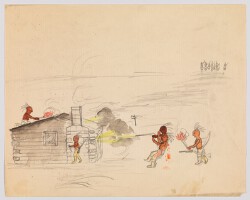
This is a very early Hopper, from the 3,000 works at The Whitney, you can access online
and1: as is the nature of the internet, checking “edward hopper” and “native americans” sent me to this Robert Henri painting of a Santa Clara pueblo subject and a black bowl, 1917, at Ulrich Museum in Wichita, Kansas.

In my research about the good news about Stanford’s Cantor Museum acquiring an early Edward Hopper piece, I found myself investing a couple hours to scanning through the website of the Whitney Museum which has more than 3,0000 Hoppers, most of which are drawings, many from his early and formative years, and non collectible. Of these I downloaded — as information wants to be free and some of it wants to be Plasty — a subset of 50, the bulk of the Indian material plus a couple other topics — athletes, blacks, maybe one or two for prurient reasons.
I don’t know if anyone has written about “Hopper” and “Indians”. It was not something he put much energy into during the heart of his career. I did find a couple drawings of blacks and some interesting compositions. What I found seems to rebut what people say about “South Carolina” which they say is his only work to depict blacks, or a black rather.
For the sports work, I also downloaded some source material that I think he might be drawing from.
The archivist at Whitney, maybe Gail Levin or her successor, has a piece labeled “Kiplin” sic which I presume is better titled “Kipling” as it appears to be the author Rudyard K. The piece is cropped to yield the misleading title, i.e. Whitney titles it’s pieces based on what writing, comment or label is on the actual piece. Later in the portfolio there is also a drawing from a Kipling work, which reinforces my inference.
There’s a piece called “(baseball player)” which depicts an athlete in gear standing on a field that has a goal post so I presume it is actually a gridder.

Edward Hopper, in Whitney
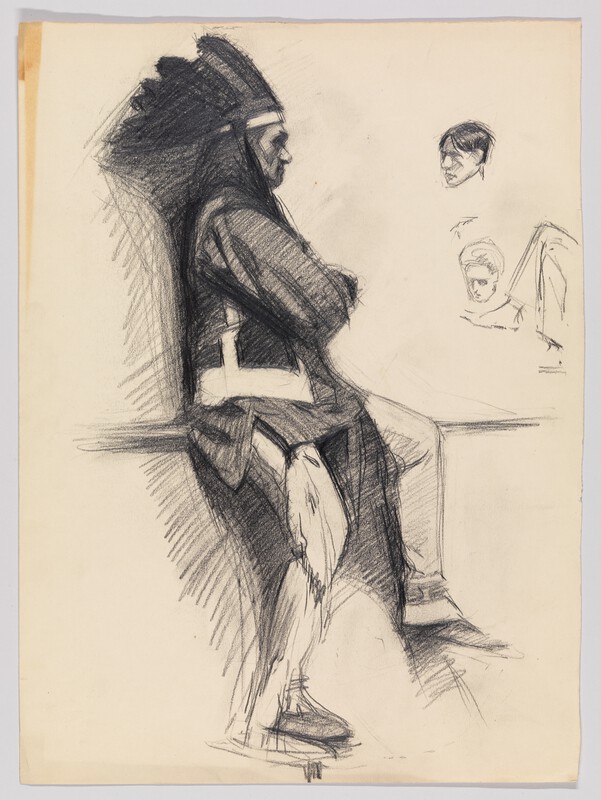
Hopper drawing, in Whitney archive: looks like the same subject as directly above
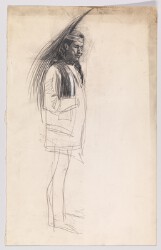
Hopper, Whitney 83030


 Plastic Alto with Mark Weiss