
My little set of jokes about Mindy Kaling and the potentially raunchy meaning of “wah-hoo-wah” also had me thinking about a conjoined set of threads of Dartmouth stories regarding the history of track and field, Harry Hillman, Don Burnham, Gunder Hagg and the word “fartlek” which means “speed play”.
What I recall from my research a few years ago on Hillman, the three-time Olympic Gold medalist in sprints and hurdles, who also coached the Big Green tracksters for almost 40 years, was that Burnham had mentioned, and perhaps included in our written correspondence, the fact that Gunder Hagg had trained or at least rested in Hanover before his big 1943 U.S. tour.
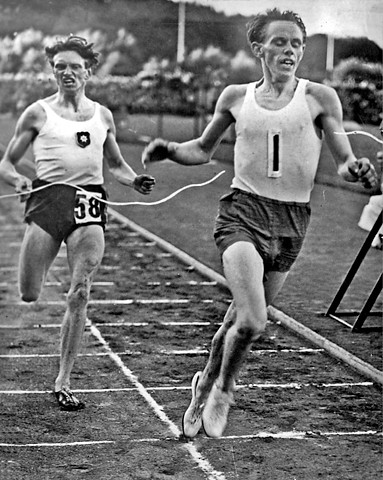
Here corroborating that is the contents of a brief article the search-injuns offer up, from The Telegraph, June 9, 1943:
Gunder Haegg, Swift Swede, at Dartmouth
Hanover (AP) — After sniffling the cool, clear air and gazing at the surrounded wooded hills, Gunder Hagg, the sensational Swedish runner who has seven world records to his credit, today compared his Dartmouth training quarters favorably with his homeland. This reminds me of the country around Jamtland, my northern Sweden birthplace ,” Hagg said through Sig Steinwall, his interpreter and masseur, when he arrived here from New York. “I’m sure I will like it here. It’s so cool and quiet.”
Steinwall, a former Dartmouth ski coach, added that Hagg desired rest and solitude more than anything else for he explained his internationally famous charge has not had time to become acclimated after his 27-day tanker trip from Sweden to New Orleans.
(note: they have “Haegg” for “Hagg” but I have corrected it)
I added a little more on this topic in the previous post, which is also a “reblog” from a Swedish-language post called “badger”. His post is mostly a discussion of a particular source, a book in Swedish about Hagg’s famous 1943 tour, which included races in New York, Chicago, Los Angeles and San Francisco.
Here is Hagg’s obituary in The New York Times, 2004.
Burnham also passed away. He died in summer of 2008, at age 85, in Bethesda, Maryland.
As of 2009, Hillman’s gold medals were in a vitrine outside the door of the Dartmouth track coach. For a number of years, but not during my tenure there, they were in the lobby of Alumni Gym, donated by Hillman’s daughter.
I also had several conversations over those years about the fact that Hillman and Lawson Robertson, a Penn coach, still hold the world record for running 100-yards in a three-legged race, in 11.0 eleven seconds flat, which is probably quicker than I could go today solo. This month will most very damn likely mark the one -hundred -and -fifth anniversary of that achievement of April 25, 1909. Archived thusly.
I had a brief conversation on this topic and the question of whether today’s runners could break that record with the director of the Penn Relays, but I am not sure if he was merely pulling my leg.
edit to add: I found another version of the same AP story that continues:
As soon as Steinwall had Haegg settled in the Dartmouth football coaches’ quarters in the Davis field house, the former took him downstairs to view the lightning fast sixth-of-a-mile board track on which Glenn Cunningham ran his 4:04.4 mile, the fastest in history. Haegg’s accepted record for that distance outdoors is 4:04.6. Those historic boards, however, held Haegg’s attention for only a short time. He tested it with a foot in cautious fashion and then suggested to Steinwall that they don track attire and go for a jaunt in the woods. Steinwall, who knows all of the ski trails hereabouts, led Haegg over a two-mile course along the Connecticut river.”Gunder will start his training tomorrow,” Steinwall said. “We plan to have morning and afternoon workouts and all of them will be in the woods, for that is where he did most of his training at home. What he wants most is quiet and plenty of sleep. He thinks conditions here will be ideal,” When it was first suggested to the Haegg party that it come to Dartmouth, it was with the idea that he train with Don Burnham, the Indians’ intercollegiate mile champion. That now appears unlikely for Burnham, although he is a competent cross-country runner, wants to sharpen himself for his coming races on the cinder track. Meanwhile Harry Hillman, Dartmouth’s veteran track coach and Haecrg’s official host, was devoting himself to setting up a training table for the Swedish star. Hillman’s first move was to seek a chef who could provide Haegg’s favorite dishes to preside over the Rood club, where Dartmouth football teams are fed.
(Note: Burnham later told me his personal best in the mile was about 4:10, or about four seconds off world class).
Edita: found this from March, 1945, two years later, or a second trip by Under-Gunder to the U.S.:
Rafferty Again Defeats Haegg Swedish Star Fifth In Columbian Mile NEW YORK (TP). Little Jimmy Rafferty of the New York A.C. did it for the sixth straight time last night and scored his second triumph over Sweden’s famed Gunder Haegg when he won the Columbian mile at the K. of C. games in Madison Square Garden before 14,616 fans. Rafferty won by eight yards over Rudy Simms of N.Y.U. with Haegg fifth again behind the four men who beat him last weekwhen he stepped on the board track Just two days off a boat after a 23-day voyage from England. The hard-runnine little Irishman was clocked in the slow time of 4:16.3. But the time was no indication of what a close race it really was. Rafferty had run last in the sixman field most of the way and came up from third on the bell lap with a rousing sprint that had the season’s largest indoor track crowd right out of their seats. Forest Efaw of Bainbridge, Md., Navy, former Oklahoma Aggie star, placed third, and Don Burnham of Dartmouth came fourth, well ahead of Haegg, clocked in 4:19.1. J. F. Conley of Dartmouth captured the high jump at 6 feet, 4 Inches. Cpl. Barney Ewell, former Penn State champion, strolled the 60yard dash all alone in 6.3 seconds. Ewell went down the lanes by himself as result of four disqualifications. Haakon Lidman, the Swedish hurdler who came to the United States with Haegg, was beaten a yard in the 60-yard high hurdles after winning his qualifying heat In 7.5 seconds
And from the Harvard Crimson archives, July 27, 1943:
HAEGG BREAKS U.S. MILE RECORD HERE
GUNDER HAEGG passes BOBBY KNOWLES as BILL HULSE matches strides with the galloping fireman at the end of the first lap. Trailing behind are Gil Dodds and Don Burnham.
Dodds came up from his position here to finish eight yards behind Haegg and run the fastest mile over run by an American, 4:06.5. Hulse feel back to third in the final reckoning, but he stayed at Haegg’s shoulder until the final turn. The NYU 800 meter champion turned in the third fastest mile run by an American as he wearily tailed Dodda by four yards.
In one of the companion events Eusign John M. MacFarland of the Navy Supply Corps School here won the service men’s 880 yard obstacle race. Carrying a 60 pound pack and full battle regalia, MacFarland outdistanced his nearest opponents by 20 yards.
The crowd of 14,000 included a large number of V-12 men, who sat all together in a special section–with the WACS.


 Plastic Alto with Mark Weiss