
Yale-educated, Pulitzer-winning author Richard Rhodes of Half Moon Bay has written four books on the science of the history of “The Bomb” — that’s, by my simple math, about 2,000 pages and a half-million words — but by my reckoning, regarding his one-act play “Reykjavik”, which workshopped two nights this week at the Knight Complex at Stanford, he should spit in the hole, or mile-deep salt mine, and tune again.
Drama stalwart Rush Rehm directed here and played Ronald Reagan, in 1986, in Iceland, talking Turkey/Afghanistan with Gorbachev (played by Equity actor Peter Ruocco, although yesterday’s Stanford Daily was written as if the former Soviet Leader was playing himself). Rush towered over Ruocco which made me not buy the casting at all. It was like Steven Seagall as Reagan and Danny DeVito as Gorby. Ted Danson over Steve Buscemi.
I would have preferred Mindy Kaling as Dutch and Callie Withers as the Russian. Or Rinde Eckert, who has workshopped and performed various times on campus, with Stanford Lively Arts (who take no credit or blame here; the show was produced by the Federation of American Scientists and Center of International Security & Arms Control and three others, but not anyone named Bialystock as far as I could tell. Although I thought it would be interesting and an improvement to to tape the audience watching the piece, which is based very closely, we are told, and we tend to believe, on actual transcripts of the 1986 arms reductions talks, and perhaps add confederates to laugh on cue, and then send the whole package — play, audience, spin — to other countries, for propaganda purposes).
Rush Rehm in a wig also conjured to me Fats Domino, but that’s just me, a guy who has put two hundred hours in to jazz and NoLA “make it funky” for every hour I’ve ever put in to either physics or international affairs.
The event included some multi-media previews, which I missed. In fairness, as if this were an actual review, I should mention I got to CEMEX at 7:30, and stayed until about 9:30, so I missed the first part.
My first observation is that the play could use some cue drops, some sound, some music, a subtle soundtrack, perhaps performed live by Ava Mendoza or licensed from Sigur Ros.
Things it reminded me of, my frame of reference: Kubrick’s “Dr. Strangelove”, “Frost vs. Nixon”, John Adams/Peter Sellars/Alice Goodman’s “Nixon in China”, “Matt and Ben”, “No Exit” et cetera. Even Indiana Jones comments on this.
I met a reporter from the Stanford Daily named Natasha Weaser; she had lovely candy red manicured nails and tapped away on her Apple, which featured a cool, faux-Frankenthaler cover. She said she was a freshman, who prepped at an International School or American School in China, wanted to major in “IR” (as oppossed to, as Austin Powers might say, “MEOW!”)
sat next to me, interviewed me for her story, which was more about the post-event talk, featuring Sidney Drell of SLAC.
For a play like this, one bombshell in the audience is too much and 433 is not enough, if we are talking strategic arms limitations. I can picture Tom Wolfe, back on campus, tearing his manuscript in half and starting over as “I Am Natasha Weaser”. (Actually, finally fact-checking and correcting her name, Ms. Weaser is all over the internet, most conspicuously for carrying the Olympic Torch in 2008; she could end up a Tom Wolfe subject, but it would be a different book…)
I went to Dartmouth in the 1980s, where thanks to the Dartmouth Review SDI the strategic defensive initiative was almost pop culture. I don’t have to search-injun to recall that Greg Fossedal, the founder of the Dartmouth Review co-wrote the book on SDI with Lieutenant General Daniel O. Graham.
If I understood Rhodes and the panel Reykjavik was actually a red herring in that the strategy was bluff the Ruskies into folding then get them to agree to let us build SDI — the Star Wars weapon system, like “putting an Astrodome over the Earth” — to save us all. The only problem being that the lone person who didn’t realize this was a ruse — that the science was not going to happen — was Ronald Reagan, who was just reading from cue cards and or was such a Patriot that he could convince himself that this works – the science, more than the poker.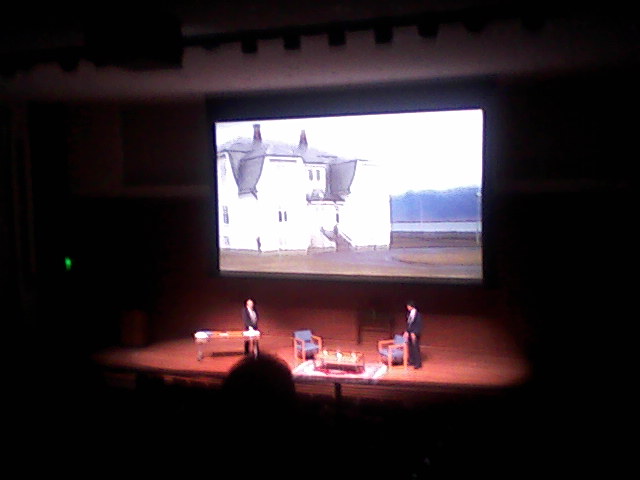
The other irony of “Reykjavik” by Richard Rhodes is that he said it started with seven characters and was whittled down to two. Huh? You mean, you cut the other five people out of the picture?
It also reminds me of the time I ran into Professor Paul J. Cohen, the Fields Prize winner and father of three — his sons Steve and Eric were classmates of mine at Gunn — and tried to make small talk about the recent New York Times article about Poincare Conjecture and a brilliant young Russian mathematician.
“Oh, there are only four people in the world who know what they are talking about!” meaning, even the Times writer was in above his head, with their rabbit-head diagrams and all. So with due respect to Rhodes, I doubt Drell was any more impressed than I was. And Rhodes told an anecdote about being not-welcomed by Ed Teller who shook the book at him if he didn’t throw it — but Rhodes said “I was scared at first then I realized I could take the guy, who was twenty years older than me.”
Note to self: don’t make jokes about possible fisticuffs with octogenarians.
I wanted to ask about the significance of the generational shift about having Michael McFaul, Stanford ’85, who is Burton Richter’s son’s age, as ambassador as compared to the Cold Warriors and Baby Boomers but remembered botching a similar opportunity at Dartmouth when, in Spalding Auditorium I asked a government scientist “Kurt Vonnegut says weapons researchers are ‘third rate –morally and scientifically’, what do you think?” not realizing who I was talking to, and Jim Newton, my editor, telling me later “I am glad you didn’t identify yourself as a reporter for The Dartmouth”.
This is Mark Weiss, drama and policy critic for “Plastic Alto” signing off from Stanford, or as Arte Johnson would say “Very interesting. But stupid.”
edit to add:
1) I like the idea of using art or drama or music or poetry to get a different take on policy, so “thumbs up” and godspeed to the workshop version of Richard Rhodes’ one-act play “Reykjavik”, despite my one thousand somewhat snarkily articulated words of reaction, more fizz than pop, I admit. Like pouring a Bodington and having it run over the rim, my review.
2) the Rhodes volumes on this topic are closer to one million words and comprise 928, 736, 432 and 480 pages respectively, including indexes and notes. I pecked my way through Gleick on Feynman, and am working on Newton on Ike, but passed on Rhodes last night. More people gathered on stage to greet the speakers than stepped into the lovely warm night air to purchase books, hum along to Peter Wegner, or chat up the nice lady from Stanford Bookstore.
3) this is completely self-serving but this discussion reminds me that I actually wrote Rinde Eckert about converting to stage a lecture Paul Cohen gave at a Godel conference.
4) “Nixon in China” will be at SF Opera next month:
edit to add, some hours and one parking ticket later: my mile deep salt mine is actually only 600-meter deep salt basin…You could do more with the projection screen. The show I saw ended with a Google maps sequence of Reykjavik point of view withdrawing to reveal view from space or what-not which is not that interesting since it has become ubiquitous, almost a cliche. How about licensing some imagery from Olafus Eliasson . The other thing that came to mind was Butoh, the Japanese reaction to Nuclear War. A little more Butoh, please! This was barely better than someone reading their term paper aloud. I would prefer Aleta Hayes at Reagan and Steve Sano as Gorby. I was also among the thousands who stood on top of Nob Hill in 1992 or so to watch Gorby’s limo go by. How about a play with a thousand people on why they were standing there, what they thought it all means — one can made a t-shirt that borrowed from “Twin Peaks” and “The Simpsons”. I thought of Shakespeare “we are all players” and that it, as Faulkner later chimed in, riffed on “it all means nothing.” It was kind of Stoppard absurdist — you can play that up. Like Gorby and Reagan are each sleep walking and talking past each other — go the other way from how they interacted. There’s also a Wallace Stegner monologue grafted to a piece about another Wallace dude, for reference. (And yes, I imagined Rinde Eckert as Stegner, or wrote about it). Or Dohee Lee doing Gorby in Korean shrieks (ala Munch), or Vijay Iyer’s anti-nukes performance piece with Japanese gibberish…That’s called “In What Language” with Iyer and Mike Ladd, and is post-911 but has a unique feel, that could be informative here (literally, to shape, to form); this link is to the follow-up, I am looking for photo from Joe’s Pub from APAP ie Jan., 2003 or so. Dave Douglas “Witness” I wanted to stage here, perhaps with Hoover. And lastly: just for yucks or because I am 48 I did fact-check my line that I remember without looking it up Fossedal and yep, Lt. Gen Daniel O. Graham, a former assistant director of CIA. There initials spell out “dog” and “gaf”. Ok, I admit that I was deliberately confusing Brenda Withers, Mindy Kaling’s former partner in crime, with Callie Withers, the former Stanford soccer standout: but, Callie apparently wrote a thesis archived herein about the relationship between inner peace and world peace, so she fits the bill here, could be tapped to contribute here. She is also an excellent visual artist, and a singer. I used a Callie Withers collage, published by Gunn High School Oracle, as poster art for a Cheryl Wheeler concert, ok, way off topic.
edit to add, again, May 15, 2012, the following Tuesday: I have been flipping through and around John Adams’ “Hallelujah Junction” and Richard Gleick “Genius: Richard Feynman” especially sections about “Dr. Atomic”, “Nixon in China”, Edward Teller and Oppie; Adams based a lot of his libretto on the work of Richard Rhodes and befriended him, the old-fashioned way.
edit to add, June 20, although this could use editing rather than more: reading Goldberg “Bumping into Geniuses” sent me online to find Killing Joke “Eighties” (which some say gave Kurt Cobain the riff to the more famous early nineties world changing collection of songs including “Come As You Are”). I like the montage here, although it might be too clashy for part of the “Reykjavik” show:


 Plastic Alto with Mark Weiss
Pingback: Steps in stone(d) | Plastic Alto with Mark Weiss
mark this is cute but way off topic