
PYRAMID OF THE PALO ALTO SOL
OR HOW I ATE TOO MUCH SOUP AND TOO MANY CHIPS AND TRIED TO PASS IT OFF AS HOMEWORK
Jordana Finnegan’s English class 1B at Foothill College in Los Altos Hills, California uses two main texts to frame a series of mini-debates and rhetorical exercises pointed towards a churn of fresh ideas regarding a distinctly Western take on the disparity between rich and poor and North and South: John Steinbeck’s quasi-classic “Tortilla Flats” and the recent and still being digested, perhaps like a giant bowl of Sopa Azteca from Hector and Helena Sol’s nearby restaurante, “Tortilla Curtain” by T. C. Boyle.
The title of the course, taught by Dr. Finnegan, who holds a doctoral degree and only recently created the offering, is “Poverty, Inequality, and the American Dream”.
I don’t know anything about Boyle’s book although the teacher hinted that it is controversial; an online reviewer compared it to Dubus’ “Sand and Fog” which I know of only as a film adaptation. I, perhaps superficially, thought of a Wallace Stegner story called “Pop Goes the Weasel” about a white photographer trying to work with blacks and Latinos in 1940s SoCal, and also because of the opening device of hitting someone, Wolf’s “Bonfire of the Vanities.” I also recently read (most of) William T. Vollman’s “Imperial”.
I hope to chronicle my progress through this course here in Plastic Alto, or Plastic Altlandia (but not Plastic Aztlan — that would be going too far, or too far south). Likewise I hope somewhere along the line MAYBE NOW to start swapping my actual assignments for these less structured missives. If I continue to write about the class in real time, I will try to do so within the parameters of respecting the academic environment of the student; when I was at Dartmouth Laura Ingraham the future right wing commentator famously outed professor Bill Cole for his unorthodox viewpoints and techniques, creating a disruptive furor that culminated in Cole leaving the Ivy League school. I’m no Laura Ingraham.
I’m more of a Bill Cole, frankly. “Plastic Alto” is a jazz riff. O K ?
In terms of the homework assignment of bringing in content, here is a picture of my mom, Barbara Weiss, 81, hiding behind what seems to be an Aztec Mask. I am using it here —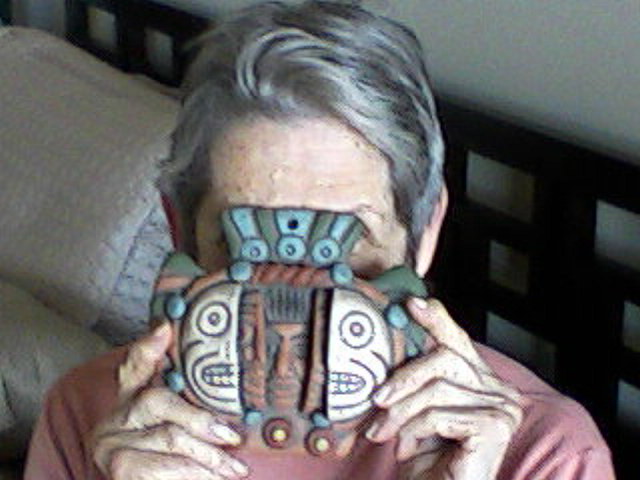 in the context of my classroom assignment — to symbolize “wealth”. Not everybody, I admit, has the luxury of storing artworks (even ones of dubious authenticity — I assume we got this on the beach of a resort and it is for the tourist market, meaning not a museum piece. But even the phrase “on the beach” connotes a certain amount of privilege. Barbara probably does not remember where she got the piece, owing partly to her age but also due to the fact that she traveled extensively in her life). It is more useful on the subtopic of authenticity of the Mexican culture — comparing that of Steinbeck in 1935 to that of Boyle in 1996, for examples, as staples, like tortillas at a meal — than as depiction of squalor or surfeit. (I have been looking for an excuse to upload it; I mainly think it’s quaint).
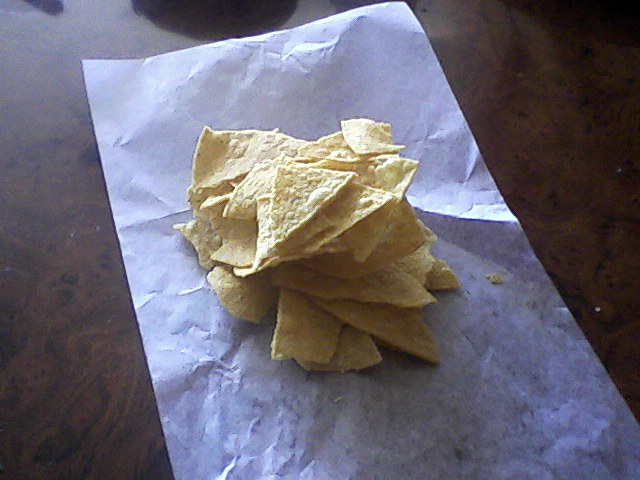
I am also importing here, although slightly off topic, a picture I took today called “Pirimida” referencing the Pyraminds of the Sun and Moon near Mexico City, but also, again, abundance – these were leftovers from my lunch at Palo Alto Sol. Further, I am eating them as I compose this blog entry, in fat.
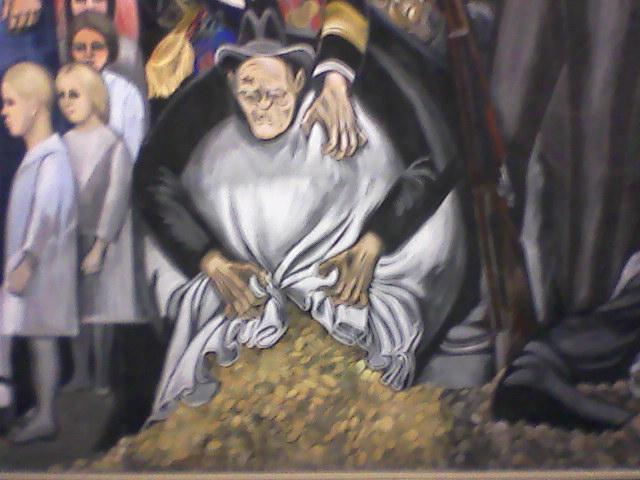
I am also importing from a previous post two of my shots of Orozco’s murals, from Dartmouth College’s Baker Library. I shot these at my 25th class reunion held in July, 2010; the murals are from 1939 or so.
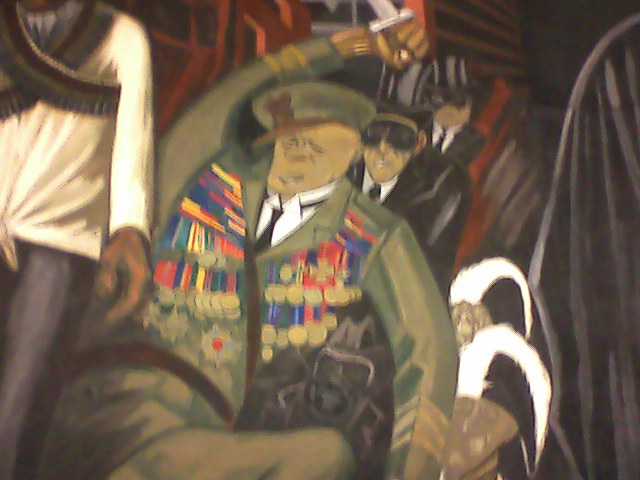
detail of Orozco mural
I said in classroom introductions that one of my rationale for taking the course is to find context for understanding and talking about Occupy. I am generally interested in expanding my concept of this hemisphere, especially regarding Mexico. In Spain the uprising was called “Los Indignatos” — the indignant — as opposed to the Bunuel film in DF called “Los Olivados” — the forgotten.
My neighbor Otto Slater — former neighbor I mean — says that in the 1950 or early 1960s Mexican workers would gather in front of what eventually became my parents house to dry apricots and sing songs into the evenings. More of a “apricot flats” than “tortilla flats”. Meanwhile, to continue my run of associations or prejudices, my Oaxacan exchange brother (from Palo Alto’s Sister City), Guillermo Gomez Abascal reminded me that his state is famous for having the world’s best tortillas.
Slightly off topic, but a nice segue, Dr. Finnegan lent me her copy of a Guillermo Gomez Pena collection called “The New World Border” (City Lights, 1996). But the English 1B homework readings so far are more about the economic jargon per se; they dovetail nicely with my research on Brian Evans’ macroeconomics course — which I am distilling down to a John Maynard Keynes reading list — I described below.
On the matter of close-reading per se the class today included an exercise built around E. A. Robinson short poem “Richard Cory”, which deals with class issues, self-concept and perspective.
“YO QUIERO TACO BELL”
This is becoming more of a chop suey than “the whole enchillada” but here is an excerpt — per my actual homework instructions — and a brief reaction, from a or to a article by former New York governor and attorney general Elliot Spitzer in Slate:
Spitzer says:
These numbers portray an unraveling of the social safety net. The convergence of multiple polices—reduced taxation of the wealthy at all levels of government and greater dependence on taxes that fall on the poor (sales and payroll taxes, in particular)—has weakened government programs that help the poor and the young.
My response is that while framing the issues nicely it makes it sound like these things just happen, like a megatrend, force of nature of the weather, when in reality people forward ideas and the ideas lead to choices and actions by other people and that causes change, forward or backward, for better or for worse. For instance, (and I am indebted to a recent Rolling Stone article) a man named Grover Norquist is behind the pledge by congressmen and -women to not raise taxes and that is a set of choices that leads to the supposed crisis in the public sector. On top of that people in power are bashing Keynes and ideals of society wherein people are committed to each other, and to the least fortunate. It doesn’t make me a communist to not want desperately poor people and angry people in my midst. I’m not so much an altruist and ethical egoist: it is in my best interest not to want to fight for food. I’d rather share.
And here is a list of ideas that popped into my mind while devoting all of 40 minutes to skim the Gomez-Pena — reminds me that I have a related text with art by Enrique Chagoya and I think some of the same work or words by GGP. See also my essays with cameos by Juvenal Acosta, especially “Mere Surmise Slur”. To wit:
It also reminds me that at the gallery show (I wrote about below, at Nina Dresden Gallery) I ran into a recent acquaintance the Mexican poet, writer and professor Juvenal Acosta and he said the Michele King’s work “was a nicer price.” They were about $3,000 each for her paintings, but since we had been discussing a $110,000 painting at a gallery across the street, that would be “nicer” meaning within reach of more people, perhaps even Juvenal or myself. What he actually said was that he had met Michele previously and liked her as a person and was relieved that he liked her work likewise; it was a “nice surprise.” I told him this story, my mistake in hearing. (Juvenal’s English is appreciably better than my Spanish. His Spanish I’m certain is better than my English).
El Mexterminator, Mad Mex, Aztlan, “I Could Only Fight Back In My Poetry”, “poetic confrontation”, Wadsworth McBee, Prop 187, NAFTA, “Quebeqization of the entire Southwest”, Louis Malle Shoots GGP, velvet art, performance artist Hugo Sanchez (p. 92), glossary of borderisms, Saint Frida. Because I reference it below, I want to say the Gomez-Pena dressing in various garb made me think about the story that when Rev. Eleazer Wheelock wanted to start what became Dartmouth College he convinced Native American Samsom Occum to dress in ceremonial garb despite the fact that Occum was supposedly westernized and would have preferred to do the same pitches and appeals in normal street clothes, at least according to my professor Michael Dorris.
Always beware of too much cheese on your enchillada, hermanos y hermanas.
and outro from Manu Chau “Me Gustas Tu” for Jordana Finnegan’s class:
edit to add: despite my giddy enthusiasm for the blogosphere, I am going to pull this until I get permission from Dr. Finnegan and develop some ground rules for how to treat my fellow students, etc. (again, not being Ingraham)
edit to add, January 29, 2012: I published this after setting this to private for three weeks. The class is going well, I got an A, 99 out of 100, for an oral report I did with three other students. I like the text, Steinbeck’s “Tortilla Flat” and the class room discussions, although I have had a hard time balancing work projects and all the course requirements. I continue to appreciate and admire the instructor Dr. Jordanna Finnegan; my first impressions are holding. I chuckled when I thought about the old Rodney Dangerfield movie “Back to School” and whether or not I am now Rodney Dangerfield. I may write additionally about the class, but not blending course work and hopefully not invading the teacher-students bond or privacy or pact. I met briefly another teacher whose office is near Jordanna’s, Sarah Huerta, whose Latino art caught my eye and, somewhat obnoxiously perhaps, offered her my list of influences including: Matt Gonzalez, Guillermo Gomez Pena, Guillermo Gomez Abascal, Juvenal Acosta, Gustavo Ramos Rivera, Enrique Chagoya and Kara Marie.
I noticed a reference in the text to “enchillada” as opposed to tortilla flat; also, I bought at the Jewish Community Center Cafe, from a German-Brazilian Yannick an Armenian-Mexican flat burritto de pollo, from Marilu, I think her name was; I hope to check or straighten that out. The Foothill class will quickly move on to Glass Walls by Jeannette Castle no I mean Glass Castle by Jeannette Walls — reminds me of my line about being more about John Cage than Bill Gates. Then on to “Tortilla Curtain” by T.C. Boyle. Also, “Black Men Ski” my Stew is reminding me of Kent Manske at Foothill the art teacher who did a “Tortila Curtain” print project, that included my girl friend Terry Acebo Davis. I also chat up longtime student government director at Foothill Tricia Davoren.


 Plastic Alto with Mark Weiss